
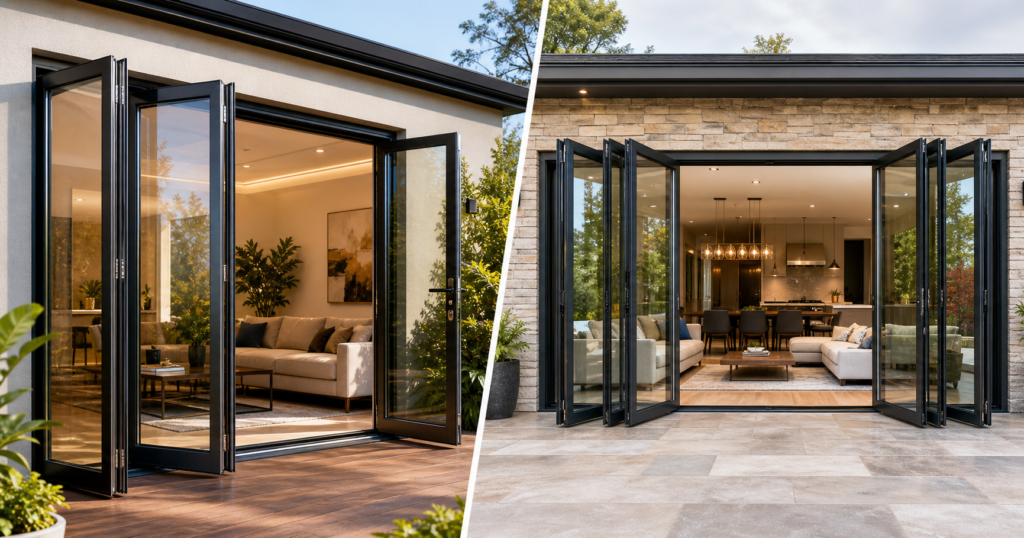
Quick Answer: A 3 panel bifold door suits openings under 9–10 feet and costs $2,000–$6,500 installed. A 4 panel bifold door handles 10–16-foot openings and runs $3,500–$10,000. Opening width is the deciding factor; everything else follows from that.
So you’ve landed on bifold doors, good call. But now the internet is giving you a wall of conflicting advice about whether to go with 3 panels or 4 panels. It’s one of those decisions that sounds minor until you’re standing in a half-finished renovation, realizing you ordered the wrong configuration.
This guide cuts through the noise. We’re going to compare a 3 panel bifold door vs 4 panel across every factor that actually matters: opening size, cost, glass view, stacking space, traffic doors, and long-term wear. By the end, you’ll have a clear answer for your specific situation.
If you’re also exploring door styles alongside panel count, our guide on Bifold Shaker Doors: A Smart, Space-Saving Upgrade for Modern Homes is worth a read before you finalise anything.
At a Glance: Which Should You Choose?
Not everyone wants to read the whole guide before getting a direction. Here’s the short version:
| Your Situation | Best Choice |
| Opening under 9–10 feet wide | 3 panel bifold door |
| Opening 10–16 feet wide | 4 panel bifold door |
| You want maximum unobstructed glass | 3 panel bifold door |
| You need a daily-use access door | 3 panel bifold door |
| You want a center-opening split | 4 panel bifold door (2+2) |
| Tighter budget | 3 panel bifold door |
| Large patio or wide garden opening | 4 panel bifold door |
| Limited stacking wall on one side | 4 panel bifold door (2+2 split) |
Still not sure? Keep reading the sections below, which explain why each situation points to a different answer.
What’s the Difference Between a 3 Panel Bifold Door vs 4 Panel?
At the most basic level, a 3 panel bifold door has three panels hinged together, and a 4 panel bifold door has four. But that one extra panel changes more than you might expect.
With a 3 panel door, each panel is typically 24 to 36 inches wide per leaf. All three panels fold and stack to one side, or you can designate one as a standalone access door that swings independently from the rest.
With a 4 panel door, each panel is narrower, closer to 18 to 28 inches each. This gives you more configuration flexibility: fold all four to one side (4+0), split them evenly down the center (2+2), or use one as a traffic door while the other three fold together (3+1).
Neither is better in an absolute sense. They’re optimized for different opening widths, layouts, and lifestyles. The right one depends entirely on your specific situation.
Opening Size: The Most Important Factor
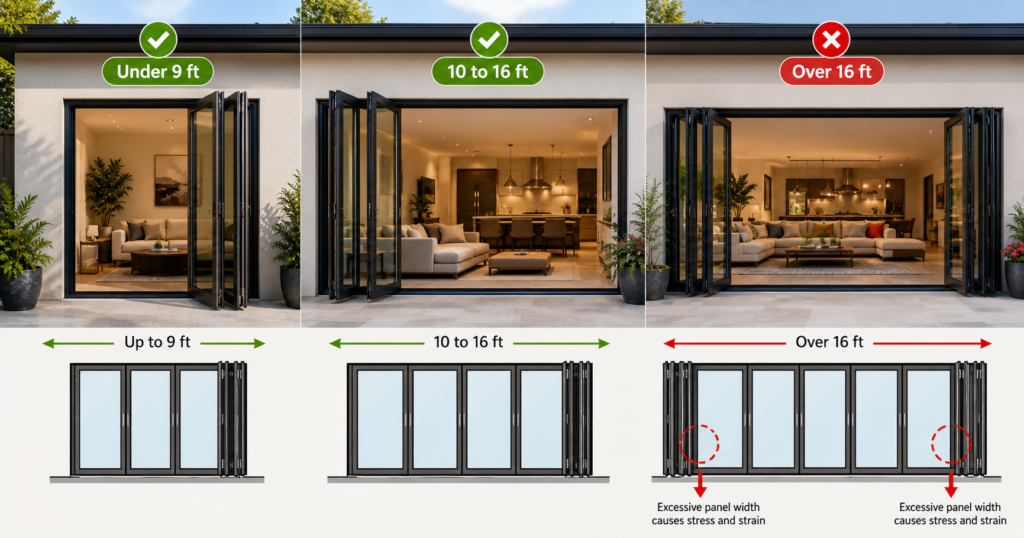
Your opening width is the single most important factor in this decision, and it’s the thing most people overlook when they get caught up comparing prices or aesthetics.
Here’s the practical rule of thumb:
- Under 9 feet wide: A 3 panel bifold door is usually the better fit. Each panel stays at a comfortable width, the system operates smoothly, and you don’t end up with panels that feel narrow or flimsy.
- 10 to 16 feet wide: A 4 panel bifold door handles this range much better. Spreading the opening across four panels keeps individual panel widths manageable and reduces strain on hinges and rollers.
- Over 16 feet: You’re likely looking at 5 or 6 panels; both 3 and 4 panel options become less appropriate here.
Why does this matter structurally? Glass is heavy. If you try to cover a 14-foot opening with just three panels, each panel ends up carrying a disproportionate amount of weight. That puts stress on the hardware, makes the door harder to operate, and can cause sagging or tracking issues over time. Four panels are spread that weigh more evenly across the full track system.
This is why premium manufacturers engineer strict panel width limits into their systems. According to HomeGuide’s 2026 bifold door cost and sizing guide, folding patio door sizes range from 8 to 24+ feet wide, and the number of panels scales directly with that width to keep individual leaves at a manageable size. If your opening would push individual panels past comfortable limits with three panels, four is the structural answer.
The Glass vs. Frame Tradeoff (This One Surprises Most People)
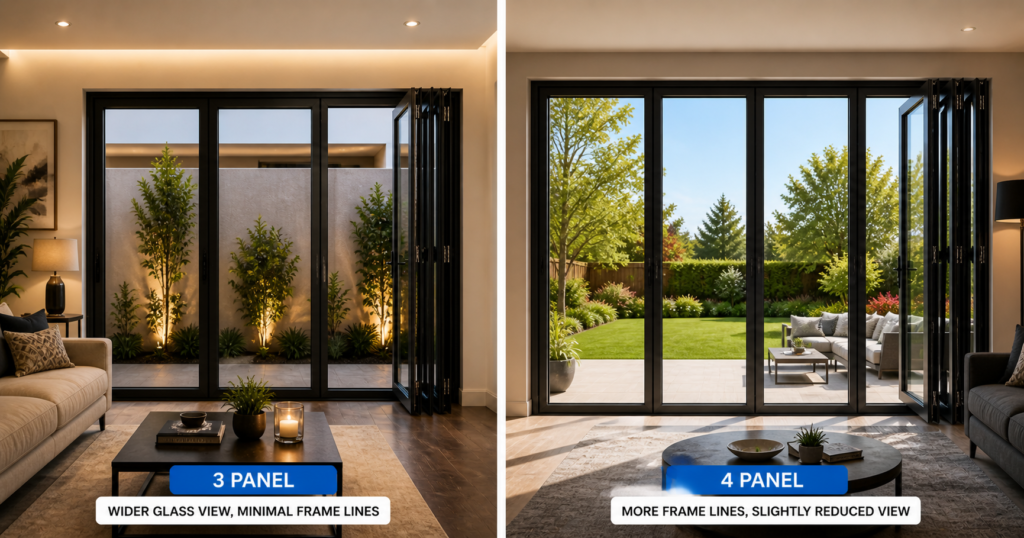
Here’s something most comparison articles get completely backwards: fewer panels can actually mean more glass.
Think about it. Every panel requires a frame. More panels mean more vertical frame lines cutting through your view. With a 3 panel bifold door covering the same opening as a 4 panel door, each pane is wider, giving you broader, uninterrupted sections of glass.
If your priority is an open, seamless view of your backyard or patio, a 3 panel bifold door on a correctly-sized opening will often look cleaner and more dramatic than a 4 panel setup.
Important: This doesn’t mean you should force a 3 panel door onto a 14-foot opening just to get wider glass. If the opening needs 4 panels structurally, putting 3 in will hurt long-term performance. Match the panel count to the opening width first the glass ratio takes care of itself.
Do You Need a Traffic Door? (Most Homeowners Do)
A traffic door, also called a lead door or access door, is a single panel that opens independently, like a regular hinged door. You use it for everyday in-and-out without folding back all the panels every time.
This matters more than people realize. If you have pets, kids who run in and out constantly, or you just want to step outside without a full production, a traffic door changes daily life significantly. Here’s how panel count affects it:
3 Panel Bifold Door Traffic Door Setup
Three panel bifold doors are naturally set up for a traffic door. With an odd number of panels, one can be designated as the access leaf. The other two fold together when you want full access. This is one of the biggest practical advantages of a 3 panel system. The configuration is clean, simple, and feels intuitive to use every day.
4 Panel Bifold Door Traffic Door Setup
Four panel bifold doors can also have a traffic door, but the configuration is slightly more involved, typically a 3+1 setup. This works perfectly fine, but it means three panels stack together on one side, which requires more wall clearance there. The 2+2 center-split configuration, on the other hand, cannot include a true traffic door.
Bottom line: if a traffic door matters to you and you’re working with a medium-sized opening, the 3 panel bifold door is the simpler, more elegant solution.
Cost Comparison: 3 Panel vs 4 Panel Bifold Door
The straightforward truth is that 4 panel bifold doors cost more than 3 panel doors. More panels mean more glass, more hardware, more frame material, and a more complex installation.
According to HomeGuide’s 2026 bifold door cost data, bifold patio doors cost $5,000 to $20,000 installed on average, with prices ranging from $800 to $2,000+ per linear foot depending on material and customization. Here’s how that breaks down by panel count and material:
| Configuration | Material | Estimated Installed Cost (US) |
| 3 Panel | Aluminum | $3,000 – $6,500 |
| 3 Panel | Fiberglass | $2,500 – $5,000 |
| 3 Panel | Wood / Composite | $2,000 – $4,500 |
| 4 Panel | Aluminum | $5,000 – $10,000 |
| 4 Panel | Fiberglass | $4,000 – $8,000 |
| 4 Panel | Wood / Composite | $3,500 – $7,500 |
These are estimates and vary by region, brand, glazing type, and installer. Interior bifold doors for closets, pantries, or room dividers are much cheaper. HomeGuide puts interior bifold installations at $250 to $800 on average, regardless of panel count.
Key rule: Don’t let budget pressure you into the wrong panel count for your opening. If your opening structurally needs 4 panels, installing 3 will cost you more in hardware repairs and re-installation down the road than the upfront savings.
Bifold Door Stacking Space: How Much Wall Do You Need?
This is the detail that catches homeowners off guard on installation day. When bifold doors open, the panels fold and stack against the wall beside the opening. They don’t disappear into a pocket; they take up real, measurable space.
If you have a window, furniture, or a structural element right next to your opening, you may not have enough clearance for your chosen configuration. Here’s a practical guide:
- 3 panel bifold door (stacking one direction): You need roughly 35–45% of the total door width as clear wall space on one side. A 9-foot door needs approximately 38–48 inches of clear wall.
- 4 panel bifold door (stacking one direction): Similar math about 35–40% of door width on one side. A 12-foot door needs roughly 50–58 inches clear.
- 4 panel bifold door (2+2 center split): This is where 4 panels have a major advantage. You split the stack evenly between the two sides, so each side only needs to accommodate 2 panels. If you can’t clear a large stretch of wall on one side, this configuration solves the problem entirely.
If you’re tight on wall space on one side, the 2+2 center-split configuration of a 4 panel bifold door is often the smarter choice, even if your opening might technically work with 3 panels.
Long-Term Maintenance: Which Holds Up Better?
Both configurations are lower maintenance than traditional hinged or sliding doors, but there are real differences worth knowing before you commit.
3 Panel Bifold Door Maintenance Profile
- Wider individual panels mean more weight per leaf, more stress on hinges if the hardware quality is low
- Fewer moving parts overall, fewer hinges, fewer rollers, simpler track system
- Easier to diagnose and adjust because the system is simpler
4 Panel Bifold Door Maintenance Profile
- Narrower panels mean lighter individual leaves less stress per hinge
- Weight is distributed more evenly across the full track system
- More components overall, more hinges, more pivot points, slightly more to maintain
- If a roller or hinge develops an issue, you have more of them to inspect
The honest bottom line: hardware quality matters far more than panel count when it comes to long-term reliability. A well-built 4 panel system with quality stainless steel rollers will outlast a cheap 3 panel system every time. Whatever configuration you choose, don’t cut corners on the hardware.
Interior vs. Exterior Bifold Doors: Does the Answer Change?
Most of the discussion above applies to exterior bifold doors, the kind connecting a living room to a patio, garden, or deck. But if you’re using bifolds for interior purposes, the calculation shifts.
For Interior Bifold Doors (closets, pantries, room dividers)
- 3 panel is almost always the better choice for standard room widths
- Interior panels are lighter with no heavy glazing, so hardware strain is less of a concern
- The traffic door benefit is largely irrelevant indoors; you’re more likely to fold everything back and leave it open
- Cost is dramatically lower regardless of panel count
For Exterior Bifold Doors (patios, gardens, deck openings)
- Everything in this guide applies in full opening width, stacking space, traffic door, glass area, and cost all deserve careful thought
- Exterior doors also require weatherproofing, energy performance ratings, and proper threshold sealing, worth confirming with your installer
- Aluminum frames are the most popular exterior choice for durability and slim sightlines
If you’re weighing up door styles at the same time as panel count, our guide on Bifold Shaker Doors: A Smart, Space-Saving Upgrade for Modern Homes covers how different bifold styles perform in real home settings.
3 Panel Bifold Door vs 4 Panel: Full Side-by-Side Comparison
| Factor | 3 Panel Bifold Door | 4 Panel Bifold Door |
| Best opening width | Up to 9–10 ft | 10–16 ft |
| Individual panel width | Wider (24–36″) | Narrower (18–28″) |
| Glass-to-frame ratio | More glass per opening | More frame lines |
| Traffic door | Simple (natural odd-panel) | Possible (3+1 config) |
| Configurations | 3+0 or 2+1 | 4+0, 2+2, 3+1 |
| Installed cost | $2,000 – $6,500 | $3,500 – $10,000 |
| Stacking flexibility | One side only | One side or 2+2 split |
| Hardware complexity | Simpler | More components |
| Weight per panel | Heavier | Lighter |
| Best for | Medium openings, max glass, budget buyers | Large openings, center-open layouts, split stacking |
How to Measure Your Opening Before You Order
Choosing between a 3 panel and 4 panel bifold door means nothing if your measurements are off. Most installation headaches, awkward trimming, misaligned tracks, panels that won’t sit flush, come down to one thing: the opening wasn’t measured properly before ordering.
Here’s how to do it right.
Step 1: Measure width at three points. Measure the opening width at the top, middle, and bottom. Frames are rarely perfectly parallel. Use the smallest measurement as your ordering width and subtract 10–15mm for clearance.
Step 2: Measure height at three points. Do the same vertically, left side, center, right side. Use the smallest figure. Account for floor coverings if you’re adding new flooring after installation.
Step 3: Check for square Measure diagonally, corner to corner in both directions. If the two diagonal measurements differ by more than 5mm, your frame is out of square. A bifold door system fitted into an out-of-square frame will bind, drag, and cause track problems no matter how good the hardware is.
Step 4: Check the floor level. Use a spirit level across the full width of the opening. An unlevel floor affects how the bottom track sits and how smoothly the panels roll. If there’s a slope, flag it with your installer before ordering, not after.
Step 5: Check for plumb. Hold a level vertically against both sides of the frame. If the jambs lean in or out, your panels won’t hang correctly, and the hinges will carry uneven load from day one.
One more thing: always order based on your measured rough opening, not the finished frame size. Confirm which measurement your manufacturer requires before placing the order; getting this wrong is the most common and most avoidable mistake in bifold door installations.
Final Verdict: Which One Should You Pick?
Here’s the honest answer: the best configuration is the one that matches your opening size, your layout, and how you’ll actually use the door every day. There’s no universal winner.
Choose a 3 Panel Bifold Door if:
- Your opening is under 9–10 feet wide
- You want a traffic door for everyday use without added complexity
- Maximum unobstructed glass and view is a priority
- You’re working with a tighter budget
- You prefer a simpler system with fewer moving parts
Choose a 4 Panel Bifold Door if:
- Your opening is 10 feet or wider
- You want a center-opening 2+2 configuration for a symmetrical look
- You have limited wall clearance on one side and need to split the stack
- You’re connecting a large living space to an expansive outdoor area
- Long-term hardware wear from heavy individual panels is a concern
Measure your opening, figure out your stacking situation, and decide whether a traffic door matters to you. The right answer usually becomes obvious once you’ve worked through those three questions. When in doubt, talk to a local bifold door installer, most of whom offer free consultations and can walk you through which configuration makes sense for your specific space.
Frequently Asked Questions
Is a 3 panel bifold door cheaper than a 4 panel?
Yes, generally. A 3 panel bifold door typically costs $2,000–$6,500 installed, compared to $3,500–$10,000 for a 4 panel door, depending on material.
What opening size needs a 4 panel bifold door?
Openings of 10 to 16 feet wide generally call for a 4 panel bifold door. During that span, four panels distribute the glass weight more evenly across the track system, reducing strain on hinges and rollers. Three oversized panels on a large opening are a common hardware problem waiting to happen.
Can a 4 panel bifold door have a traffic door?
Yes, in a 3+1 configuration, one panel swings independently like a regular hinged door while the other three fold together to one side. It works well, but requires more stacking wall space on that side. If a simple traffic door is your priority, a 3 panel bifold handles it more cleanly with its natural odd-panel layout.
Which has more glass, a 3 panel or 4 panel bifold door?
For the same opening width, a 3 panel bifold door typically delivers more visible glass. With fewer panels, fewer vertical frame lines are cutting through the view. Each pane is wider, giving you a broader, less interrupted sightline to the outside.
How much wall space does a 3 panel bifold door need to stack?
About 35–45% of the total door width. For a 9-foot door, that means approximately 38–48 inches of clear wall space beside the opening. Make sure you account for furniture, windows, and structural elements before finalizing your configuration.
Are 4 panel bifold doors harder to maintain?
They have more components, more hinges, more rollers, but hardware quality matters far more than panel count for long-term reliability. A high-quality 4 panel system will outlast a budget 3 panel system. Whatever you choose, invest in good hardware.
Which is better for a patio, a 3 panel or 4 panel bifold door?
It depends on your patio opening width. For openings under 10 feet, a 3 panel bifold door is usually the better structural and aesthetic choice. For patios 10 feet wide or more, a 4 panel bifold door is typically the right call both for weight distribution and proportional appearance.
Can I use a 3 panel bifold door for a large opening?
Technically, yes, but it’s not recommended for openings beyond 10 feet. Oversized panels put excessive stress on hinge and track hardware, leading to sagging, difficult operation, and accelerated wear. Match the panel count to the opening width for the best long-term performance.
Have questions about your specific opening or configuration? Drop them in the comments, we’re happy to help you work through the right setup for your home.

Samreen Khadim Hussain is a home improvement writer and content creator at Domelite Home. She specializes in making home renovation, interior design, and bathroom safety accessible to everyday US homeowners, turning technical subjects into clear, actionable advice. Her work is rooted in research, real-world practicality, and a genuine belief that a better home is within everyone’s reach.
Door fitting looks simple until the frame, floor level and hinges are out of square. Measuring the opening properly before ordering avoids a lot of awkward trimming later.
Spot on, and this is exactly why we’ve added a full measuring section to the guide now. Frame, floor level, and square checks before ordering saves so much grief later. Thanks for flagging it.