

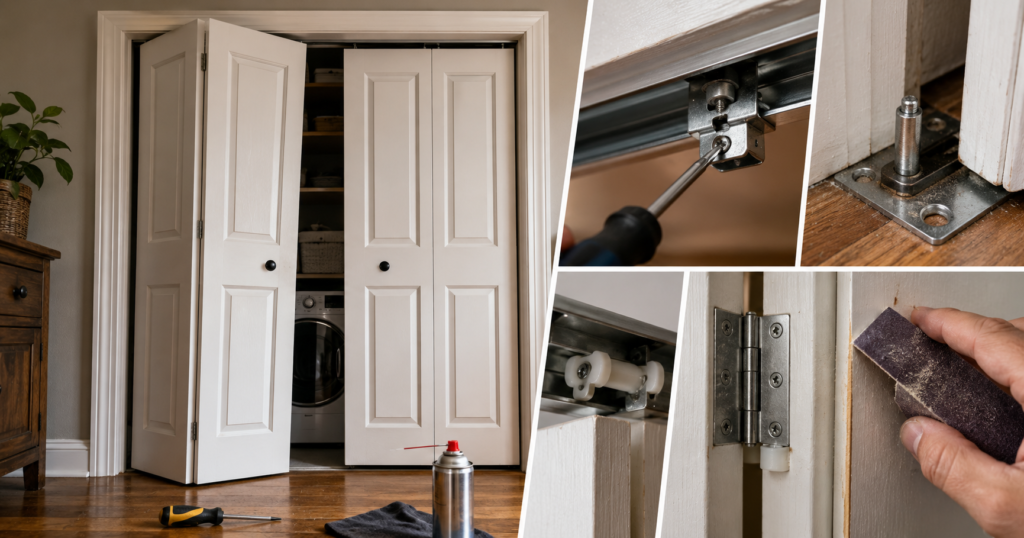
You push it. You wiggle it. You lift it slightly and try again. And still, your bifold door just refuses to close properly.
It’s one of those problems that feels way more complicated than it actually is. The good news is you can fix a bifold door that won’t close yourself; most root causes take under 30 minutes to sort out with nothing more than a screwdriver and a can of silicone spray.
This guide walks you through how to diagnose what’s wrong first, then fix it, so you’re not randomly adjusting things and hoping for the best.
Quick Answer: Why Won’t Your Bifold Door Close?
If you’re in a hurry, here’s the fast version:
| Symptom | Most Likely Cause | Fix |
| Door drags on the floor | Bottom pivot pin too low | Raise the bottom pivot bracket |
| Door folds but won’t fully shut | Top bracket misaligned | Adjust the top pivot bracket left or right |
| The door pops back open after closing | Snugger/snubber in the wrong position | Slide snugger toward the door edge |
| The door feels stiff and grinds | Dirty or dry track | Clean track + silicone spray |
| Door panels won’t fold flat | Worn hinge spacers | Replace hinges |
| The door leans and one side gaps | Bottom pivot off-center | Realign the bottom pivot pin |
| The wooden door is swollen shut | Humidity warping | Sand edges + seal with primer |
The fastest way to fix a bifold door that won’t close is to match your symptom to the right cause; that table above does exactly that.
Found your symptom? Jump straight to that fix below.
How to Fix a Bifold Door That Won’t Close, Diagnose First
This is the step most people skip, and it’s the reason they end up adjusting things twice.
Before grabbing a screwdriver, open and close your bifold door slowly three or four times. Watch carefully. Ask yourself:
- Where exactly does it stop? Does it stop halfway, or does it almost close but leave a gap?
- Does it drag on the floor at any point during the fold?
- Do the panels fold flat against each other, or do they splay outward?
- Is there a gap at the top or bottom when it’s in the closed position?
- Does it pop back open on its own after you close it?
The answer to each of these points directly relates to a specific part that needs attention. Now let’s fix it.
Fix 1: Adjust the Top Pivot Bracket (Most Common Fix)
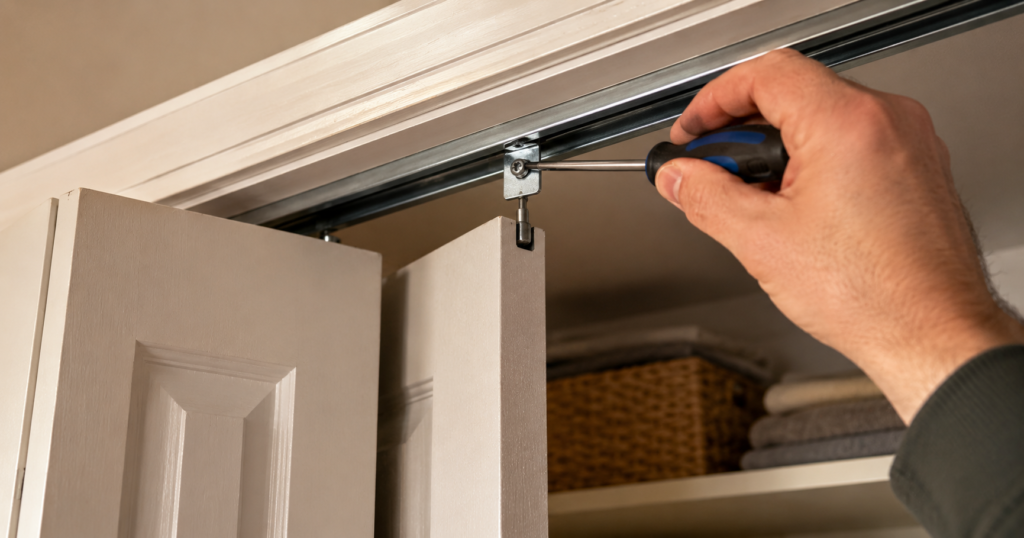
The top pivot bracket is the small metal bracket inside the track at the top corner of the door. It controls where the top of the door sits horizontally. When it drifts out of position, which happens gradually with regular use, the door can’t line up with the frame when closed.
Tools needed: Phillips screwdriver
How to fix it:
- Open the door fully so you have clear access to the top corner
- Look up into the track and find the top pivot bracket. It has one visible screw
- Loosen the screw just enough so the bracket can slide (don’t remove it fully)
- Slide the bracket slightly toward the door jamb if the door isn’t reaching the frame, or away from it if the door is hitting the frame too hard.
- Tighten the screw back up.
- Close the door and check the gap; it should be even top to bottom
- Repeat in small increments until the door closes flush
Pro tip: Move the bracket in very small increments; sometimes a quarter inch can make all the difference. Don’t overcorrect on the first adjustment.
Fix 2: Raise or Lower the Bottom Pivot Bracket
If your bifold door drags along the floor when you open or close it, the bottom pivot bracket needs to come up. If the door sits too high and leaves a gap at the bottom when closed, bring it down.
The bottom pivot bracket sits on the floor directly below the door’s pivot corner. It holds the bottom pivot pin that anchors the door’s movement.
Tools needed: Phillips screwdriver or small wrench
How to fix it:
- Open the door and locate the bottom bracket on the floor
- Loosen the screws on the bracket
- Slide the bracket slightly up (toward the door) to raise the door, or down (away from the door) to lower it
- Retighten and test to open and close the door to check if it’s still dragging
- Repeat until the door swings freely without touching the floor
Most bottom brackets have adjustment slots rather than fixed holes, which makes this a simple slide-and-tighten operation. If yours has notched positions, lift the pivot pin and move it to the next notch up.
Fix 3: Fix the Snugger (The Fix Nobody Talks About)
This is the most overlooked cause of a bifold door that won’t stay closed, and almost no other guide explains it properly.
The snugger (also called a snubber) is a small plastic or metal piece that sits inside the top track. Its entire job is to hold tension on the door in the closed position and stop it from swinging back open. When it’s loose or in the wrong position, your door closes but immediately pops back open, which feels infuriating because the door looks perfectly aligned.
Tools needed: Phillips screwdriver
How to fix it:
- Open the door fully and look inside the top track
- Find the snugger — it’s a small clip or cylinder, usually near the door edge end of the track
- If the door pops open after closing, slide the snugger further toward the door edge (closer to where the door ends up when closed) and tighten its screw
- If the door is hard to push fully closed, slide the snugger slightly toward the center of the track to reduce resistance
- Test after every small adjustment you’ll feel when the tension is right
Once the snugger is in the correct position, the door will close with a satisfying click and hold itself shut without any effort.
Fix 4: Clean the Track and Lubricate Everything
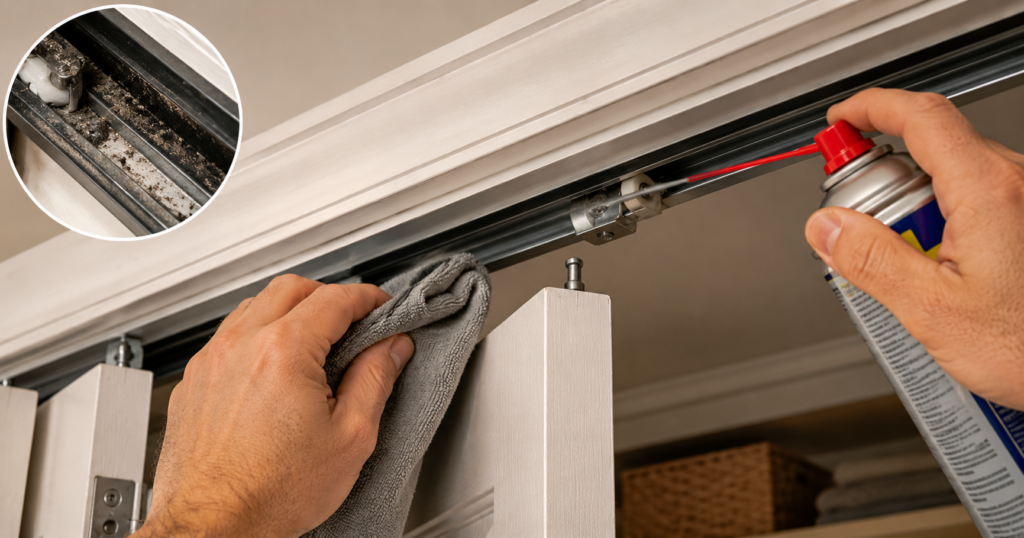
This sounds too simple to be a real fix. It isn’t. A surprising number of bifold door problems are caused entirely by dirt, dust, and dried-out hardware, not misalignment at all.
Dust and grit in the top track create friction that stops the roller from gliding freely. Dry pivot pins cause sticking and grinding. Over time, the door starts feeling stiff, doesn’t fully close, and begins putting stress on the brackets, which eventually causes the misalignment problems described in the other fixes.
Tools needed: Vacuum with nozzle, damp cloth, silicone-based lubricant spray
How to fix it:
- Use a vacuum nozzle to clear dust and debris from the top and bottom tracks
- Wipe the tracks with a damp cloth, and get into the corners
- Let it dry completely
- Spray a silicone-based lubricant onto the top roller, the pivot pins at the top and bottom, and along the track
- Open and close the door several times to work the lubricant in
- Wipe away any excess
Important: Use silicone spray only, not WD-40, not heavy oil, not grease. Heavy lubricants attract dust and create the same blockage problem all over again within weeks.
Fix 5: Realign the Bottom Pivot Pin
If your bifold door leans noticeably to one side, so that one edge lines up with the frame but the other has a visible gap, the bottom pivot pin has shifted off-center. This usually happens when the anchor point in the floor bracket wears out or when the pin has been knocked sideways.
Tools needed: Screwdriver, possibly pliers
How to fix it:
- Open the door and look at the bottom pivot pin, the small metal peg that sits inside the floor bracket
- Check if the pin is sitting straight and centered in the bracket slot
- If it’s off to one side, lift the door slightly off the bottom bracket to relieve tension
- Reposition the pin to the correct centered slot
- Lower the door back onto the pin carefully
- Close the door and check whether the lean has corrected
If the pin keeps slipping out of position, the bracket slot is likely worn, and the bracket needs replacing. A replacement bottom pivot bracket costs around $5–$12 at any hardware store and takes ten minutes to swap out.
Fix 6: Replace Worn Hinge Spacers
Each hinge between your bifold door panels has small plastic spacers, usually at the bottom of the hinge, that maintain the correct gap between panels as they fold. Over time, gravity wears these spacers down. When they’re gone, the hinges begin to overlap each other, which physically prevents the panels from folding flat and stops the door from closing completely.
This fix is often misdiagnosed as a track or bracket problem, but if you look closely at the hinges and see metal touching metal, or the panels can’t fold fully flat even when the door is off its track, worn spacers are almost certainly the cause.
Tools needed: Screwdriver
How to fix it:
- Open the door and inspect each hinge between panels
- Look at the lower plastic spacer on each hinge, check for cracks, missing pieces, or complete absence
- If spacers are damaged or missing, the entire hinge needs replacing (spacers aren’t sold separately in most cases)
- Remove the old screws and hinge, align the new hinge in the same position, and drive the screws in. Don’t overtighten, or you’ll strip the wood.
- Test the folding action panels should fold completely flat with no overlapping metal.
New bifold door hinges cost $8–$20 per pair, depending on material. If your door has four panels, budget for replacing all hinges at once so they wear evenly going forward.
Fix 7: Fix a Swollen or Warped Wooden Door
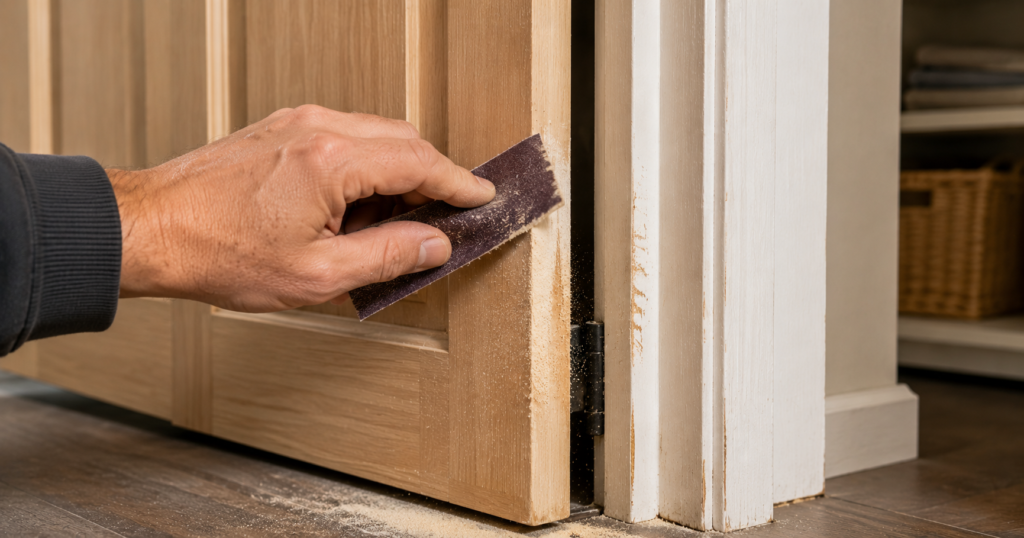
This fix applies specifically to wooden bifold doors, and it’s completely different from any of the hardware fixes above.
Wood expands in humidity and contracts in dry conditions. If your bifold door closes fine in winter but jams or refuses to shut during summer, the door panels are swelling with seasonal moisture. This is extremely common in bathrooms, laundry rooms, and any space near exterior walls.
How to fix it:
- Identify where the door is sticking, usually along the edges or at the top, where the wood has swollen into the frame
- Use fine-grit sandpaper (120 grit) to sand down the sticking edges lightly
- Don’t remove too much sand, a little, test, sand a little more
- Once the door closes cleanly, apply a wood primer or sealant to the sanded edges
- This seals the wood against moisture and slows future swelling significantly
Prevention tip: If your wooden bifold door is in a bathroom or laundry room, run a dehumidifier or improve ventilation. The problem will keep coming back every summer if the root moisture cause isn’t addressed.
When to Stop DIYing and Call a Pro
Most of the time, you can fix a bifold door that won’t close without any professional help at all. But there are a few situations where pushing further without professional help will cost you more in the long run:
- The track itself is bent or cracked tracks can’t be straightened effectively, and needs replacement, which involves removing the door completely
- The door frame is damaged or warped if the frame itself has shifted due to settling, subsidence, or water damage; no amount of bracket adjustment will create a lasting fix.
- You’ve adjusted everything twice, and nothing has changed. Sometimes, the problem is a combination of multiple worn parts, and a fresh set of eyes from a handyman or door specialist will find it in five minutes.
- The pivot pin holes in the floor or door header are stripped. Anchor points need proper repair before any adjustment will hold
A local handyman typically charges $75–$150 to diagnose and fix a bifold door. That’s worth it if you’ve already spent two hours on it with no results.
Choosing the Right Bifold Door Matters Too
Sometimes the door itself is the underlying problem, not the hardware. Doors that were undersized for their opening, made from low-quality materials, or installed incorrectly from day one will never stay adjusted for long, no matter how many times you tweak the brackets.
If you’re finding yourself fixing the same door repeatedly every few months, it might be time to look at a better replacement. For interior spaces, bifold shaker doors are worth a serious look. They’re built with tighter tolerances and better hardware than most builder-grade doors, which means far fewer adjustment headaches over time.
And if you’re working with a tight or awkward space, the door configuration itself could be contributing to the problem. This guide on the best bifold doors for small spaces walks through which configurations actually work in compact openings without constant track stress.
Preventing the Problem From Coming Back
Once your door is closing smoothly again, keep it that way with a simple maintenance routine:
- Every 6 months: Vacuum the top and bottom tracks, wipe clean, apply silicone spray to rollers and pivot pins
- Every 12 months: Check all screws on brackets and hinges, and tighten anything that has worked loose
- After any humid season: Check wooden doors for swelling, sand, and seal if needed
- Immediately: If the door starts feeling stiffer than usual, lubricate before it becomes a full alignment problem
Five minutes of maintenance twice a year prevents 90% of bifold door problems from ever developing in the first place.
Still Thinking About Which Bifold Door to Buy?
If this article found you before you’ve actually installed your door yet, good timing. The panel count and configuration you choose affect how often you’ll deal with alignment issues long term. The comparison between a 3 panel vs 4 panel bifold door is a good place to start if you haven’t made that call yet. It covers exactly which setup works best for different opening widths and how that affects long-term hardware performance.
For general bifold door hardware guidance and specifications, the National Wood Window and Door Association (NWWDA) publishes industry standards that are worth referencing when evaluating door quality and hardware ratings before you buy.
Frequently Asked Questions
Q: Why does my bifold door keep coming off the track?
A: The most common cause is a worn or loose top roller. The roller sits in the top track and guides the door as it folds. When it wears down or the track screw loosens, the roller pops out during use. Reseat the roller in the track, check the track screw, and replace the roller if it’s visibly worn or cracked.
Q: Can I fix a bifold door without removing it?
A: Yes, for most fixes in this guide, the door stays in place. The only fixes that require removing the door are replacing the bottom bracket, swapping out hinges, or sanding a swollen wooden door. Everything else is adjustable with the door hanging in its track.
Q: Why does my bifold door close but won’t latch?
A: The latch not engaging usually means the door is slightly misaligned; it’s closing, but not sitting flush enough for the latch to catch. Start with Fix 1 (top pivot bracket adjustment) and Fix 3 (snugger repositioning). Those two fixes together almost always resolve a door that closes but won’t latch.
Q: How long should a bifold door last before needing replacement?
A: A good quality bifold door with proper maintenance should last 15–25 years. If you’re fixing the same alignment issues every few months on a door that’s under 10 years old, the hardware quality was likely poor from the start. Replacement is often more cost-effective than continued repairs.

Samreen Khadim Hussain is a home improvement writer and content creator at Domelite Home. She specializes in making home renovation, interior design, and bathroom safety accessible to everyday US homeowners, turning technical subjects into clear, actionable advice. Her work is rooted in research, real-world practicality, and a genuine belief that a better home is within everyone’s reach.
