
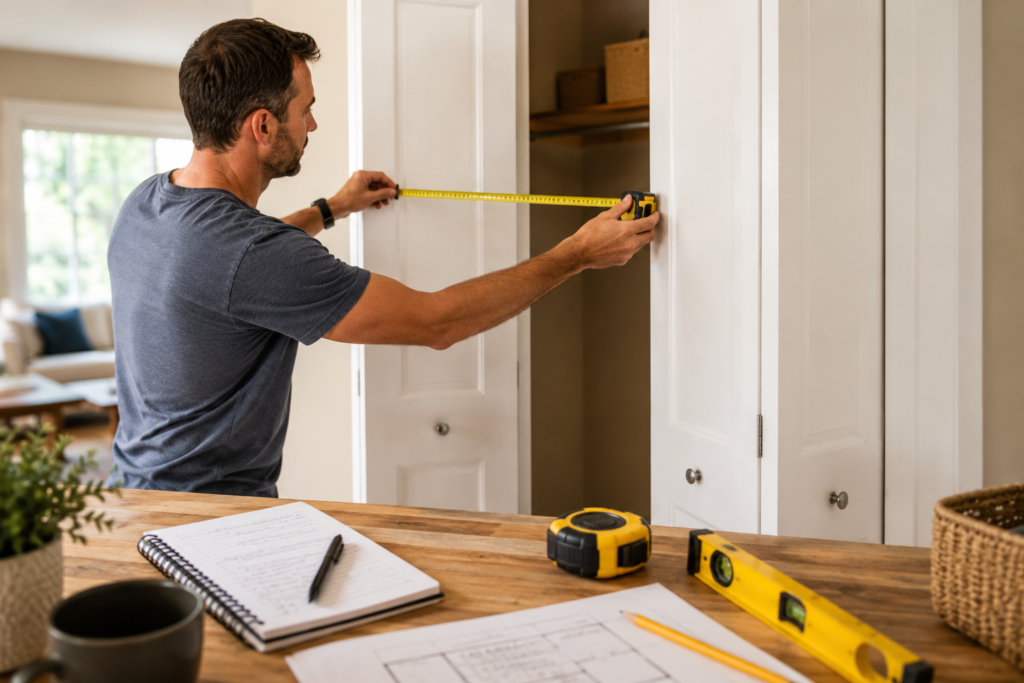
Buying the wrong bifold door size is one of the easiest and most expensive mistakes homeowners make. A door that’s just half an inch off can refuse to close properly, leave noticeable gaps, or force you to return an expensive order.
The confusing part? Bifold door sizes aren’t as straightforward as they seem. A door labeled 36 × 80 inches usually doesn’t measure exactly 36 × 80. You’ll also run into terms like nominal size, actual size, and rough opening, and knowing the difference is the key to getting the right fit.
That’s exactly what this guide covers.
You’ll find a complete bifold door sizes chart, learn the difference between nominal and actual measurements, discover standard interior and exterior dimensions, and follow a simple measuring process that helps you order the correct door the first time without costly mistakes or guesswork.
Bifold Door Sizes at a Glance (Quick Answer)
Measure the finished opening (inside jamb to inside jamb for width, and floor to the top of the frame for height). Then choose the nominal bifold door size that matches those measurements, not the door’s physical dimensions.
| Finished Opening Width | Nominal Size to Order | Typical Use |
| 24 inches | 24″ bifold | Small closet, pantry |
| 30 inches | 30″ bifold | Standard closet |
| 32 inches | 32″ bifold | Standard closet |
| 36 inches | 36″ bifold | Wide closet, laundry |
| 48 inches | 48″ bifold (4-panel) | Double closet |
| 60 inches | 60″ bifold (4-panel) | Walk-in closet, bedroom |
| 72 inches | 72″ bifold (4-panel) | Large walk-in, utility room |
Still confused about nominal vs actual? That’s the next section, and it’s the most important thing in this entire guide.
Nominal Size vs Actual Size: The Confusion Nobody Warns You About
Here’s the scenario that catches almost every first-time buyer off guard.
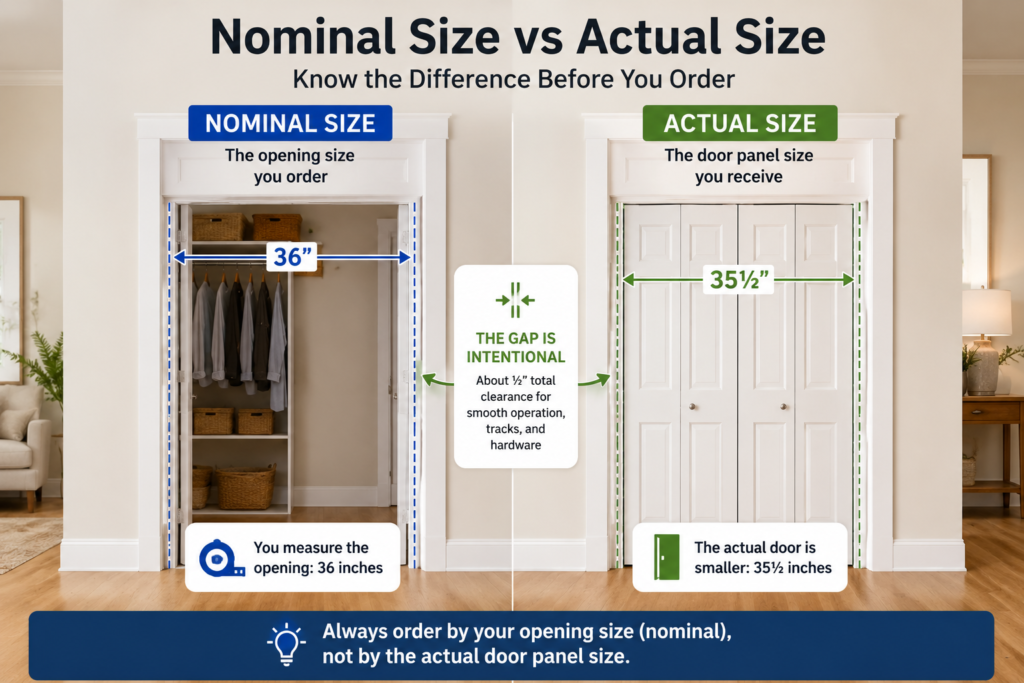
You measure the closet opening. It’s exactly 36 inches wide. You order a 36-inch bifold door. It arrives and measures 35½ inches. You panic and think they sent the wrong door.
They didn’t. That’s exactly right.
A bifold door with a nominal size of 36″ x 80″ may have an actual size of 35½” x 79″. This slight size reduction is intended to allow for easier installation. Every manufacturer intentionally builds this clearance in. The door needs a small gap around its edges to operate smoothly, accommodate the track hardware, and allow for the pivot pins to sit correctly in their brackets.
Here’s how to think about it simply:
- Nominal size = the opening the door is designed to fit. It’s the number you use when ordering.
- Actual size = the physical dimensions of the door panel itself. Always slightly smaller than nominal.
The difference between nominal and actual size is usually about ½ inch and occurs due to allowances made for the installation, including space for hinges and tracks.
So when you’re measuring your opening and ordering a door, always order by your opening size, not by trying to find a door that physically matches it inch for inch. The door is meant to be smaller. That’s not a defect. That’s how it’s designed.
Standard Interior Bifold Door Sizes
Interior bifold doors are used for closets, pantries, laundry rooms, and room dividers. Standard heights are usually 80 inches, 84 inches, or 96 inches. Widths follow a standard range that covers most residential openings.
Interior Single Bifold Door Sizes (2-Panel)
| Nominal Size | Actual Door Size | Rough Opening Needed |
| 18″ x 80″ | 17½” x 79″ | 18½” x 80½” |
| 24″ x 80″ | 23½” x 79″ | 24½” x 80½” |
| 28″ x 80″ | 27½” x 79″ | 28½” x 80½” |
| 30″ x 80″ | 29½” x 79″ | 30½” x 80½” |
| 32″ x 80″ | 31½” x 79″ | 32½” x 80½” |
| 36″ x 80″ | 35½” x 79″ | 36½” x 80½” |
| 24″ x 96″ | 23½” x 95″ | 24½” x 96½” |
| 30″ x 96″ | 29½” x 95″ | 30½” x 96½” |
| 36″ x 96″ | 35½” x 95″ | 36½” x 96½” |
Interior Double Bifold Door Sizes (4-Panel)
These cover wider openings, bedroom closets, walk-in closets, and laundry rooms with wide openings.
| Nominal Size | Panels | Each Panel Width | Rough Opening Needed |
| 48″ x 80″ | 4 | ~11¾” each | 48½” x 80½” |
| 60″ x 80″ | 4 | ~14¾” each | 60½” x 80½” |
| 72″ x 80″ | 4 | ~17¾” each | 72½” x 80½” |
| 48″ x 96″ | 4 | ~11¾” each | 48½” x 96½” |
| 60″ x 96″ | 4 | ~14¾” each | 60½” x 96½” |
| 72″ x 96″ | 4 | ~17¾” each | 72½” x 96½” |
The most commonly ordered interior bifold sizes in the US are 24×80, 30×80, and 36×80. These fit the vast majority of standard residential closet openings built after 1980.
Standard Exterior Bifold Door Sizes
Exterior bifold doors used for patios, gardens, and large living space openings work on a completely different sizing logic than interior doors. There is no single standard. A single external panel is about 39 inches wide with a height of 118 inches, and total bifold door widths for something like a patio bifold door can reach 20 feet.
That said, here are the most common exterior configurations installed in US homes:
| Total Opening Width | Panel Count | Each Panel Width | Typical Use |
| 6 feet (72″) | 2 panels | 36″ each | Small patio, apartment balcony |
| 8 feet (96″) | 3 panels | 32″ each | Standard patio door |
| 9 feet (108″) | 3 panels | 36″ each | Wide patio opening |
| 10 feet (120″) | 4 panels | 30″ each | Large patio, entertaining space |
| 12 feet (144″) | 4 panels | 36″ each | Open-plan living extension |
| 14 feet (168″) | 5 panels | ~33″ each | Large indoor-outdoor space |
| 16 feet (192″) | 6 panels | 32″ each | Full wall opening |
For exterior doors, always work with a certified installer for final measurements. Glass panel weight, structural load, weatherproofing thresholds, and energy ratings all vary by manufacturer and cannot be generalized the way interior door sizes can.
Bifold Door Sizes by Panel Count
Understanding how panel count affects individual panel width is crucial, especially for exterior doors. Bifold doors vary in sizes, with widths generally ranging from 18″, 20″, 24″, 28″, 30″, 32″, to 36″ for single panels, while 4DR door sizes are wider at 48″, 60″, and 72″ and are designed with two sets of bifolds suitable for larger openings.
Here’s how the math works when you’re deciding between panel configurations:
| Opening Width | 2 Panels | 3 Panels | 4 Panels |
| 72″ (6 ft) | 36″ per panel | 24″ per panel | 18″ per panel |
| 96″ (8 ft) | 48″ per panel | 32″ per panel | 24″ per panel |
| 120″ (10 ft) | 60″ per panel | 40″ per panel | 30″ per panel |
| 144″ (12 ft) | 72″ per panel | 48″ per panel | 36″ per panel |
Why this matters: Individual panels over 36 inches wide start to feel heavy and put more stress on track hardware. If your math works out to panels over 36 inches each, consider adding a panel rather than using wider individual leaves. This is one of the most practical decisions in the whole bifold sizing process and one of the least talked about.
If you’re still deciding between a 3 panel and 4 panel setup for your specific opening, this detailed comparison of 3 panel vs 4 panel bifold doors walks through exactly which configuration works best at different widths and why panel width affects long-term hardware performance.
How to Measure for Bifold Door Sizes, 3 Measurements You Must Take
This is where most buying mistakes happen. People measure once, measure the wrong thing, and end up with a door that doesn’t fit. Here’s the correct process.
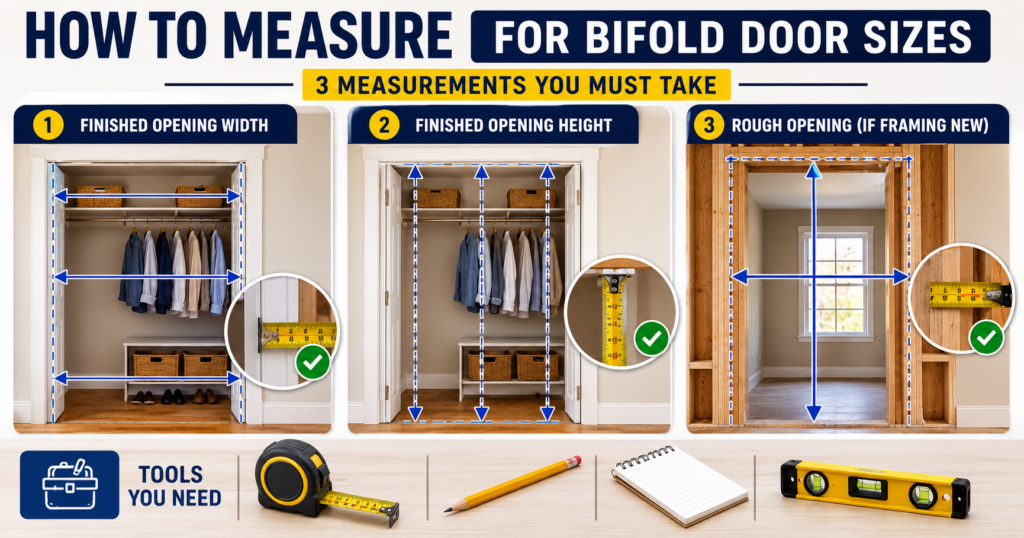
Tools you need: Steel tape measure, pencil, notepad, 2-foot level
Measurement 1: Finished Opening Width
The finished opening is the space between your door jambs, the actual wood or drywall frame on each side of the opening. This is the number you use to order your door.
- Measure across the opening at three points: top, middle, and bottom
- Write down all three measurements
- Use the smallest of the three numbers
- That smallest measurement is your finished opening width
Always measure the inside of the door jamb, the actual wood or metal frame forming the opening. Never measure the decorative casing or trim installed around the opening. The trim doesn’t represent the opening’s functional dimensions.
Measurement 2: Finished Opening Height
- Measure from the floor to the underside of the door header at three points: left, center, right
- Again, use the smallest measurement
- This is your finished opening height
Standard residential ceiling heights give finished opening heights of 80″, 84″, or 96″. If yours falls between these, you’ll need a custom door or minor frame adjustment.
Measurement 3: Rough Opening (If Framing New)
The rough opening is stud-to-stud, before drywall. Rough opening width equals the door slab width plus 9/16 inch for most standard residential interior installations.
If you’re framing a new opening from scratch, build the rough opening about ½ to 1 inch wider and ½ inch taller than your intended finished opening. This gives you room for the door frame, shims, and final adjustments.
Rough Opening vs Finished Opening: What’s the Difference?
This is the second most confusing concept in bifold door sizing, and getting it wrong means your door either won’t fit or will rattle in an oversized frame.
- Rough opening = the stud-to-stud framed hole in the wall before drywall and trim are installed. It’s always larger than the door.
- Finished opening = the opening after drywall and jambs are in place. This is what you actually measure when buying a replacement door.
- Actual door size = the physical door panels. Smaller than the finished opening by about ½ inch in width and 1 inch in height.
Think of it as three nested sizes: rough opening (biggest) → finished opening → actual door (smallest).
For replacement doors in existing homes: measure the finished opening and order that nominal size. For new construction: frame the rough opening, then the finished opening follows from your framing, then order the door to match.
What If My Bifold Door Opening Isn’t a Standard Size?
Older homes, custom remodels, and converted spaces frequently have openings that don’t match any standard bifold door size. Here’s what to do:
Option 1: Adjust the opening to match a standard size. This is almost always the most cost-effective approach. Adding a filler strip to narrow an oversized opening, or reframing slightly to hit a standard dimension, is usually cheaper than a custom door.
Option 2: Order a custom bifold door. Custom doors are available from most manufacturers for non-standard openings. Before ordering custom bifold doors, measure the height from floor to top of the opening, measure the width at top, middle, and bottom, taking the smallest measurement, and add space for fitting tolerance of about ½ inch per side. Custom doors typically add $200–$600 to the cost and extend lead times by 2–4 weeks.
Option 3: Trim a wood bifold door. Some solid wood bifold doors allow limited trimming. Wood panels often allow ½ inch to 1 inch total trimming, while molded or laminate panels may allow less or none. Always check product specifications before attempting to trim. Never trim a hollow-core or molded door; you’ll cut through the internal structure and destroy it.
For tight or awkward spaces where standard sizing is a constant challenge, it’s worth looking at which door configurations actually work best in compact openings. This guide on the best bifold doors for small spaces covers the configurations that handle non-standard measurements most gracefully.
3 Measuring Mistakes That Make You Return the Door
These are the three errors that cause the most returned bifold doors every year, and all three are completely avoidable.
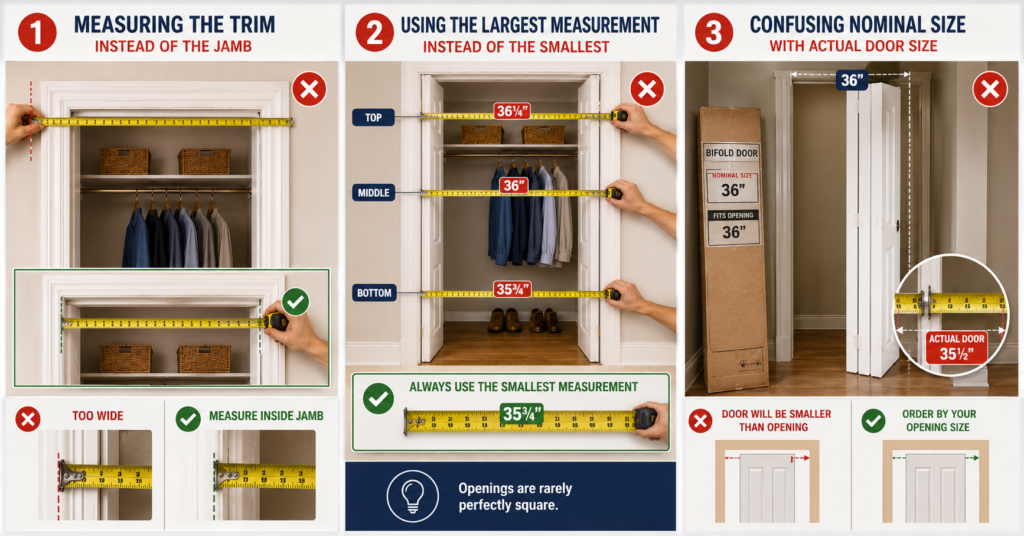
Mistake 1: Measuring the Trim Instead of the Jamb
The decorative casing around your door opening looks like part of the frame, but it’s just trim. The actual opening sits behind it. If you measure to the outside of the trim, you’ll order a door several inches too wide. Always pull the tape to the inside edge of the jamb, not the face of the trim.
Mistake 2: Using the Largest Measurement Instead of the Smallest
Openings are rarely perfectly square, especially in homes more than 20 years old. Measuring only at one point and getting lucky with a big number means ordering a door that fits at the top but binds at the bottom. Measure at three points every time and always use the smallest number.
Mistake 3: Confusing Nominal Size with Actual Door Size
This is the mistake that causes the most panicked phone calls to hardware stores. A nominal 36-inch door is actually meant for a 36-inch opening; the door itself will be slightly smaller. Always check the manufacturer’s specs for actual vs nominal size and measure twice before buying. The door arriving smaller than the size printed on the box is not a manufacturer’s error. It is correct. Order by your opening size, not by trying to find a door that physically matches your opening dimension.
Choosing the Right Style Once You Have the Size
Once your measurements are locked in, the next decision is style. If you’re going for a modern or transitional interior look, bifold shaker doors are one of the most popular choices right now. They work in almost every home style and come in all standard sizes covered in this guide.
For official door sizing standards and building code requirements in your state, the Window and Door Manufacturers Association (WDMA) publishes industry specifications that are worth referencing if you’re working with a contractor or pulling permits for a remodel.
Frequently Asked Questions
Q: What is the most common bifold door size?
A: For interior closet doors, the most commonly installed size in the US is 36″ x 80″ nominal, a 4-panel set that covers a 36-inch wide opening at standard ceiling height. For wider closets, 60″ x 80″ and 72″ x 80″ 4-panel sets are the next most popular.
Q: Can I use a bifold door in a non-standard opening?
A: Yes, with three options: adjust the framing to match a standard size, order a custom door for your exact dimensions, or trim a solid wood bifold door within its allowable trim range (typically ½ to 1 inch). Custom doors cost more and take longer, but give a perfect fit.
Q: How much smaller is the actual door than the nominal size?
A: Typically ½ inch narrower and 1 inch shorter than the nominal size. A 36″ x 80″ nominal bifold door will physically measure approximately 35½” x 79″. This is correct and intentional — not a manufacturing defect.
Q: Do bifold doors come in 84-inch height?
A: Yes. While 80 inches is the most common height, 84-inch and 96-inch bifold doors are available in most standard widths. These are used in homes with 9-foot or 10-foot ceilings where an 80-inch door would look undersized relative to the wall height.
Q: What tools do I need to measure for a bifold door?
A: A steel tape measure, a pencil and notepad, and a 2-foot level. Measure at three points across both width and height, always record the smallest number, and double-check before ordering. A steel tape is an important cloth or flexible tapes can sag and give inaccurate readings for door-sized measurements.
Measured your opening and not sure which size to order? Drop your dimensions in the comments, and we’ll help you figure out the right fit.

Samreen Khadim Hussain is a home improvement writer and content creator at Domelite Home. She specializes in making home renovation, interior design, and bathroom safety accessible to everyday US homeowners, turning technical subjects into clear, actionable advice. Her work is rooted in research, real-world practicality, and a genuine belief that a better home is within everyone’s reach.
5 thoughts on “Bifold Door Sizes: Complete Chart + How to Measure Right”