
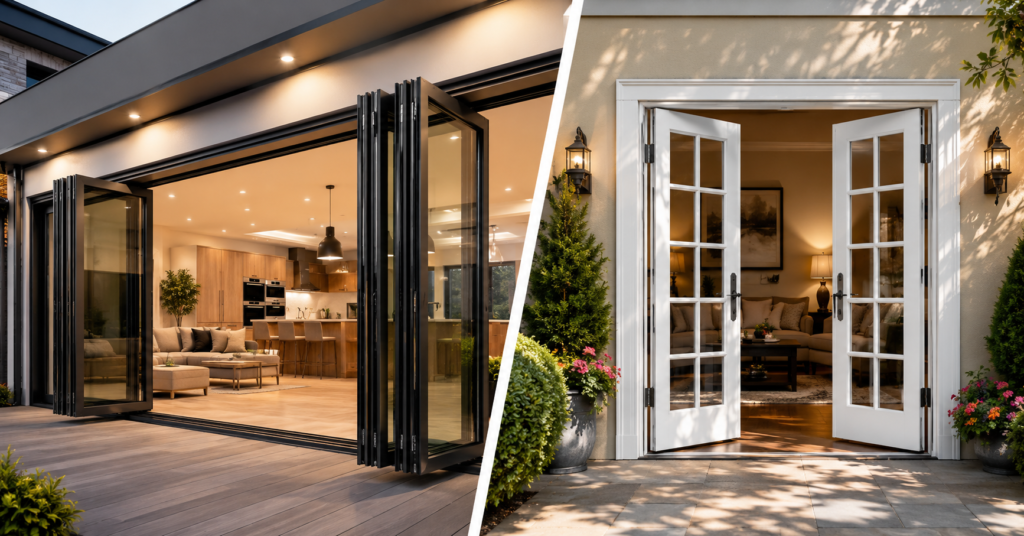
You’ve narrowed it down to two. Bifold door or French door, both look stunning in the showroom, both connect your living space to the outdoors, and both come with a price tag that makes you want to get the decision right the first time.
Here’s the thing most comparison guides won’t tell you: neither door is universally better. But one of them is almost certainly better for your specific home, your specific opening, and the way you actually live. This guide tells you exactly which one that is, category by category, with a clear winner every time.
No vague “it depends.” Just straight answers.
Quick Answer: Bifold Door vs French Door
In a hurry? Here’s the fast version:
| Factor | Bifold Door | French Door |
| Maximum opening width | Up to 90% of doorway | Up to 50% of the doorway |
| Cost | $3,000 – $10,000 installed | $1,500 – $5,800 installed |
| Best home style | Modern, contemporary, open-plan | Traditional, colonial, farmhouse, craftsman |
| Maintenance | More — track cleaning, lubrication | Less — simple hinges, occasional repaint |
| Energy efficiency | Good (modern systems) | Slightly better |
| Security | Multi-point locking — strong | Multi-point locking — strong |
| Resale value | High in modern/luxury homes | Consistent ROI across most home styles |
| Space needed to open | Stacking clearance on one side | 3–4 feet swing clearance in or out |
| Daily convenience | Great with the traffic door | Effortless, always |
| Budget pick | ❌ | ✅ |
| Wow factor | ✅ | ❌ |
Still not sure? Every row in that table has a story behind it. Keep reading.
How a Bifold Door vs French Door Actually Works
Understanding the mechanism explains almost every difference between these two doors.
A bifold door is made up of multiple panels, typically 2 to 7, connected by hinges and suspended from a top track. When you open it, the panels fold against each other accordion-style and stack neatly to one side of the opening. The result is a wide, dramatic opening that can expose up to 90% of the total doorway width. It’s the door you use when you want to genuinely open up a wall.
A French door is simpler by design. Two large hinged panels sit in a door frame and swing open, inward, outward, or both. There’s no track, no folding, no stacking. You push one or both panels open and walk through. The mechanism hasn’t changed much in 300 years, and that’s largely because it works beautifully.
That simplicity difference, complex folding system vs simple hinged swing, is the root cause of almost every contrast between the two doors, from cost to maintenance to daily convenience.
Cost Comparison: Bifold Door vs French Door
Let’s get straight to the number most homeowners care about first.
French doors are significantly cheaper than bifold doors across every material category. Here’s a full breakdown of installed costs in the US:
| Door Type | Material | Installed Cost Range |
| French door | Fiberglass | $1,500 – $3,000 |
| French door | Wood | $2,000 – $4,000 |
| French door | Aluminum | $2,500 – $5,800 |
| Bifold door | Vinyl/uPVC | $2,500 – $5,000 |
| Bifold door | Wood | $3,500 – $7,500 |
| Bifold door | Aluminum | $4,000 – $10,000 |
The price gap is real, and it’s significant. Bifold doors cost more because they have more components, more panels, more hinges, more hardware, a track system, rollers, pivot brackets, and a snugger. Every extra part adds to manufacturing cost, shipping weight, and installation labor.
French doors cost less because they are fundamentally simple. Two panels, two hinges each, one lock. Installation is straightforward and fast; most professional installs are done in a half day. Bifold door installation typically takes a full day or more for a multi-panel exterior system.
The honest bottom line: If budget is your primary concern, French doors win without question. If you have the budget and want the bifold experience, the extra cost buys something genuinely different, and we’ll get to what that is in the next section.
Winner: French door, lower cost at every material level.
Opening Width and Space: A Tale of Two Mechanisms
This is where bifold doors justify their higher price tag, and where the two doors become truly incomparable.
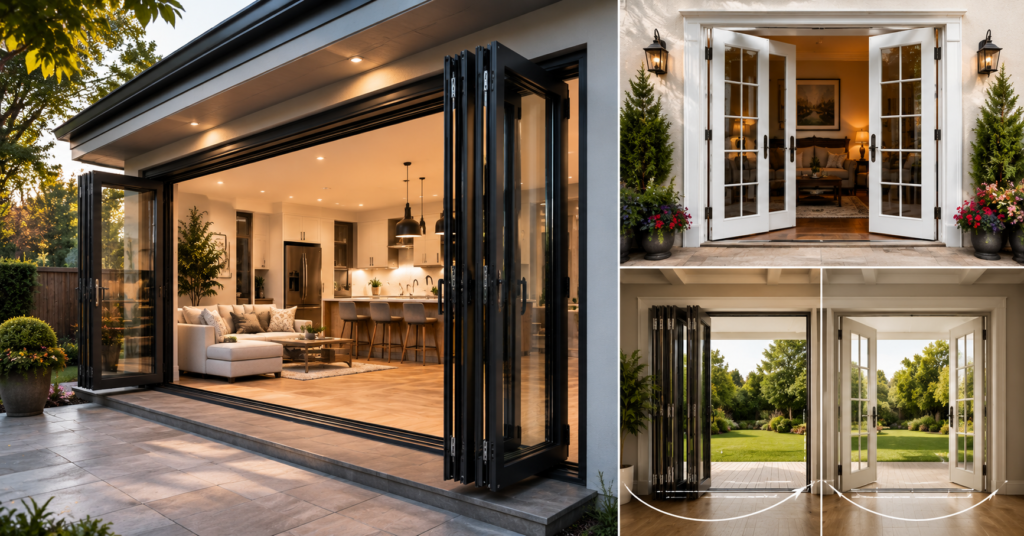
A bifold door can open up to 90% of your doorway width. When all panels are folded and stacked, you get an opening that genuinely feels like a missing wall. If you’ve ever walked from a living room straight onto a patio with nothing in between, no frame, no panel, just open space, that’s a bifold door doing its job.
A French door maxes out at around 50% open. One panel stays fixed while the other swings. Even with both panels fully open, the center post and fixed panel always occupy part of the opening. For everyday use, that’s completely fine. But for that full indoor-outdoor flow — for the kind of entertaining where inside and outside merge completely, French doors physically can’t deliver it.
Now flip the equation. Bifold doors need stacking space, typically 35–45% of the door’s total width as clear wall space beside the opening. A 10-foot bifold door needs roughly 42–50 inches of clear wall on one side. If you have a window, a light switch, or a structural element right next to your opening, bifold doors may not work at all.
French doors need swing clearance, 3 to 4 feet of clear floor space either inside or outside, depending on swing direction. In a small room or on a narrow patio, that’s a real constraint. But it’s predictable and manageable in a way that stacking space often isn’t.
If you’re working with a compact space and wondering whether bifold doors can still work, the answer is yes, with the right configuration. This guide on the best bifold doors for small spaces covers exactly which setups handle tight openings most effectively.
Winner: Bifold door for maximum opening. French door for spaces where stacking clearance is unavailable.
Style and Curb Appeal: Which Suits Your Home?
This is the most personal factor in the whole comparison, and the one most articles skip over with a generic “both look great.” They don’t always look great. The wrong door on the wrong house looks jarring and can actually hurt resale value.
Here’s a straightforward home style guide:
| Home Style | Best Door Choice | Why |
| Modern/contemporary | Bifold door | Clean lines, glass wall effect, open-plan aesthetic |
| Craftsman/bungalow | French door | Symmetrical panels echo the architectural details |
| Colonial/traditional | French door | Classic elegance, heritage proportions |
| Farmhouse | French door | Warm, timeless feel, bifolds can look too industrial |
| Open-plan new build | Bifold door | Designed for exactly this, wide openings, indoor-outdoor flow |
| Victorian / period home | French door | Preserves character, bifolds look anachronistic |
| Beach house / coastal | Either | Both work, bifolds for maximum view, French for classic coastal charm |
The rule of thumb: if your home has strong architectural character, period details, symmetrical facades, traditional molding, and French doors, respect and enhance that character. If your home is newer, more minimal, or you’ve deliberately designed an open-plan interior, bifold doors feel like they were built for the space.
Winner: Depends entirely on your home style; use the table above to match correctly.
Energy Efficiency: Which Door Keeps Bills Lower?
Both doors are available with excellent double and triple-glazed options, and both can perform well thermally when properly installed. But there are structural differences worth knowing.
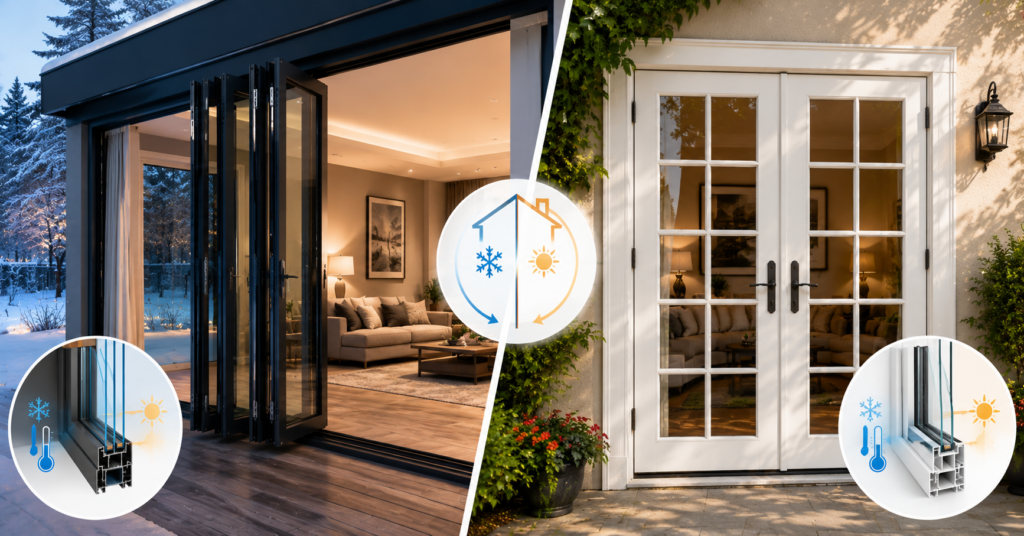
French doors have an inherent efficiency advantage. Smaller individual glass panes, simpler frame construction, and fewer joints mean fewer potential points where drafts and heat loss can occur. A well-sealed French door with quality double glazing is an excellent thermal performer.
Bifold doors have more hinges, more panel joints, and more potential gap points. An older or poorly installed bifold door can develop drafts along panel edges over time, especially after years of thermal expansion and contraction. Modern bifold systems with quality weatherstripping and multi-point compression seals have closed this gap significantly, but the structural disadvantage remains.
The practical difference in energy bills between a quality French door and a quality bifold door is small — but in extreme climates like the Upper Midwest, New England winters, or desert Southwest heat, it adds up over years of ownership.
Winner: French door, marginally, and only if installation quality is equal on both.
Security: Which Door Is Harder to Break Into?
Good news here, both doors have come a long way on security, and neither is a weak point in a well-specified home.
Modern bifold doors come standard with multi-point locking systems, typically 5 to 8 separate lock points distributed along the door’s height. Hinges are usually concealed within the frame, removing a common attack vector. The main historical weakness of bifold doors, lifting panels off the track, has been addressed in current designs with anti-lift bolts built into the track system.
French doors have a different security profile. Traditional French doors with a single center lock were a known vulnerability; the center gap between panels could be forced relatively easily. Modern French doors address this with multi-point locking rods that extend into the top frame and floor when locked, making forced entry significantly harder.
Both doors, when specified with quality hardware and properly installed, offer strong security. The old reputation of bifold doors being less secure than French doors is largely outdated for any door bought in the last five years.
Winner: Tie both perform well with quality hardware. Avoid budget-spec locks on either door type.
Maintenance: Which Door Is Easier to Live With?
This is where French doors have a genuine long-term lifestyle advantage that often goes underappreciated at the point of purchase.
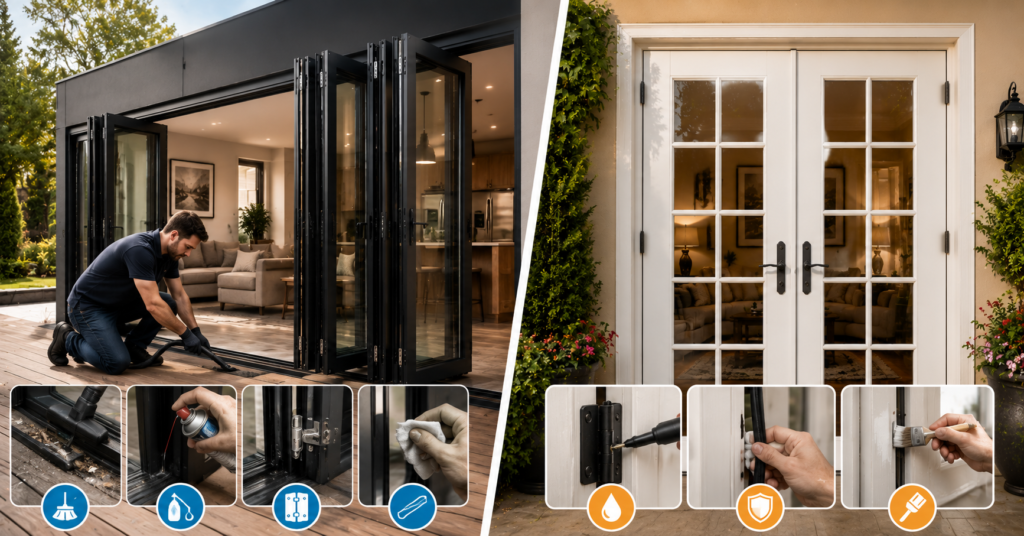
French doors are low-maintenance by design. The mechanism is simple: hinges, a handle, and a lock. Maintenance amounts to lubricating hinges once a year, checking weatherstripping seasonally, and repainting or refinishing wooden frames every few years. That’s it. Most homeowners spend less than an hour a year maintaining French doors.
Bifold doors require more consistent attention. The track needs vacuuming and cleaning monthly to prevent debris buildup that causes grinding and misalignment. Rollers and pivot pins need lubrication with silicone spray every six months. Hinges need checking annually. Seals along panel edges need inspection each season. None of it is difficult, but it’s ongoing, and skipping it leads to alignment problems that compound over time.
The maintenance difference isn’t a reason to avoid bifold doors. It’s a reason to factor ongoing care into your decision, especially if you’re not a naturally hands-on homeowner.
Winner: French door, significantly less maintenance over the life of the door.
Resale Value: Which Door Adds More to Your Home?
This question has a more nuanced answer than most articles give it, and the nuance is worth understanding before you spend $5,000 or more.
French doors deliver consistent, predictable resale value across almost every home style and price bracket. They appeal to a wide range of buyers, traditional, modern, budget-conscious, and premium. Installing quality French doors on a mid-range home is almost always a net positive for resale, regardless of neighborhood or architectural style.
Bifold doors deliver higher absolute value in the right context: a modern home, an open-plan layout, a premium neighborhood where buyers expect luxury features. In that context, a well-specified bifold door system is a genuine selling point that can add significant value. But the high installation cost means the percentage return on investment can be lower than that of French doors in many cases.
The practical takeaway: if you’re in a traditional neighborhood with mostly conventional homes, French doors will resonate with more buyers and deliver more reliable ROI. If you’re in a modern development or upgrading a high-end property, bifold doors can be a genuine value-add that appeals to exactly the buyers looking at your home.
Winner: French door for consistent broad-market ROI. Bifold door for a luxury and modern home value uplift.
Bifold Door vs French Door: Full Side-by-Side Summary
| Factor | Bifold Door | French Door |
| Maximum opening | Up to 90% | Up to 50% |
| Installed cost | $3,000 – $10,000 | $1,500 – $5,800 |
| Home style fit | Modern, contemporary | Traditional, farmhouse, colonial |
| Space needed | Stacking clearance (one side) | Swing clearance (3–4 feet) |
| Daily convenience | Great (with traffic door) | Effortless always |
| Energy efficiency | Good | Slightly better |
| Security | Multi-point strong | Multi-point strong |
| Maintenance | Monthly + biannual | Annual |
| Resale value | High in the right context | Consistent across markets |
| Best for | Large openings, entertaining, wow factor | Budget, traditional homes, low maintenance |
Final Verdict: Which One Is Worth the Money?
Choose a bifold door if:
- You want to fully open a wall between your living space and the outdoor area
- Your home is modern, contemporary, or open-plan
- You entertain regularly and value that seamless indoor-outdoor experience
- Your opening is 9 feet or wider
- You have adequate stacking wall space beside the opening
- You’re in a premium or modern home market where bifolds add resale value
Choose a French door if:
- Your home is traditional, colonial, craftsman, or farmhouse in style
- Budget is a genuine constraint. French doors cost significantly less
- You want low-maintenance doors that you rarely have to think about
- Your opening is under 8 feet wide
- You don’t have stacking clearance beside the opening
- You want consistent, broad-market resale value
Still on the bifold side of the fence? Once you’ve made that call, your next decision is how many panels your opening actually needs. The comparison between a 3 panel vs 4 panel bifold door is worth reading before you talk to any installer. It covers exactly which configuration works best at different opening widths and why it matters for long-term performance.
And when you’re ready to size up your opening correctly, the complete bifold door sizes guide gives you the full chart plus a step-by-step measuring guide so you don’t order the wrong size.
For US building code requirements and door performance standards, the Window and Door Manufacturers Association (WDMA) is the authoritative source for specifications and energy ratings worth checking before any major door purchase.
Frequently Asked Questions
Q: Is a bifold door more expensive than a French door?
A: Yes, consistently across every material category. Bifold doors start around $3,000 installed and can reach $10,000 or more for large aluminum systems. French doors start around $1,500 and top out around $5,800 for premium aluminum installations. The price gap reflects the additional components, hardware complexity, and installation time involved in bifold systems.
Q: Which door is better for a small patio?
A: It depends on your constraint. If you have limited wall space beside the opening, a French door wins; it only needs swing clearance, not stacking space. If your patio is narrow but your opening is wide, a bifold door with a 2+2 split configuration can actually work better. Check your specific measurements before deciding.
Q: Do bifold doors add value to a home?
A: Yes, in the right context. Bifold doors add significant value in modern, open-plan, or high-end homes where buyers expect premium features. In traditional neighborhoods or mid-range markets, French doors often deliver better percentage ROI because they appeal to a wider pool of buyers at a lower installation cost.
Q: Which door is better for security, bifold or French?
A: Both are equally secure when specified with quality multi-point locking hardware. The old reputation of bifold doors being less secure is outdated for any system purchased in the last five years. Avoid budget-spec locks on either door type; the door frame and glass are rarely the weak point, but cheap locks always are.
Q: Can I replace French doors with bifold doors?
A: Yes, in most cases, but it usually requires structural work. Bifold door systems are typically wider and heavier than French doors, so the opening may need to be widened and the header above reinforced to carry the additional load. Always consult a structural engineer or experienced installer before converting from French to bifold doors.
Deciding between bifold and French doors for a specific room? Drop your measurements and home style in the comments, happy to help you figure out which one fits.

Samreen Khadim Hussain is a home improvement writer and content creator at Domelite Home. She specializes in making home renovation, interior design, and bathroom safety accessible to everyday US homeowners, turning technical subjects into clear, actionable advice. Her work is rooted in research, real-world practicality, and a genuine belief that a better home is within everyone’s reach.
2 thoughts on “Bifold Door vs French Door: Which One Is Worth the Money?”