
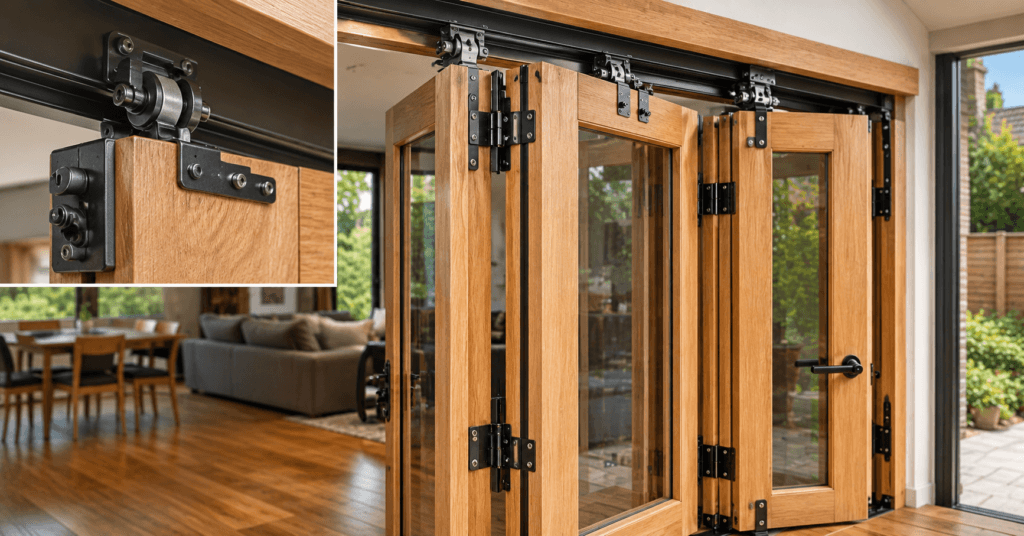
Bifold doors are a smart way to save space, but their smooth operation depends heavily on the hardware behind them. A door can look perfectly fine and still stick, drag, wobble, or refuse to close because a roller, pivot, track, hinge, or bracket is worn or incorrectly adjusted.
That is why choosing bifold door hardware requires more than finding a replacement kit that looks similar to the original.
The hardware needs to match the door’s size, weight, thickness, number of panels, track configuration, and intended use. A lightweight closet door and a large exterior folding door may both be called bifold doors, but their hardware requirements can be very different.
This guide explains the essential bifold door hardware parts, what each component does, how to choose compatible replacements, how installation works, and what to check when a bifold door is not operating correctly.
Quick Answer: What Bifold Door Hardware Do You Need?
Bifold door hardware typically includes a top track, rollers or guides, top and bottom pivots, pivot brackets, hinges, door aligners, a snugger or track stop, and a handle or pull. The exact combination depends on the door’s weight, panel thickness, number of panels, and hardware design.
For a typical interior bifold door, the track, roller, pivot hardware, hinges, and bottom bracket control most of the door’s movement. Aligners and a snugger help keep multi-panel doors properly positioned when closed.
Before buying replacement hardware, measure the existing door and opening, identify the current hardware configuration, and check the manufacturer’s specifications. Bifold hardware is not universally interchangeable.
What Is Bifold Door Hardware?
Bifold door hardware is the mechanical system that allows two or more door panels to fold together while moving within an opening.
Unlike a standard hinged door, a bifold door needs to perform several movements at the same time. The panels have to fold at their hinges while the door assembly pivots and, in many interior systems, a roller or guide travels through a top track.
A typical interior system may contain:
| Hardware part | Main job |
| Top track | Guides the door assembly |
| Roller or hanger | Allows movement through the track |
| Top pivot | Establishes the upper pivot point |
| Bottom pivot | Establishes the lower pivot point |
| Jamb or floor bracket | Holds the lower pivot |
| Hinges | Allow panels to fold |
| Door aligners | Help panels meet correctly |
| Snugger or track stop | Helps hold the door closed |
| Handle or pull | Provides a grip for opening |
Not every bifold door uses every component in the same way. Some systems use surface-mounted hardware, while others use components designed for specific panel thicknesses or weights.
For example, Johnson Hardware’s 100FD system is designed for interior applications and specifies panel thicknesses from 1 to 1 3/4 inches and a maximum panel weight of 75 pounds. Its 1700 series has different limits and is designed for solid-core wood panels.
That difference is important when choosing replacement hardware.
9 Essential Bifold Door Hardware Parts
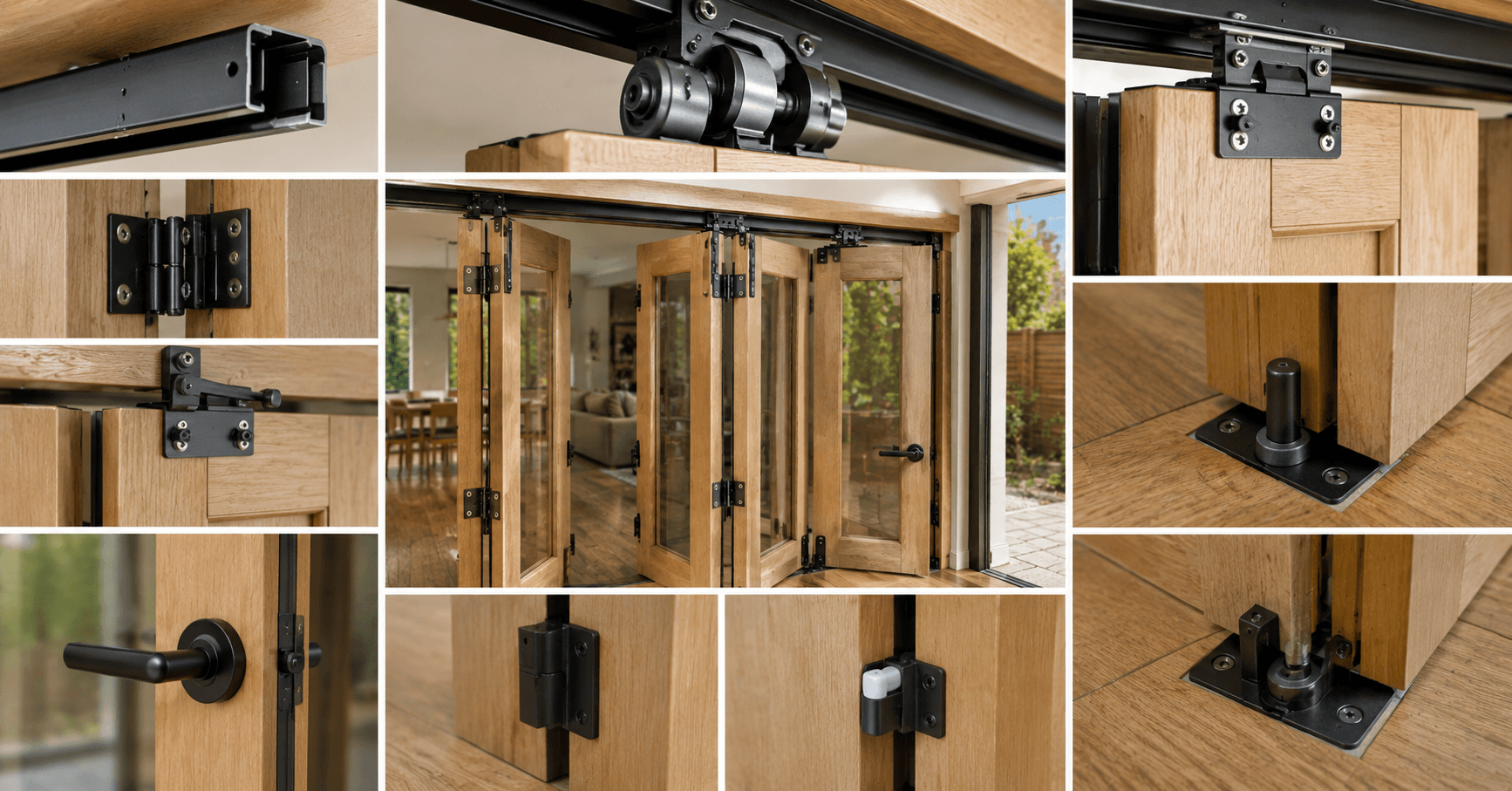
1. Top Track
The top track provides the main path for the moving hardware.
On many interior bifold doors, the track is mounted horizontally across the top of the opening. A roller, hanger, or guide moves through the track while the pivot hardware controls the opposite side of the door.
The track needs to be:
- Straight
- Securely mounted
- Properly aligned
- Appropriate for the door’s weight
- Compatible with the roller or hanger
A bent or poorly secured track can create symptoms that look like a bad roller or pivot.
Do not assume a longer track is automatically better. Track length needs to correspond to the door and opening configuration. Some manufacturer systems allow a longer track to be cut to suit narrower panels, but that is a specification of the particular system, not a universal rule.
2. Roller, Hanger, or Guide
The roller or hanger is the part that travels along the track.
It helps the door move as it opens and closes. If the wheel becomes damaged or the hanger is incorrectly installed, the door may:
- Drag
- Jump
- Stick
- Make noise
- Sit unevenly
- Come out of alignment
Before replacing a roller, inspect the track too. A replacement roller will not solve a bent or badly mounted track.
3. Top Pivot
The top pivot establishes the upper pivot point of the door.
It connects the door panel or pivot plate to the pivot mechanism in the track. This allows the door to swing and fold instead of simply sliding in a straight line.
A loose or incorrectly seated top pivot can cause excessive movement or make the door difficult to align.
4. Bottom Pivot
The bottom pivot establishes the lower pivot point.
It normally works with a jamb bracket or floor bracket. Many systems allow some adjustment at this point so the door can be raised, lowered, or repositioned.
This adjustment becomes especially useful when the door rubs against the frame or has an uneven gap.
5. Jamb or Floor Bracket
The bracket receives the lower pivot and anchors the pivot side of the door.
Its position is critical. The lower bracket needs to align with the pivot point above it. If it is installed too far forward, backward, or out of plumb, the door can sit crooked.
Installation instructions from The Home Depot likewise specify positioning the lower jamb bracket in line with the track and pivot assembly.
6. Hinges
Hinges connect the individual bifold panels.
They allow the panels to fold against one another when the door opens.
Loose hinges can cause surprisingly large problems because even a small amount of movement between panels can change the overall alignment.
Check the hinges if:
- The panels no longer meet evenly
- One panel appears lower than another
- The door rubs while folding
- Screws have loosened
- The panels have developed excessive movement
7. Door Aligners
Door aligners help keep multiple panels in the correct relationship when the door is closed.
They are especially useful on four-panel configurations.
Some installation instructions specify aligners only for four-panel installations. Lowe’s installation documentation, for example, describes attaching aligners to the back of guide door panels on four-panel installations and adjusting them until the doors snap closed.
If a four-panel bifold door closes unevenly, check the aligners before assuming that the entire track system is defective.
8. Snugger or Track Stop
A snugger helps maintain closing tension and keeps the door from drifting open.
A track stop can also establish the final closed position in certain systems.
These components may look small, but they affect how firmly the door stays closed.
If a bifold door closes but immediately moves away from the frame, inspect the snugger, stop, and alignment.
9. Handle or Pull
The handle gives the user leverage to open and close the door.
Handle placement affects usability. Installing it too close to the folding hinge line can make the door harder to pull because the user has less leverage.
Follow the door or hardware manufacturer’s recommended location rather than choosing a position purely for appearance.
Bifold Door Hardware Parts Diagram: How the System Works
The easiest way to understand the hardware is to think about the movement in stages.
Track → roller/hanger → pivot points → hinges → alignment hardware → closing hardware
The track guides movement.
The roller or hanger allows the assembly to travel.
The upper and lower pivots establish the turning points.
The hinges allow the panels to fold.
The aligners help the panels meet correctly.
The snugger or stop helps hold the assembly in its closed position.
This is why replacing a single component without checking the rest of the system can sometimes fail to solve the problem.
Top-Hung vs. Bottom-Rolling Bifold Door Hardware
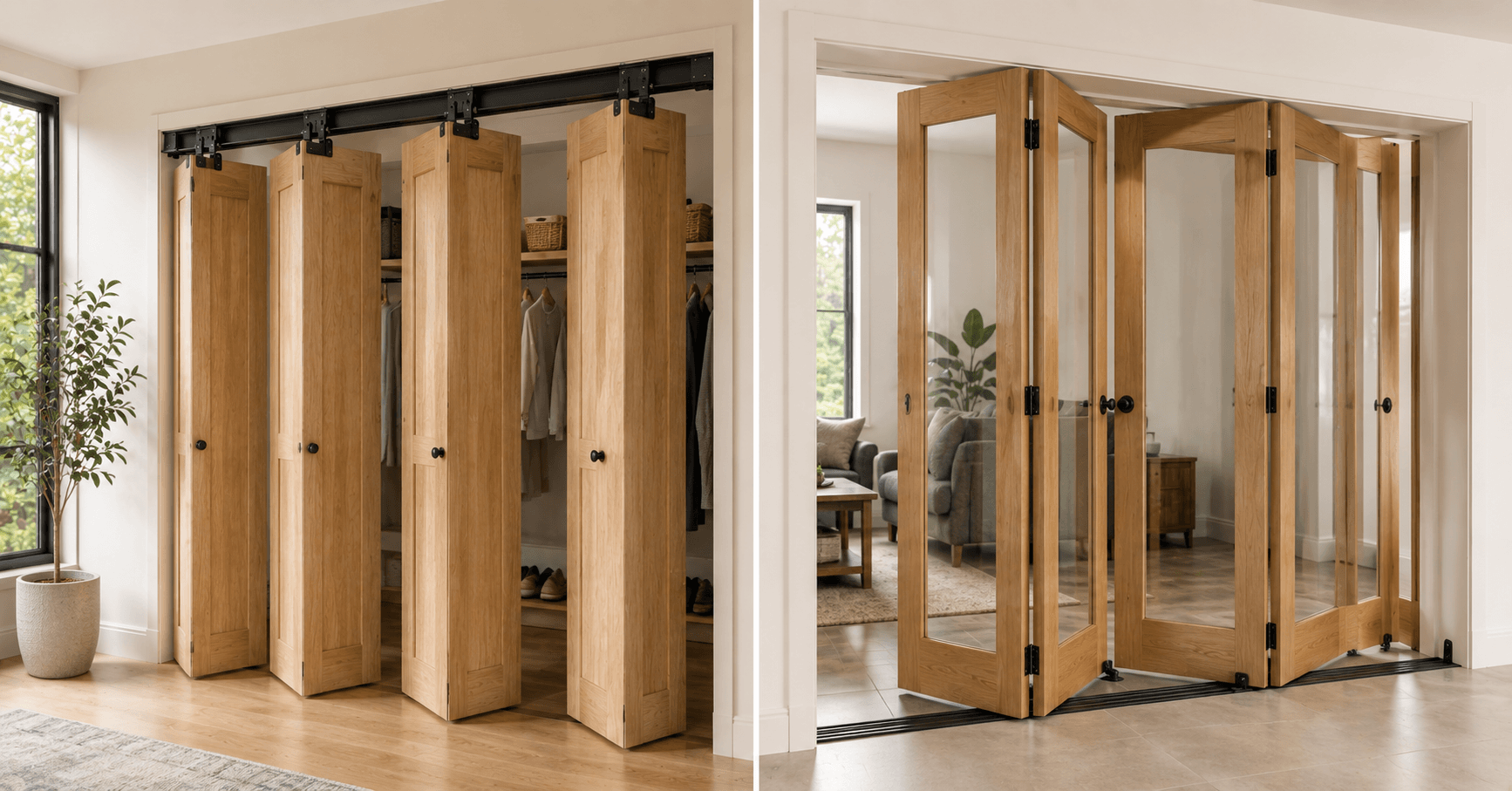
One of the most important distinctions is how the door carries its load.
Top-hung bifold hardware
In a top-hung system, much of the door’s operating load is supported through hardware at the top.
Many interior bifold systems use this configuration.
Johnson Hardware, for example, describes its 1700 series as residential-grade top-hung bifold hardware.
The advantage is that the floor can remain relatively clear of a continuous running track.
Bottom-rolling bifold hardware
A bottom-rolling system transfers the door’s load through rollers operating near the floor.
This changes the hardware requirements and installation details.
The floor or lower track becomes an important part of the operating system, so it needs to remain level, secure, and free from debris.
Which system is better?
Neither is automatically better.
The correct choice depends on:
- Door weight
- Door size
- Opening configuration
- Floor conditions
- Installation requirements
- Manufacturer specifications
For an existing door, replace the hardware with a compatible system rather than converting between configurations without checking whether the door and opening can support the change.
Interior vs. Exterior Bifold Door Hardware
This distinction matters because “bifold door hardware” can refer to very different products.
Interior bifold door hardware
Interior systems are commonly used for:
- Closets
- Pantries
- Laundry rooms
- Bedrooms
- Home offices
- Room dividers
They often use a relatively compact top track, pivots, rollers, hinges, and brackets.
Exterior bifold door hardware
Exterior folding doors are substantially more demanding.
Large glazed or patio bifold systems can be much heavier and may use:
- Heavy-duty rollers
- Multiple locking points
- Specialized hinges
- Weather-resistant components
- Larger tracks
- Threshold systems
- Multipoint handles and locks
Do not use interior closet-door hardware simply because the dimensions appear similar.
The load requirements are completely different.
How to Choose the Right Bifold Door Hardware
Choosing the right hardware starts with the door, not the hardware aisle.
1. Check the door weight
Weight is one of the most important specifications.
Hardware manufacturers publish different weight limits for different systems, so check the manufacturer’s bifold door hardware specifications before choosing a replacement kit. For example, Johnson Hardware lists specific panel-weight and thickness limits for its bifold hardware systems, which shows why you should verify compatibility rather than assume it.
For example, Johnson Hardware’s 100FD system is designed for interior applications and supports panels up to 75 pounds each, with specific panel-thickness requirements.
That illustrates why two products marketed for bifold doors cannot automatically be treated as interchangeable.
2. Measure panel thickness
Panel thickness affects which pivot plates, brackets, guides, and mounting components will fit.
Do not estimate this measurement.
Measure the actual door panel.
3. Count the panels
A two-panel door and a four-panel door can require different hardware arrangements.
Four-panel systems may require additional aligners and different track configurations.
4. Measure the opening
Measure the finished opening width and height.
Before choosing hardware, check the standard bifold door sizes to make sure the door and opening dimensions are compatible.
Do not rely only on the nominal door size.
For a complete measuring process, see our guide on how to measure for bifold doors.
5. Identify the existing track
If replacing individual components, identify the existing track and hardware series first.
The roller must physically work with the track profile, and the pivot components need to match the system.
6. Check the hardware configuration
Determine whether the existing system is:
- Top hung
- Bottom rolling
- Side mounted
- Top mounted
- Two panel
- Four panel
The configuration can completely change which parts you need.
7. Check the manufacturer’s specifications
This is the step many DIYers skip.
Look for:
- Maximum panel weight
- Maximum panel width
- Maximum panel height
- Panel thickness
- Track length
- Recommended opening size
- Hardware compatibility
A manufacturer’s product page or installation manual is more reliable than assuming two visually similar parts are interchangeable.
Bifold Door Hardware Buying Checklist
Before ordering replacement hardware, check these measurements and specifications:
- Door height
- Door width
- Individual panel width
- Door thickness
- Approximate door weight
- Number of panels
- Track type
- Track length
- Roller or hanger style
- Top pivot style
- Bottom pivot style
- Bracket position
- Existing hinge configuration
- Manufacturer or model number
If several of these details are unknown, measure the existing system before ordering.
That small amount of preparation can prevent buying a complete kit that does not fit.
How to Install Bifold Door Hardware
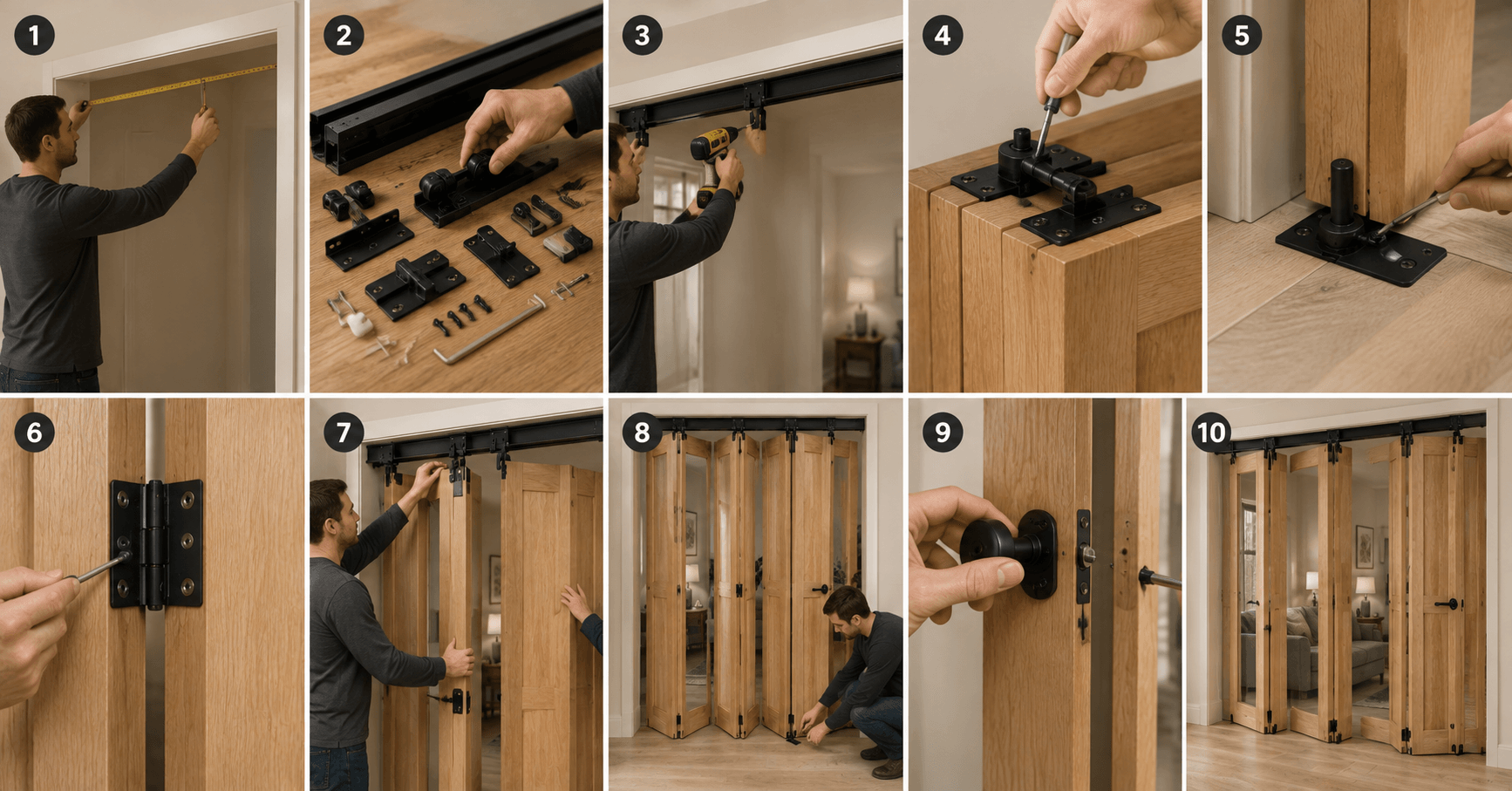
The exact procedure varies by manufacturer, so the supplied instructions should always take priority. For model-specific hardware information, check Dormakaba’s bifold door hardware installation instructions, which provide technical documentation for several sliding and folding door hardware systems.
Step 1: Measure the finished opening
Measure the actual finished width and height.
The opening should be reasonably square, and the header should provide a secure mounting surface.
Step 2: Prepare the track
Assemble the track hardware according to the manufacturer’s instructions.
Some systems include pivots, hangers, rollers, stops, or snugger components that must be inserted before the track is mounted.
Step 3: Mount the track
Secure the track to the header or approved mounting surface.
Keep it level and properly positioned.
A poorly mounted track can cause operating problems even when the rest of the hardware is installed correctly.
Step 4: Install the pivot and mounting hardware
Attach the appropriate top and bottom pivot components and door plates.
The exact location varies by hardware model, so use the supplied measurements rather than copying dimensions from another kit.
Step 5: Install the jamb or floor bracket
Position the bracket so the lower pivot aligns with the upper pivot.
This alignment is critical to keeping the door plumb.
Step 6: Connect the panels
Attach the hinges between the panels according to the hardware instructions.
Check that the hinge orientation allows the panels to fold in the intended direction.
Step 7: Hang the door
Insert the upper pivot and roller or hanger into the track.
Then seat the lower pivot into its bracket.
Bifold doors can be awkward to handle, so having another person support the door during this step is a sensible safety measure. The Home Depot also recommends assistance when installing bifold doors.
Step 8: Adjust the door
Open and close the door several times.
Check:
- Top clearance
- Bottom clearance
- Side clearance
- Panel alignment
- Door height
- Track movement
- Closing action
Many systems allow the door height or horizontal position to be adjusted through the pivot hardware.
Step 9: Install the handle
Install the pull or knob after the door operates correctly.
Step 10: Test the complete system
Open and close the door repeatedly.
A properly installed door should move smoothly without excessive force, rubbing, popping out of the track, or shifting out of alignment.
Why Is My Bifold Door Hard to Open?
A difficult bifold door usually has a mechanical or alignment problem.
Start with the simplest checks.
Dirty or obstructed track
Dust, debris, or paint inside the track can interfere with the roller.
Clean the track and inspect the roller before replacing parts.
Damaged roller
A worn wheel may create resistance or cause the door to jump.
Inspect the roller for cracks, flat spots, or excessive play.
Misaligned pivot
If the pivot is not seated correctly, the door can bind during movement.
Loose hinges
Loose hinges allow the panels to shift and can cause them to rub against each other or the frame.
Incorrect door height
A door set too low can rub against the floor. A door set too high may create excessive gaps or put unnecessary stress on the hardware.
Adjust the pivot only according to the manufacturer’s instructions.
Why Won’t My Bifold Door Close?
If the door opens normally but refuses to close properly, check these areas first.
The panels are misaligned
Look at the gap between the panels.
If the gap changes dramatically from top to bottom, the panels may not be hanging square.
The bottom pivot needs adjustment
A small adjustment can change the door’s position within the opening.
The aligners are loose
This is especially worth checking on four-panel installations.
The snugger is incorrectly adjusted.
If the door does not stay closed, the snugger or closing mechanism may need adjustment.
The track is out of position
A track that has shifted can change the entire geometry of the door.
If you need a more detailed repair process, see our guide on how to fix a bifold door that won’t close.
Can You Replace Bifold Door Hardware Without Replacing the Door?
Yes.
If the door panels are still straight and structurally sound, replacing worn hardware can extend the life of the existing door.
Commonly replaceable components include:
- Rollers
- Pivot pins
- Pivot brackets
- Hinges
- Jamb brackets
- Door aligners
- Snuggers
- Handles
- Track stops
The key question is compatibility.
If only one roller has failed and the rest of the system is in good condition, replacing that component may be enough.
If the track is damaged, multiple pivots are worn, several hinges are loose, and the door has recurring alignment problems, a complete hardware replacement may make more sense.
Should You Buy Individual Parts or a Complete Hardware Kit?
Use this simple rule:
| Situation | Better choice |
| One damaged roller | Individual replacement |
| Broken pivot | Matching pivot replacement |
| Loose hinge | Replacement hinge |
| Damaged track | Matching track |
| Several worn components | Complete hardware kit |
| Unknown old hardware | Identify system first |
| Changing door configuration | Complete compatible system |
| Heavy door | Manufacturer-rated hardware |
Buying a complete kit is not automatically the best option.
If the existing system is still compatible and only one component has failed, replacing everything can waste money.
On the other hand, installing one new part into a badly worn system can create another failure point.
Are Bifold Door Hardware Kits Universal?
No. Bifold door hardware kits are not universally compatible.
Compatibility can depend on:
- Panel thickness
- Panel weight
- Panel width
- Door height
- Number of panels
- Track design
- Pivot configuration
- Mounting method
- Manufacturer
Even products from the same manufacturer may have different specifications.
For example, Johnson Hardware’s 100FD and 1700 systems have different panel weight and thickness specifications.
This is why “universal bifold hardware” should be treated carefully. Always verify the actual specifications.
Can You Mix Bifold Door Hardware Brands?
Sometimes individual components can physically fit, but compatibility should never be assumed.
A roller might fit into a track while still having the wrong diameter or mounting geometry.
A pivot may appear identical while having a different shaft length.
A bracket may attach to the frame but place the pivot at the wrong height.
For replacement work, matching the original manufacturer and model is usually the safest route.
If you want to change to a different hardware system, treat it as a complete compatibility project rather than swapping random components.
Common Bifold Door Hardware Mistakes
Buying by appearance
Two rollers can look nearly identical while having different dimensions.
Ignoring weight capacity
Hardware must be rated for the actual door.
Forgetting panel thickness
Pivot plates and brackets may be designed for specific thickness ranges.
Installing a track without checking the opening
A track that is not properly aligned can make every other adjustment harder.
Mixing hardware systems
Combining incompatible pivots, rollers, and brackets can create alignment problems.
Replacing the door before checking the hardware
A worn roller or pivot can make a perfectly good door appear defective.
Replacing one component in a completely worn system
If several parts have reached the end of their service life, a complete hardware kit may be more practical.
How to Make Bifold Door Hardware Last Longer
Good maintenance does not require much work.
Keep the track clean
Remove dust and debris regularly.
Check loose screws
Inspect track and bracket screws periodically, especially on frequently used doors.
Watch for unusual movement.
If the door suddenly becomes harder to open, starts rubbing, or begins sitting unevenly, investigate early.
Do not force a stuck door
Forcing the panels can damage the roller, pivot, hinges, or track.
Find the source of the resistance first.
Use the correct lubricant.
If the manufacturer’s instructions permit lubrication, use the recommended product and avoid coating surfaces unnecessarily.
Some manufacturer instructions specifically recommend silicone lubricant for smoother operation.
Frequently Asked Questions About Bifold Door Hardware
What hardware do I need for a bifold door?
A typical interior bifold door uses a top track, roller or hanger, top and bottom pivots, a bracket, hinges, and a handle. Four-panel systems may also use door aligners and additional closing hardware.
What is the most important bifold door hardware?
The track, roller, pivots, and hinges are central to the door’s movement. However, the hardware works as a system, so one poorly matched component can affect the entire door.
Can I replace just the bifold door roller?
Yes. If the existing track and other components are in good condition, you can often replace the roller alone. Match the replacement to the existing track and hardware specifications.
Do all bifold doors use a top track?
No. Hardware configurations vary. Many interior systems use a top track, while other folding systems use different arrangements.
Do bifold doors need a bottom track?
Not necessarily. Some interior systems use a top track with a lower pivot bracket instead of a continuous bottom running track.
Why does my bifold door keep coming off the track?
Possible causes include a poorly seated roller or pivot, damaged hardware, an improperly secured track, or incorrect adjustment.
How do I know which bifold door hardware to buy?
Start by identifying the door’s weight, height, width, panel thickness, number of panels, and existing track configuration. Then match those specifications to the hardware manufacturer’s requirements.
Is it worth replacing old bifold door hardware?
Usually, if the door panels remain structurally sound. Replacing worn rollers, pivots, hinges, or brackets can be much less work than replacing the entire door.
Final Thoughts
The right bifold door hardware should make the door feel almost effortless to operate.
If a bifold door sticks, rubs, rattles, or refuses to close, do not immediately assume the door itself has failed. The problem may be a worn roller, loose hinge, misaligned pivot, damaged track, or incorrectly positioned bracket.
For new installations, start with accurate measurements and select hardware based on the door’s actual specifications. For replacements, identify the existing hardware system before ordering individual parts.
The most important rule is simple: match the hardware to the door, not just to the name “bifold.”
Check the panel weight, thickness, dimensions, number of panels, track type, and manufacturer specifications. That approach gives the door a much better chance of opening smoothly, closing correctly, and staying reliable for years.

Samreen Khadim Hussain is a home improvement writer and content creator at Domelite Home. She specializes in making home renovation, interior design, and bathroom safety accessible to everyday US homeowners, turning technical subjects into clear, actionable advice. Her work is rooted in research, real-world practicality, and a genuine belief that a better home is within everyone’s reach.