
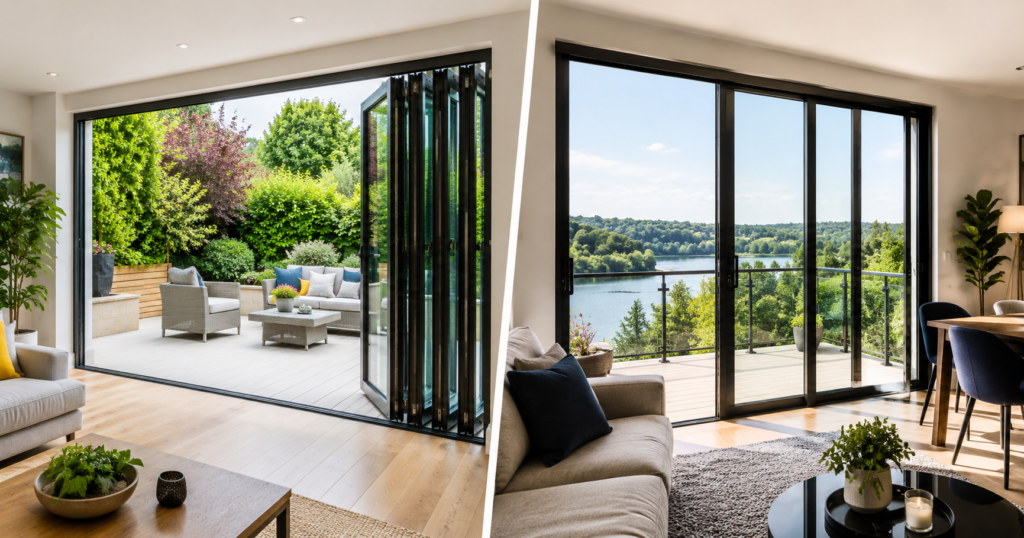
You’ve measured the opening. You’ve watched the YouTube videos. And now you’re stuck between two doors that both look amazing in the showroom but feel completely different once you’re actually living with one.
Bifold door vs sliding door, it sounds like a simple choice. It’s not.
Most guides tell you, It depends on your space. That’s not helpful. This guide tells you exactly what depends on what, who wins in each situation, and which door will quietly frustrate you six months after installation if you pick the wrong one.
Let’s get into it.
Quick Decision Table: Bifold Door vs Sliding Door
Don’t want to read the whole thing? Here’s your fast answer:
| Your Situation | Best Choice |
| You want to fully open an entire wall | Bifold door |
| You want maximum glass and unobstructed closed views | Sliding door |
| Limited wall space beside the opening | Sliding door |
| You step outside multiple times a day | Bifold door (with traffic door) |
| Tight budget | Sliding door |
| Large patio, entertaining space, indoor-outdoor living | Bifold door |
| Small room or apartment balcony | Sliding door |
| Security is a top concern | Bifold door |
| Best energy efficiency | Sliding door (slight edge) |
Still not sure? Keep reading. The details matter more than the table.
How a Bifold Door vs Sliding Door Actually Works
Before comparing them, it helps to understand exactly what you’re dealing with.
A bifold door is made up of multiple panels, usually between 2 and 7, connected by hinges. When you open it, the panels fold against each other accordion-style and stack to one side of the opening. The result is a wide, almost completely clear opening. Some bifold door systems can expose up to 90% of the total doorway width when fully open.
A sliding door works differently. Two or more large glass panels sit in a horizontal track and slide sideways. One panel moves in front of the other. The panels don’t fold or stack; they just shift. Because of this, a standard two-panel sliding door can only open about 50% of the opening at most. Even a three-panel sliding door maxes out around 65% clear opening.
That difference, 90% vs 65%, is the most important single fact in the entire bifold door vs sliding door debate.
1. Opening Width: Bifold Door Wins by a Wide Margin
If you want to genuinely open up a wall, to connect your living room to a patio, merge an indoor dining space with an outdoor deck, or throw the kind of summer party where inside and outside blur together, a bifold door is the only real choice.
Sliding doors physically cannot open the full width of a doorway. At least one panel always stays in place, covering part of the opening. That’s just how the mechanism works. For casual daily use, that’s completely fine. But for those big open moments, it’s a real limitation.
A bifold door folds everything away. When all panels are stacked to one side, you get an opening that feels genuinely wall-free. That’s the wow factor sliding doors simply can’t replicate.
And if you’re still deciding how many panels your bifold door should have, this breakdown of 3 panel vs 4 panel bifold doors will help you nail down the right configuration before you buy.
Winner: Bifold door, and it’s not closed.
2. Closed Views and Natural Light: Sliding Door Wins
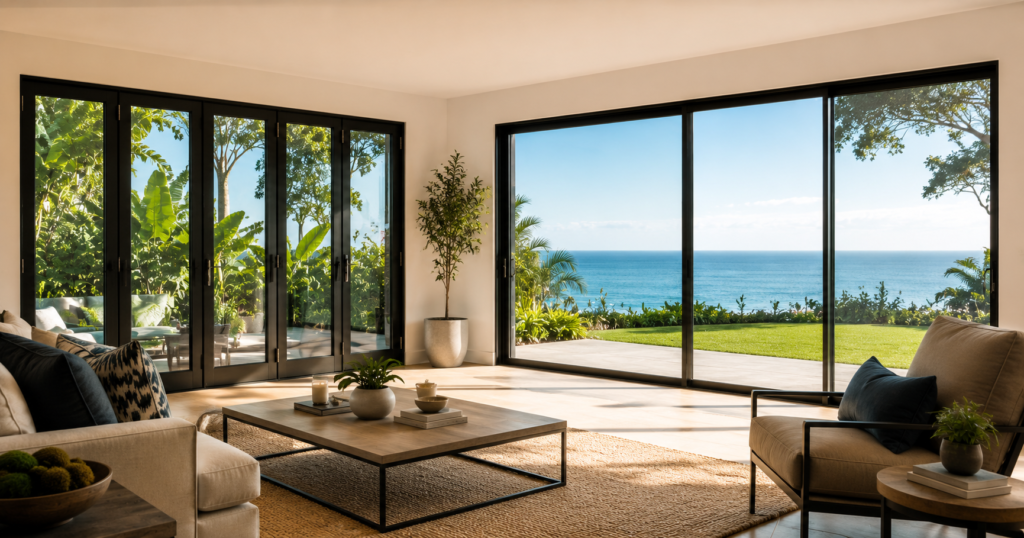
Here’s the brutal truth about bifold doors that nobody likes: when they’re closed, they look busier than sliding doors.
A bifold door has multiple panels, which means multiple vertical frame lines running through your view. If you have a beautiful backyard, a garden, or an ocean view, those frame lines are always there, interrupting the picture even when the door is shut tight.
Sliding doors are the opposite. They use fewer, larger panes of glass. Fewer frames mean a cleaner, wider, more uninterrupted view when the door is closed. If you live somewhere with a view worth looking at year-round, that matters every single day, not just when the door is open.
Natural light follows the same logic. Fewer frames means more glass area, which means more light floods in on a closed winter day when you’re not opening the door at all.
Winner: Sliding door, especially for homes where the door stays closed most of the year.
3. Daily Use and Convenience: It Depends on One Thing
This is where most comparisons miss a critical detail: the traffic door.
A traffic door (also called an access door or lead door) is a single panel in a bifold system that swings open like a regular hinged door. You use it for everyday in-and-out, letting the dog out, grabbing the mail, stepping onto the porch for your morning coffee, without having to fold back all the other panels.
With a traffic door, a bifold door is actually more convenient for daily use than a sliding door. One push, and you’re out. One pull, and you’re back in.
Without a traffic door, the opposite is true. Folding back three or four panels every time you want to step outside gets old fast. Sliding doors win on ease of daily use in that scenario, just slide one panel open a few inches, and you’re done.
Winner: Bifold door (with traffic door) or Sliding door (without traffic door). Decide whether you want a traffic door before you buy.
4. Space Requirements: Sliding Door Wins for Small Spaces
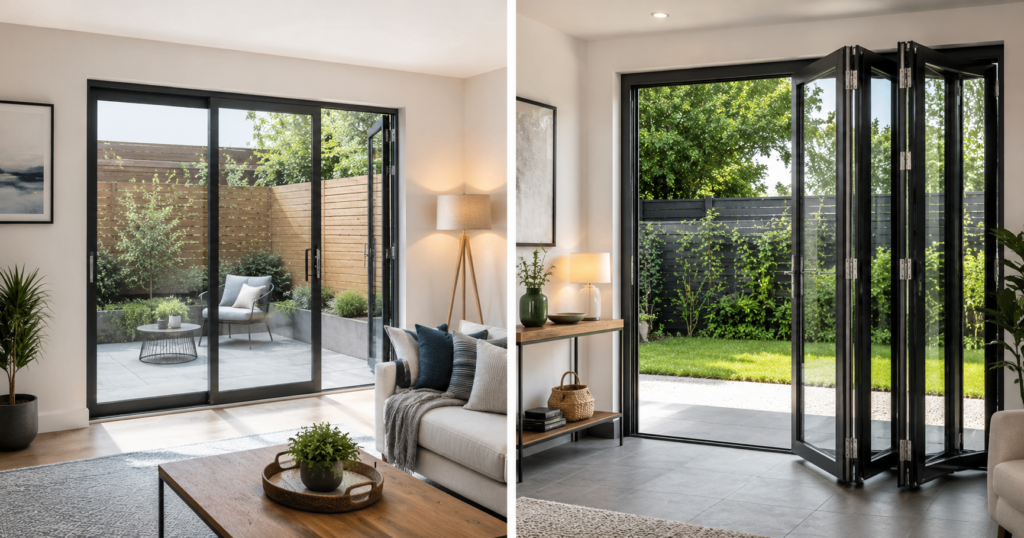
Sliding doors are the clear winner here. The panels move along a track that runs parallel to the wall. They don’t project into the room or out onto the patio. They don’t need any clear wall space beside the opening to stack into.
Bifold doors need stacking space. When you open a bifold door, all those folded panels have to go somewhere, typically against the wall beside the opening. For a 10-foot bifold door, you might need 3 to 4 feet of clear wall space on one side. If you have a window, a light switch, a piece of furniture, or a structural wall right there, you have a problem.
A 2+2 split configuration (two panels folding to each side) helps with this, but you still need some clearance on both sides.
If your opening sits in a tight corner, or if wall space beside the door is limited, sliding doors fit where bifold doors physically can’t.
That said, bifold doors are more adaptable to smaller spaces than most people assume. If you’re working with a compact room and still want the bifold look, check out this guide on the best bifold doors for small spaces. There are smarter configurations worth knowing about.
Winner: Sliding door, no stacking space required.
5. Security: Bifold Door Has a Genuine Edge
This one surprises people, but it’s real.
Most sliding doors come with a single locking point, one handle, and one lock. That’s a known weakness. A determined intruder with the right tools can work around a single-point lock much faster than most homeowners realize. Many sliding door owners end up adding aftermarket security pins or floor locks to compensate.
Bifold doors are built with multi-point locking systems as standard. The door locks at multiple points along the frame, sometimes five or eight separate locking points, making forced entry significantly harder. The hinges are also typically concealed and reinforced, removing another common attack vector.
If you’re buying an exterior door and home security genuinely concerns you, bifold doors have a structural advantage out of the box.
Winner: Bifold door, multi-point locking vs single-point locking is a meaningful difference.
6. Energy Efficiency: Sliding Door Has a Slight Edge
Here’s the honest breakdown on thermal performance.
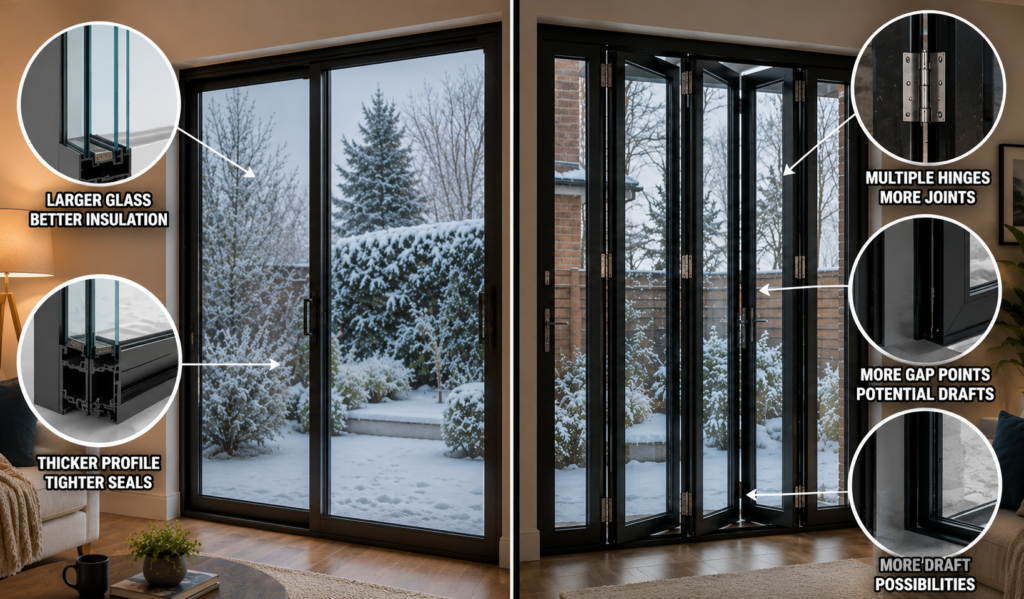
Sliding doors have larger glass panes and less aluminum framing. Since glass (especially double or triple-glazed) tends to insulate better than aluminum frames, fewer frames means better overall thermal performance. Sliding doors also tend to have thicker profiles and tighter seals because they don’t have the multiple hinge points and panel joints that bifold doors have.
Bifold doors have more hinges, more joints, and more potential gap points where drafts can creep in. A poorly installed bifold door or one with worn seals will lose heat faster than a well-sealed sliding door.
That said, both door types are available with excellent double and triple-glazed options, and a well-installed bifold door with quality seals performs very well. The difference is real but not enormous. If your home is in an extreme climate and energy efficiency is a top priority, slightly favor the sliding door.
Winner: Sliding door, marginally, and only if installation quality is equal.
7. Cost: Sliding Doors Are Generally Cheaper
For standard sizes and comparable materials, sliding doors tend to cost less than bifold doors.
Here’s why: bifold doors have more components. More panels, more hinges, more hardware, more track complexity. That adds up in both materials and installation labor.
A rough US cost comparison for installed exterior doors:
| Door Type | Material | Estimated Cost Installed |
| Sliding door | Vinyl/uPVC | $1,500 – $3,500 |
| Sliding door | Aluminum | $3,000 – $6,000 |
| Bifold door | Vinyl/uPVC | $2,500 – $5,000 |
| Bifold door | Aluminum | $4,000 – $8,500 |
One important exception: for very wide openings (12 feet or more), large single-pane glass panels for sliding doors become extremely expensive to manufacture and ship. At that width, bifold doors sometimes end up being the more cost-effective option because spreading the opening across multiple smaller panels is cheaper than casting massive individual glass sheets.
Prices vary significantly by region and installer. The U.S. Department of Energy’s guide on energy-efficient doors and windows is a useful reference point when evaluating glazing options and thermal ratings before you commit to either door type.
Winner: Sliding door, for standard sizes. For very wide openings, it evens out.
Bifold Door vs Sliding Door: Full Side-by-Side Summary
| Factor | Bifold Door | Sliding Door |
| Maximum opening width | Up to 90% of doorway | Up to 65% of doorway |
| Closed glass view | More frame lines | Cleaner, unobstructed |
| Natural light (closed) | Good | Slightly better |
| Daily use convenience | Great (with traffic door) | Easy, always |
| Space needed to open | Needs stacking clearance | None — slides within frame |
| Security | Multi-point locking (stronger) | Single-point (weaker by default) |
| Energy efficiency | Good | Slightly better |
| Cost | Higher | Lower |
| Best for | Large openings, entertaining, indoor-outdoor flow | Small spaces, view-focused homes, tight budgets |
| Wow factor | High | Moderate |
Final Verdict: Which One Should You Actually Choose?
Choose a bifold door if:
- You want to open up a full wall to a patio, garden, or outdoor living space
- You entertain and love the indoor-outdoor feel
- You want a traffic door for everyday convenient access
- Security is a priority, and you don’t want to add aftermarket locks
- Your opening is 10 feet wide or more
Choose a sliding door if:
- Your space is limited, and you can’t give up on stacking clearance beside the opening
- You have a view you want to enjoy every single day, with the door closed
- You want maximum natural light in a closed position
- You’re working with a tighter budget
- It’s an apartment balcony, a small room, or a secondary access point
Both are genuinely great options. The bifold door vs sliding door debate doesn’t have a universal winner. It has a winner for your specific home, your specific opening, and the way you actually live day to day.
Figure out which of the seven factors above matters most to you, and the right answer becomes obvious. And if you’ve already landed on bifold doors but want a style that adds real character to your home. Bifold shaker doors are worth a serious look, a smart upgrade that works beautifully in both modern and traditional interiors.
Frequently Asked Questions
Is a bifold door more expensive than a sliding door?
Generally yes. Bifold doors cost more due to additional panels, hinges, and hardware. Expect to pay $500–$2,000 more for a bifold door over a comparable sliding door in the same material.
Which door is better for small spaces?
Sliding doors. They require zero stacking clearance and move within their own frame, making them ideal for tight spaces or apartments.
Are bifold doors more secure than sliding doors?
Yes. Bifold doors use multi-point locking systems with 5–8 lock points, while most sliding doors have a single locking point by default.
Can a bifold door be used as a sliding door?
No, they operate on completely different mechanisms. However, bifold doors with a traffic door can function similarly to a sliding door for everyday access.

Samreen Khadim Hussain is a home improvement writer and content creator at Domelite Home. She specializes in making home renovation, interior design, and bathroom safety accessible to everyday US homeowners, turning technical subjects into clear, actionable advice. Her work is rooted in research, real-world practicality, and a genuine belief that a better home is within everyone’s reach.
2 thoughts on “Bifold Door vs Sliding Door: 7 Brutal Truths Nobody Tells You Before You Buy”