
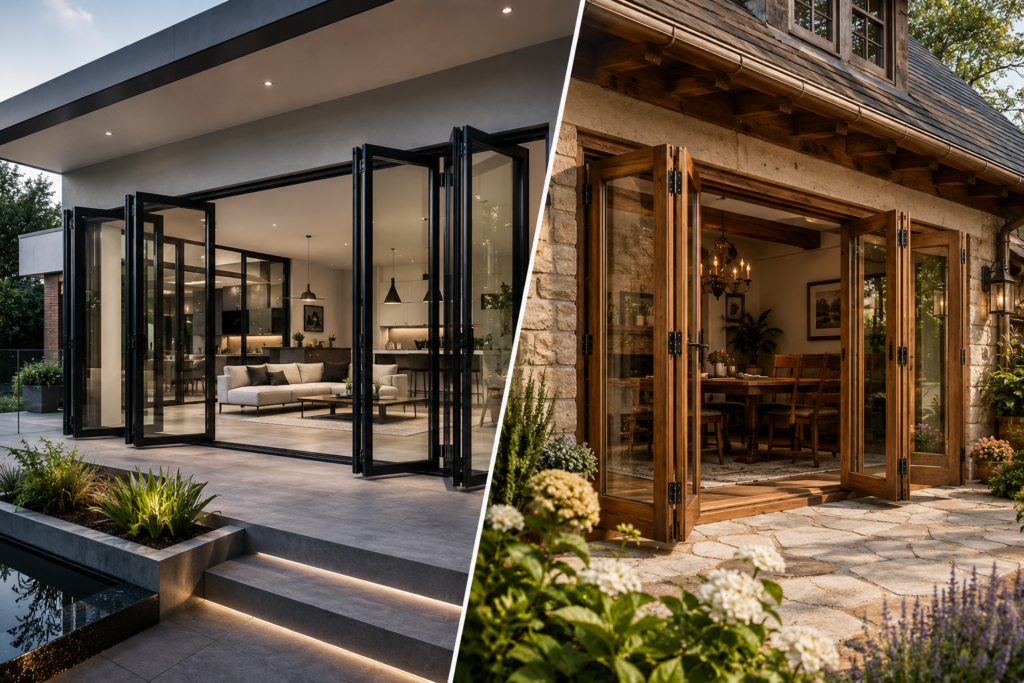
You’ve decided on bifold doors. Now comes the question that trips up more homeowners than almost anything else in the buying process: aluminum or wood?
Both materials look stunning in the right home. Both have genuine strengths. And both have real weaknesses that showroom visits and product pages conveniently gloss over. The truth is, one of these materials will serve you significantly better than the other. Which one that is depends almost entirely on your climate, your home’s architectural style, and how much maintenance you’re willing to commit to over the next 20 years.
This guide gives you the honest comparison, category by category, with a clear winner every time and no manufacturer bias.
Quick Answer: Aluminum vs Wood Bifold Door
No time to read everything? Here’s the fast version:
| Factor | Aluminum | Wood |
|---|---|---|
| Upfront cost | Higher | Lower |
| Long-term cost | Lower | Higher |
| Lifespan | 30 to 45 years | 20 to 40 years (with maintenance) |
| Maintenance | Minimal | High, annual sealing and staining |
| Energy efficiency | Excellent (with thermal break) | Good naturally |
| Weather resistance | Superior in all climates | Vulnerable to moisture and heat |
| Style fit | Modern, contemporary, open-plan | Traditional, farmhouse, craftsman |
| Environmental impact | Recyclable, low waste | Renewable if FSC certified |
| Best for exterior use | Strong choice | Requires serious upkeep |
| Best for interior use | Works well | Excellent choice |
When Aluminum Wins
Aluminum is your best choice when you want an exterior bifold door, live in a demanding climate, hate maintenance, or have a modern home. It costs more upfront but saves you real money over the life of the door.
When Wood Wins
Wood is genuinely the better choice for interior bifold doors, traditional or period homes, budget-conscious buyers who don’t mind maintenance, and homeowners who prioritize natural aesthetics above everything else.
How Aluminum vs Wood Bifold Door Actually Differs
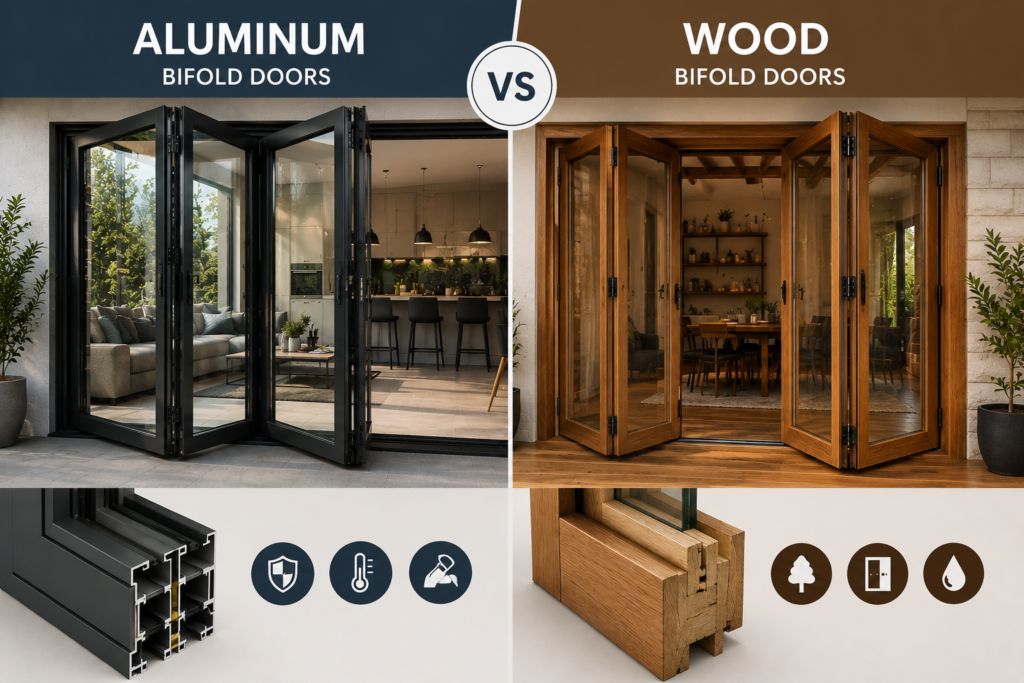
Before comparing them category by category, it helps to understand what you’re actually working with. The material difference goes deeper than just looks.
What Aluminum Bifold Doors Are Made Of
Aluminum bifold doors use extruded aluminum alloy frames. This manufacturing process creates exceptionally strong, slim profiles from a lightweight metal. Most exterior aluminum bifold doors include a thermal break, which is a strip of polyamide inserted between the inner and outer aluminum sections of the frame. This thermal break stops cold from transferring through the metal frame directly into your home. That solves what was historically aluminum’s biggest weakness as a door material.
The frames are finished with a powder-coated paint that bonds to the aluminum at a molecular level. This creates a surface that resists scratching, fading, and corrosion for decades without repainting.
What Wood Bifold Doors Are Made Of
Wood bifold doors are typically made from hardwoods, most commonly oak, mahogany, or accoya, or engineered wood products that combine timber veneers with stable composite cores. Solid hardwood doors are the premium option: beautiful, weighty, and genuinely impressive in person. Engineered wood doors offer more dimensional stability with less swelling and shrinking, at a lower price point.
The critical difference from aluminum is that wood is a living material. It responds to its environment, expanding in humidity, contracting in dry cold, and absorbing moisture if its protective finish breaks down. That responsiveness is both its greatest aesthetic asset and its greatest maintenance liability.
Cost Comparison: Upfront vs Long-Term
Upfront Purchase and Installation Cost
Wood bifold doors start cheaper. Aluminum starts higher. That’s the simple version, but it doesn’t tell the whole story.
Here’s a full US cost breakdown for installed bifold doors:
| Door Type | Material | Installed Cost (US) |
|---|---|---|
| Interior bifold | Wood (pine/poplar) | $300 to $1,200 |
| Interior bifold | Wood (oak/hardwood) | $800 to $2,500 |
| Interior bifold | Aluminum | $1,000 to $3,000 |
| Exterior bifold | Wood (hardwood) | $3,500 to $8,000 |
| Exterior bifold | Aluminum (standard) | $4,000 to $10,000 |
| Exterior bifold | Wood-clad aluminum | $6,000 to $14,000 |
For interior doors like closets, pantries, and room dividers, wood’s lower upfront cost is a real advantage. The maintenance challenge is minimal since interior doors don’t face weather exposure.
For exterior doors, the calculation flips immediately.
Long-Term Cost of Ownership
This is where most homeowners get surprised, and where wood’s upfront price advantage quietly disappears.
An exterior wood bifold door needs professional refinishing or resealing every 1 to 3 years, depending on climate exposure. In harsh climates like Gulf Coast humidity, Northeast freeze-thaw cycles, and desert UV exposure, that interval shrinks fast. Over 20 years, maintenance costs on an exterior wood bifold door can easily add $3,000 to $6,000 on top of the original purchase price.
Aluminum requires essentially none of that. A wipe down with soapy water a few times a year is genuinely all most aluminum bifold doors need. No repainting, no resealing, no refinishing. Over the same 20-year period, that maintenance cost difference more than offsets aluminum’s higher purchase price in most cases.
Winner: Wood for upfront cost. Aluminum for the long-term total cost of ownership.
Durability and Lifespan: Which Door Lasts Longer?
Aluminum Lifespan
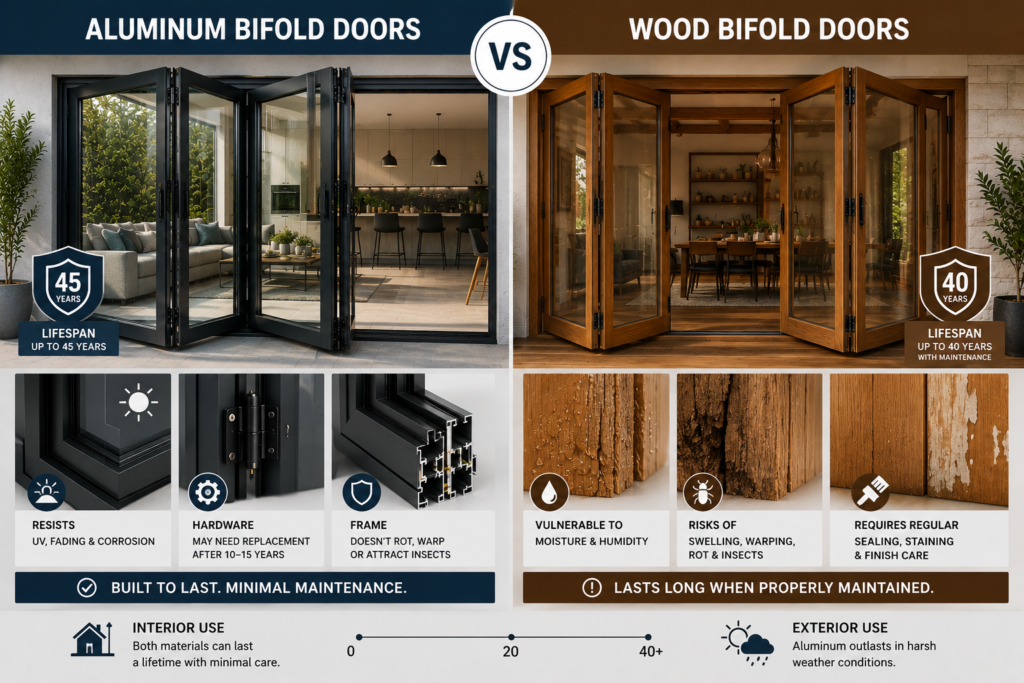
Aluminum bifold doors are built to last. A well-maintained aluminum system has a life expectancy of around 45 years. The powder-coated finish resists UV fading, surface scratching, and corrosion. Unlike paint on wood, it doesn’t peel or flake. The aluminum frame itself doesn’t rot, warp, swell, or become vulnerable to insect damage.
The weak points in aluminum systems are typically the hardware: rollers, hinges, and seals, rather than the frame material itself. These components wear over time and may need replacing after 10 to 15 years, but the structural frame almost always outlasts them.
Wood Lifespan
Timber bifold doors can last upwards of 40 years, but with one critical condition attached. They need consistent maintenance over that entire period to get there. A neglected wood bifold door in a wet or humid climate can begin deteriorating in as few as 5 to 7 years. Swelling, warping, rot, and finish failure are all genuine risks when maintenance lapses.
Interior wood bifold doors are a completely different story. Away from weather exposure, a solid hardwood interior bifold door can last the life of the house with minimal care. The durability gap between aluminum and wood essentially disappears in interior applications.
Winner: Aluminum for exterior use. Tie for interior use.
Maintenance: Which Material Is Easier to Live With?
This is probably the most practically important factor for most homeowners. It has the biggest impact on day-to-day life with your door over the years of ownership.
Aluminum Maintenance Routine
Aluminum bifold doors are about as close to maintenance-free as exterior doors get. Here’s what the full annual routine looks like:
- Every 3 to 6 months: Wipe frames with warm soapy water and a soft cloth
- Every 6 months: Vacuum the track and apply silicone spray to rollers and pivot pins
- Every 12 months: Check and tighten any loose screws on brackets and hinges
- Every 2 to 3 years: Inspect weatherstripping seals and replace if compressed or cracked
Total time per year: about 1 to 2 hours. Total cost per year: essentially nothing beyond a can of silicone spray.
Wood Maintenance Routine
Wood bifold doors, especially exterior ones, demand significantly more attention. A responsible maintenance schedule looks like this:
- Every 3 to 6 months: Inspect finish for cracking, peeling, or bare patches
- Every 1 to 2 years: Sand and refinish or reseal exposed areas, with a full refinish every 2 to 3 years
- Every season: Check for swelling or sticking, especially before humid summers
- Every year: Inspect all joints and end grain for moisture penetration
- Immediately: Address any finish failure before water gets into the wood
Total time per year: 4 to 8 hours minimum. Total cost per year: $100 to $400 in materials, more if professional refinishing is needed.
If you’re not a hands-on homeowner, or if your door is in a hard-to-reach location, that maintenance burden compounds fast.
Winner: Aluminum by a significant margin.
Energy Efficiency: Which Keeps Your Bills Lower?
Aluminum With Thermal Breaks
Aluminum has a historical reputation as a poor insulator. In older systems without thermal breaks, that reputation was deserved. Modern aluminum bifold doors with polyamide thermal breaks have closed that gap completely. Paired with double or triple glazing, a thermally broken aluminum bifold door delivers excellent energy performance that meets or exceeds Energy Star requirements in most US climate zones.
The U.S. Department of Energy recommends looking for doors with low U-factors and quality glazing regardless of frame material. Modern aluminum systems with thermal breaks score well on both counts. For more on what to look for in door energy ratings, the U.S. Department of Energy’s guide on energy-efficient doors is a useful reference before any major door purchase.
Wood’s Natural Insulation
Wood is a naturally good insulator. Timber’s cellular structure creates air pockets that slow heat transfer without any engineered intervention. No thermal break required. A solid hardwood bifold door provides inherent insulation that older aluminum systems couldn’t match.
The catch is that wood’s thermal performance is only as good as its condition. As wood ages, expands, and contracts with seasonal temperature changes, small gaps can open between the frame and the door. Those gaps let drafts in, and the insulation advantage erodes over time without careful maintenance and weatherstripping replacement.
A well-maintained wood door performs well thermally. A neglected one performs poorly. Aluminum’s thermal performance is consistent and doesn’t degrade with age in the same way.
Winner: Tie. Both perform well when properly specified and maintained.
Climate Performance: Which Material Suits Your US Region?
This is the section most guides skip entirely, and it’s genuinely one of the most important factors in the aluminum vs wood bifold door decision for US homeowners.
Hot and Humid Climates (Gulf Coast, Southeast)
Aluminum wins clearly here. High humidity is wood’s worst enemy. Constant moisture exposure causes swelling, warping, and finish breakdown that requires relentless maintenance in states like Florida, Louisiana, Mississippi, and coastal Georgia. Aluminum is completely impervious to humidity. It doesn’t absorb moisture, doesn’t swell, and doesn’t rot. For any exterior bifold door on the Gulf Coast or in the Southeast, aluminum is the only practical long-term choice.
Cold and Wet Climates (Northeast, Pacific Northwest)
Aluminum wins again. Freeze-thaw cycles are brutal on wood joints. Water penetrates micro-cracks in the finish during wet weather, then freezes and expands, widening those cracks and accelerating deterioration. In states like Maine, Vermont, Washington, and Oregon, exterior wood bifold doors require aggressive maintenance schedules. Aluminum handles freeze-thaw cycles without any structural impact.
Dry and Hot Climates (Desert Southwest)
Wood needs extra caution here, too. Extreme UV exposure bleaches and degrades wood finishes faster than almost any other climate condition. In Arizona, Nevada, and New Mexico, an exterior wood bifold door can lose its finish protection within 12 to 18 months without UV-resistant sealant reapplication. Aluminum with a powder-coated finish resists UV fading for decades.
Moderate Climates (Midwest, Mid-Atlantic)
This is where wood becomes a more viable option. In states like Ohio, Pennsylvania, Virginia, and the Carolinas, where temperature extremes are present but not severe, a well-maintained exterior wood bifold door can perform adequately. The maintenance commitment is still higher than aluminum, but the climate isn’t actively working against you the way it is in the regions above.
Style and Home Compatibility
Aluminum: Best Home Styles
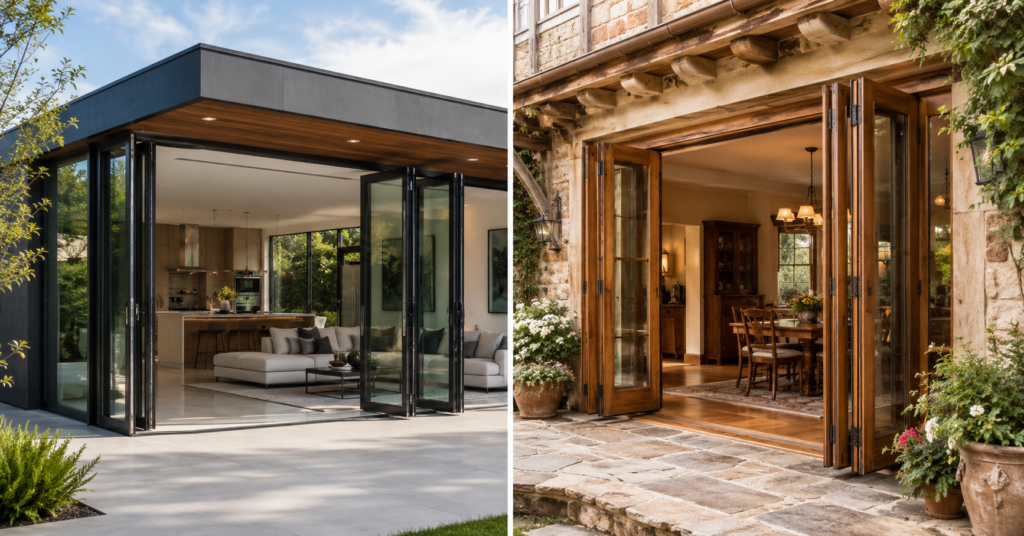
Aluminum bifold doors are built for modern architecture. Their slim frames, expansive glass panels, and clean geometric profiles look exactly right in contemporary and modern homes, open-plan new builds, mid-century modern properties, minimalist interiors, and homes with industrial or urban aesthetic elements.
In these settings, aluminum bifold doors don’t just fit. They enhance. The slim sightlines maximize glass area and reinforce the clean-line aesthetic that modern homes are designed around.
Wood: Best Home Styles
Wood bifold doors carry warmth and character that aluminum can’t replicate. They belong in traditional and colonial homes, craftsman and bungalow properties, farmhouse and rustic interiors, Victorian and period homes, and any space where natural warmth and texture are the design priority.
Putting aluminum bifold doors in a Victorian farmhouse feels jarring. Putting wood bifold doors in a glass-and-steel modern home feels equally out of place. Material and architecture should reinforce each other, not fight each other.
For a complete overview of how door styles match different home architectures, the comparison between a bifold door vs French door covers the style compatibility question in full detail across both door types.
The Third Option Nobody Mentions: Wood-Clad Aluminum
What Is Wood-Clad Aluminum?
Here’s the option that solves the aluminum vs wood bifold door debate for homeowners who want the best of both materials. Most articles never mention it.
Wood-clad aluminum bifold doors have an aluminum structural core and frame on the exterior side. That aluminum handles weather resistance, structural strength, and low maintenance. On the interior side, there is a real wood veneer or cladding that delivers the warmth, texture, and aesthetic of natural timber inside the home.
Outside, the door performs like aluminum. Inside, it looks like wood.
Who Should Consider It?
Wood-clad aluminum makes strong sense if you have a traditional or period home interior but want exterior durability. It also works well if you live in a demanding climate but don’t want industrial aluminum aesthetics inside the house. These systems typically cost $6,000 to $14,000 installed. If you want interior warmth without the exterior maintenance commitment and are willing to pay the premium, this hybrid option genuinely delivers.
It’s not for everyone. The cost premium is real. But if you’ve been going back and forth between aluminum and wood and neither feels quite right, this option often resolves the tension completely.
Environmental Impact: Which Material Is Greener?
Aluminum’s Recyclability Advantage
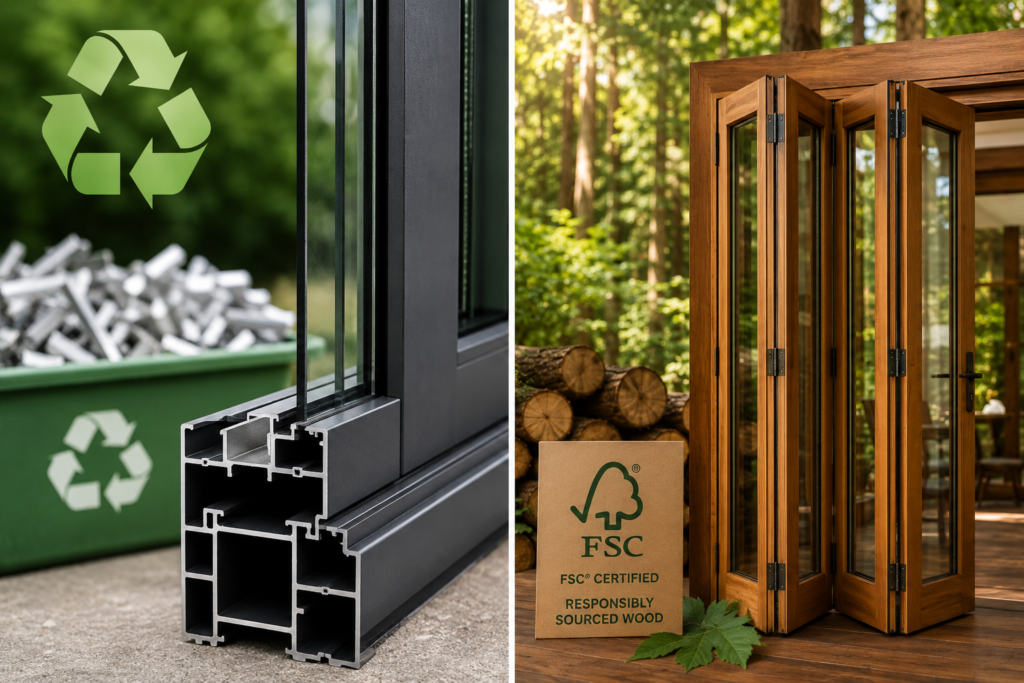
Aluminum is one of the most recyclable materials on earth. About 70% of all aluminum ever produced is still in use today. It can be recycled indefinitely without losing quality or strength. Recycling aluminum uses only 5% of the energy required to produce it from raw materials. An aluminum bifold door that reaches the end of its life doesn’t go to a landfill because the frame material has real recovery value.
One caveat worth knowing: producing virgin aluminum is energy-intensive. If your aluminum door is made from recycled aluminum, which most quality manufacturers now use, the environmental footprint drops dramatically.
Wood’s Renewable Material Advantage
Wood is a renewable resource. Trees grow back, and responsibly managed forests can be harvested sustainably without net environmental loss. A wood bifold door from certified sustainable sources has a low carbon footprint and stores carbon within the material for its entire lifespan.
The catch is that not all wood is sustainably sourced. Irresponsible logging contributes to deforestation and biodiversity loss. Before buying a wood bifold door, look for Forest Stewardship Council (FSC) certification. FSC is the globally recognized standard that verifies wood comes from responsibly managed forests. FSC-certified wood genuinely earns the environmental credentials that wood marketing claims.
Winner: Tie. Both materials have legitimate environmental credentials when sourced responsibly.
Bifold Door Sizes and Panel Count
Once you’ve locked in your material choice, the next two decisions are sizing and panel configuration. They’re closely connected. Getting the panel counts right for your specific opening width affects how both aluminum and wood systems perform long-term. Wider individual panels put more stress on hinges regardless of material, and that stress compounds faster in wood systems as the door ages.
The complete bifold door sizes guide gives you the full chart plus a step-by-step measuring guide to use before you talk to any installer. And if you’re still deciding between panel configurations, the comparison of 3 panel vs 4 panel bifold doors walks through exactly which setup works best at different opening widths in both aluminum and wood.
Final Verdict: Aluminum vs Wood Bifold Door
Choose Aluminum If…
- Your bifold door is exterior, opening to a patio, garden, or deck
- You live in a humid, wet, or extreme climate (Gulf Coast, Northeast, Pacific Northwest, Desert Southwest)
- You want a door that needs minimal maintenance over its lifetime
- Your home is modern, contemporary, or open-plan in style
- You’re thinking long-term about the total cost of ownership over 20 or more years
- You want maximum glass area and slim sightlines
Choose Wood If…
- Your bifold door is interior, for a closet, pantry, or room divider
- Your home is traditional, farmhouse, craftsman, or period in style
- Budget is a genuine constraint, and upfront cost matters more than long-term savings
- You live in a moderate climate and are committed to regular maintenance
- Natural aesthetics and warmth matter more to you than performance metrics
- You’re environmentally motivated and sourcing FSC-certified timber
And if you genuinely can’t decide between the two, the wood-clad aluminum hybrid is worth the premium. It’s the option that makes both compromises disappear.
Frequently Asked Questions
Q: Is aluminum or wood better for exterior bifold doors?
A: Aluminum is the better choice for exterior bifold doors in most US climates. It resists moisture, warping, UV damage, and freeze-thaw cycles without requiring the intensive maintenance schedule that exterior wood doors demand. The higher upfront cost is offset by significantly lower long-term maintenance expenses and a longer reliable lifespan.
Q: How long do wood bifold doors last compared to aluminum?
A: Aluminum bifold doors last 30 to 45 years with minimal maintenance. Wood bifold doors can last 20 to 40 years, but only with consistent upkeep, including annual inspection, regular refinishing, and immediate attention to any finish failure. Neglected exterior wood bifold doors can begin deteriorating in as few as 5 to 7 years in demanding climates.
Q: Are wood bifold doors cheaper than aluminum?
A: Wood bifold doors have a lower upfront purchase price, especially for interior applications. For exterior doors, though, the long-term cost of maintenance, including refinishing, resealing, and occasional repairs, can add $3,000 to $6,000 over 20 years, erasing the initial cost advantage. Aluminum costs more upfront but significantly less over the life of the door.
Q: Can wood bifold doors be used outside?
A: Yes, but with important conditions. Exterior wood bifold doors require high-quality hardwood like oak, mahogany, or accoya, premium exterior-grade finishes, and a serious commitment to annual maintenance. In humid, wet, or extreme climates, they are a demanding long-term choice. In moderate climates with a diligent homeowner, they perform well and look beautiful.
Q: What is wood-clad aluminum, and is it worth the cost?
A: Wood-clad aluminum bifold doors have an aluminum exterior frame for weather resistance and a real wood interior cladding for warmth and aesthetics. They deliver the best of both materials at a cost of $6,000 to $14,000 installed. Worth the premium if you’ve been torn between materials and want a door that satisfies both requirements without compromise.
Still deciding between aluminum and wood for a specific space? Drop your opening size, home style, and climate in the comments, and we’ll help you work through the right choice.

Samreen Khadim Hussain is a home improvement writer and content creator at Domelite Home. She specializes in making home renovation, interior design, and bathroom safety accessible to everyday US homeowners, turning technical subjects into clear, actionable advice. Her work is rooted in research, real-world practicality, and a genuine belief that a better home is within everyone’s reach.
1 thought on “Aluminum vs Wood Bifold Door: Which Is Worth Buying?”