
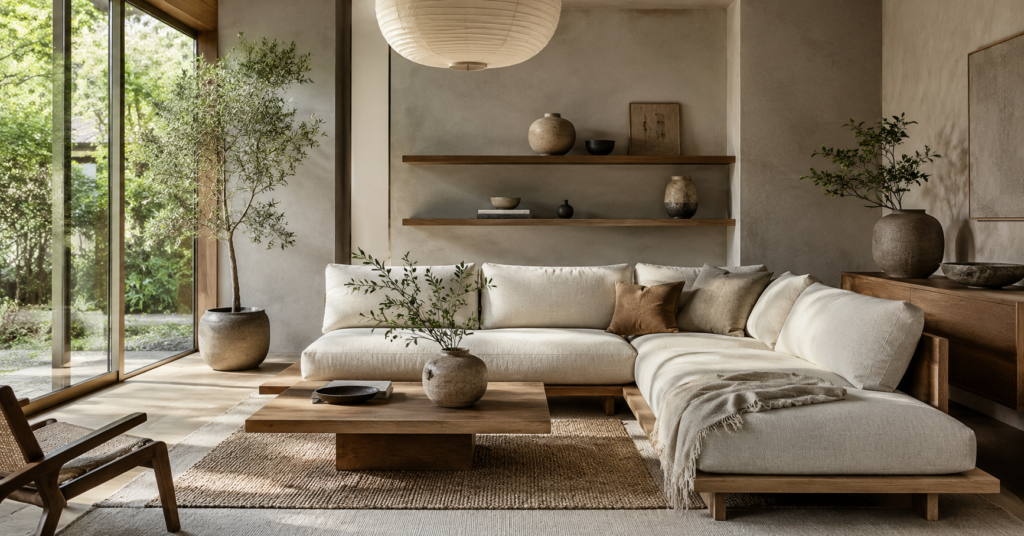
Quick Answer: Japandi interior design blends Japanese wabi-sabi philosophy with Scandinavian hygge to create spaces that are minimal but warm, calm but lived-in. The core elements are natural materials like oak, linen, and stone, a palette of warm neutrals anchored by one or two deeper earthy tones, low furniture with honest craftsmanship, and deliberate space. A light refresh costs $400 to $1,000. A full living room makeover costs around $4,500 to $9,500 mid-range.
You have seen it in every interior design feature this year. The low oak sofa. The undyed linen cushions, the single ceramic bowl on a clean shelf. The warm, slightly imperfect quality of everything in the room makes it feel lived-in rather than staged.
That is Japandi. And if you have been scrolling past it thinking it looks peaceful but wondering whether you could actually live in it, the answer for most people is yes, more easily than you might expect.
Japandi is not strict minimalism. It is not a showroom. It is not cold. At its best, it is the design equivalent of a long exhale, a space that looks simple on the surface but feels genuinely restorative to spend time in. Getting there is about subtraction as much as addition, and understanding the philosophy behind the aesthetic, not just copying the look.
This guide covers everything: the philosophy, the palette, the materials, the key pieces, how to apply it room by room, and what 2026’s evolution of the style actually looks like in real US homes.
What Japandi Interior Design Actually Is
Japandi is a portmanteau of Japanese and Scandi. It emerged as a named style around 2017 to 2019, but the design principles it draws from are centuries old.
At its core, Japandi is a hybrid of two philosophies that turned out to share a soul: Japanese minimalism and Scandinavian functionality. Both value clean lines, natural materials, and craftsmanship, and both believe a calm, uncluttered home supports a calmer life. Japandi takes the warmth and comfort of Scandinavian hygge and grounds it with the discipline and quiet of Japanese design, including the wabi-sabi idea that finds beauty in imperfect, handmade, and natural things.
The result is a room that feels intentional and serene. Low furniture. A muted natural palette. Fine craftsmanship on show. And deliberate space is treated as a design element rather than something to fill.
It is worth understanding both philosophies to get the balance right.
Wabi-Sabi: The Japanese Half
Wabi-sabi is the Japanese philosophy of finding beauty in imperfection, impermanence, and incompleteness. In Japandi interiors, it means choosing handmade over machine-made, aged over pristine, and natural irregularity over uniform perfection. It is why a slightly uneven ceramic bowl or a linen cushion with visible texture feels more at home in a Japandi space than a flawless factory piece.
This philosophy directly informs the material choices in Japandi design and explains why authenticity matters so much. Japandi is about authenticity. Using faux wood or synthetic materials misses the point entirely; the textures and imperfections of real materials are not just aesthetic choices, they are the point. For a comprehensive breakdown of wabi-sabi and its role in modern interior design, the MasterClass guide to Japandi is one of the clearest explanations available for US homeowners approaching the style for the first time.
For a deeper look at how Japanese design philosophy has influenced contemporary Western architecture and interior design, Dezeen’s Japanese design coverage tracks the global influence of Japanese spatial philosophy and provides essential context at dezeen.com.
Hygge: The Scandinavian Half
Hygge (pronounced HOO-gah) is the Danish and Norwegian concept of coziness, warmth, and simple contentment. It is the reason a Japandi room never feels cold the way stark minimalism can. Soft textiles, warm lighting, comfortable seating, and a sense of being safely enclosed are all hygge contributions to the style.
The balance between these two philosophies is what makes Japandi feel different from both a Japanese Zen room and a Scandinavian living room. Japandi merges Japanese wabi-sabi with Scandinavian hygge into a design language that is simultaneously minimal and warm, spare and deeply livable.
The 2026 Evolution: What Has Changed
Japandi has moved well beyond its trend peak into something more durable. Traditional Japandi was beautiful but sometimes austere. The 2026 evolution makes three key updates: a warmer palette where greige and warm white replace cool grey and stark white, more texture where the contrast between materials is now deliberate and celebrated, and a lived-in quality where a slightly worn edge, an imperfect weave, and one personal object are not mistakes but the point. Modern Japandi in 2026 is not a showroom. It is a home that has been thoughtfully inhabited.
The other significant 2026 development is the emergence of Dark Japandi. For years, this style was synonymous with airy, light-filled spaces. Now, we are seeing a pivot toward grounded, moody interiors that offer a sense of protection and calm, often described as a cave-like sanctuary. Walnut, smoked oak, and espresso tones are becoming the standard for flooring, cabinetry, and statement furniture. Dark Japandi works particularly well in bedrooms and media rooms where a cocooning effect is desirable.
The Japandi Color Palette
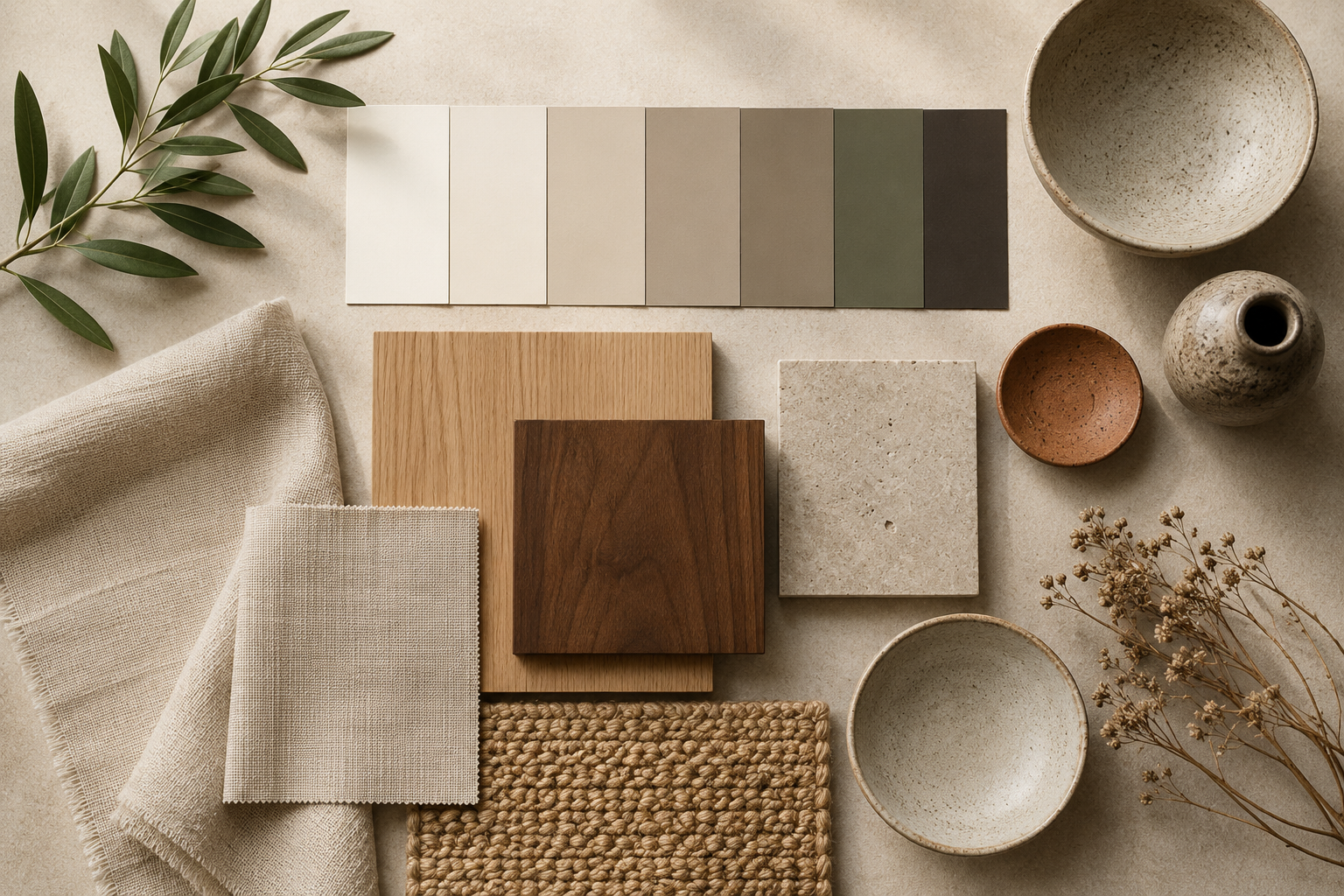
This is where most people make their first mistake. The Japandi palette is not all-white. It is not grey-on-grey. And it is not the cool, clinical grey that dominated Scandinavian interiors a few years ago.
The 2026 Japandi palette is built around warm neutrals, off-whites, warm greiges, muted taupes, soft clay tones, grounded by one or two nature-derived deeper tones used as anchors: deep forest green, dusty charcoal, raw umber, and muted terracotta.
The formula that works in most rooms is 60 percent warm neutral based on walls, large upholstered pieces, and the main rug. Then, 30 percent natural material tones in wood, stone, linen, and ceramics. Then, 10 percent deeper anchoring tones in cushions, throws, small furniture pieces, and plants.
For US homeowners, the paint names that consistently achieve this look include Benjamin Moore White Dove and Pale Oak, Sherwin-Williams Accessible Beige and Antique White, and Farrow and Ball Elephant’s Breath and Hardwick White. These are the warm, living versions of neutral, not the cool grey versions that read as clinical rather than serene.
The test that design professionals use is straightforward: hold a piece of undyed linen against your wall color. If the linen looks warmer and more golden against it, you have the right color. If it looks greyer or flatter by comparison, go warmer.
For wall color ideas that apply directly to Japandi living rooms and work alongside the furniture principles described here, the guide on living room color ideas covers specific paint names, how light direction affects color choice, and which tones work with different furniture colors.
The Core Materials of Japandi Design
If there is one thing that separates a genuine Japandi space from an imitation, it is the quality and honesty of materials. Every surface should reward touch as much as sight.
Wood
Wood serves as the structural and spiritual foundation of Japandi design, embodying both Japanese reverence for natural materials and Scandinavian craftsmanship traditions. The movement’s preference for light-toned species, oak, ash, and birch, reflects deeper cultural values about harmony with nature. These selections are not merely aesthetic choices but philosophical statements about living authentically with materials that age gracefully, developing character through use rather than deteriorating.
In 2026, darker woods are gaining ground alongside the traditional light tones. Walnut and smoked oak work beautifully in Dark Japandi spaces and ground a room in a way that light ash sometimes cannot.
Use wood honestly. Visible joinery, natural grain patterns, and slight imperfections are features in Japandi design, not defects to hide.
Linen and Natural Textiles
Undyed linen is the Japandi textile. Its texture, its slight irregularity, its way of creasing and softening with use, all of these align perfectly with wabi-sabi principles. Bouclé is the 2026 addition to the Japandi textile palette, adding tactile warmth without pattern or color.
Avoid synthetic fabrics and high-sheen materials. Cotton, wool, jute, rattan, and paper cord all belong in a Japandi space.
Stone and Ceramic
Stone surfaces, whether on countertops, floors, or decorative objects, add thermal mass and visual weight to a Japandi space. Honed finishes are preferred over polished; they have more texture, catch light differently, and align with the matte quality that defines the style.
Handmade ceramics with visible throwing marks or slight irregularities are ideal decorative objects. A single well-chosen ceramic piece on a clean shelf says more in a Japandi space than a collection of matching decorative objects.
Plants and Nature
Instead of small succulents on a shelf, designers are incorporating large indoor trees like Black Olive, Ficus Audrey, or Japanese Maple planted directly into floor beds or massive artisan pots. This scale is crucial. It makes nature a structural element of the room rather than just a decoration.
The Japanese concept of Shakkei, or borrowed scenery, is also relevant here. Windows in a Japandi home are treated as picture frames that capture specific views of the outdoors. Heavy drapes are disappearing in common areas. Window treatments now favor recessed roller blinds, or Shoji-screen inspired panels that allow diffused light to enter while maintaining privacy, without blocking the connection to the outside.
The 8 Core Rules of Japandi Design
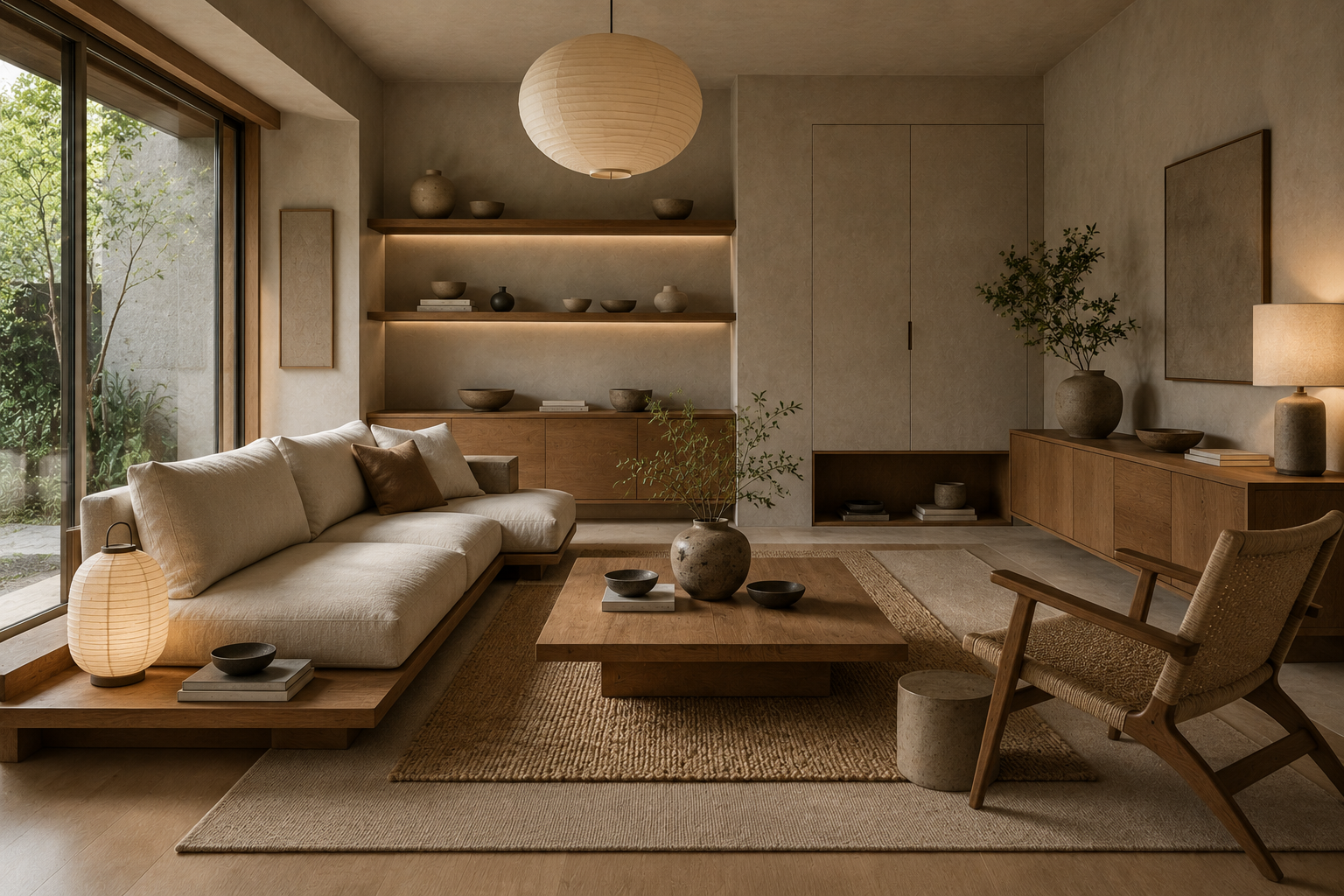
Rule 1: Start With Subtraction
Most people who achieve genuinely satisfying Japandi spaces do it through subtraction first, removing things rather than buying new ones. Before purchasing a single piece of Japandi furniture, do a radical declutter. The space you reveal is more Japandi than anything you could buy to put in it.
This is the most important rule and the most counterintuitive one for people accustomed to approaching interior design as a shopping exercise. Japandi begins with editing what you already have.
Rule 2: Choose Low Furniture
Low furniture is one of the most immediately recognizable Japandi signatures and one of the most impactful spatial decisions you can make. Low furniture at 35 to 40 centimeters makes small rooms feel larger. A sofa at standard height in a small room cuts the wall in half visually. A sofa at 35 centimeters keeps the wall visible above it, making the room feel taller and more open.
A low sofa with an exposed oak frame and linen cushions. A platform bed that sits close to the floor. A coffee table at 30 to 35 centimeters rather than the standard 45. These proportions change how a room feels to be in, not just how it photographs.
Rule 3: Show Honest Craftsmanship
Japandi celebrates visible joinery, handmade objects, and materials that show how they were made. A chair with a woven paper-cord seat, a cabinet with finger-jointed corners, a bowl with visible throwing marks, these are the objects that anchor a Japandi space.
Instead of placing a large order of furniture from a big-box store, slowly choose a few high-quality, well-made pieces with natural materials that have a specific function in the space. Japandi also focuses on artisanal, handcrafted items, so you can use this opportunity to support local furniture makers.
Rule 4: Embrace Negative Space
Empty space is a design element in Japandi, not a design failure. A single object on a shelf is not under-decorated; it is correctly decorated. The tendency to fill every surface is the single habit most at odds with genuine Japandi design.
The discipline is real. Every object in a Japandi space carries more visual weight precisely because there is less of everything. That means objects need to earn their place.
Rule 5: Layer Texture, Not Color or Pattern
Japandi gets its visual interest from the contrast between textures rather than from color variation or pattern. A jute rug under a linen sofa beside an oak table with a rough ceramic bowl, each material has a distinct texture that creates interest without visual complexity.
Texture is the secret. Layer a jute rug with a soft wool rug. Use linen curtains that pool slightly on the floor. Add soft lighting at eye level rather than overhead. The richness comes from touch as much as sight.
Rule 6: Warm, Layered Lighting
Overhead lighting only is one of the most common mistakes in any interior, and it is particularly damaging to a Japandi space. Japandi focuses on natural materials, lighting, and subtle comfort.
The approach is to layer multiple light sources at different heights: table lamps, floor lamps, paper lantern pendants, and candles for the evenings. The goal is pools of warm light rather than uniform illumination. A rice-paper or bamboo pendant shade that diffuses light softly rather than directing it sharply is a Japandi staple.
Rule 7: Edit Your Objects Ruthlessly
Every decorative object in a Japandi space should pass a test: is it beautiful, is it functional, or is it both? Purely decorative objects without being exceptionally beautiful, handmade, or personally meaningful do not belong.
This is not about having nothing. It is about the quality and intention behind what you keep. One extraordinary ceramic piece says more than fifteen ordinary ones. A single branch of dried botanicals in a handmade vase is more Japandi than a full shelf of varied objects.
Rule 8: Use Functional Storage That Disappears
Japandi requires concealed storage for the rooms to function in real life. Hidden stations and closed storage that keep surfaces clear are essential. The 2026 Japandi kitchen features hidden stations with breakfast bars and coffee stations hidden behind pocket doors, so the counters remain clear.
Built-in cabinetry with handleless fronts, storage ottomans, low credenzas with closed doors, and under-bed storage all allow a Japandi space to actually function for a household while maintaining its visual calm.
Japandi Room by Room
Living Room
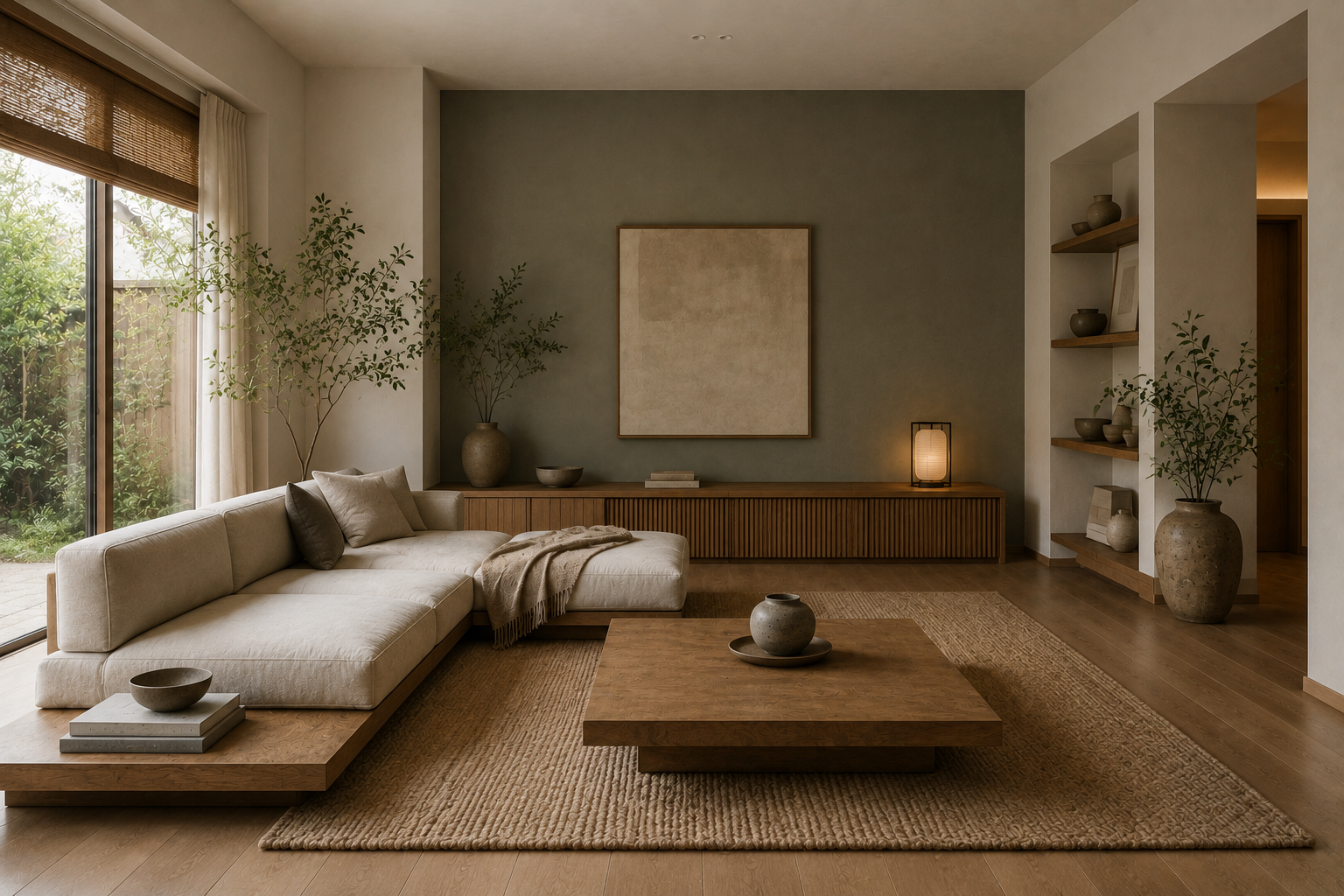
The living room is the room where most people start their Japandi journey and the room where the principles are most visible.
The anchor piece is the sofa. Choose a low profile with an exposed natural frame, oak or walnut, and upholstery in undyed linen, warm bouclé, or a muted greige fabric. The sofa should look like it belongs on the floor rather than hovering above it.
The coffee table should be low, around 30 to 35 centimeters, in natural wood or stone. One ceramic object on its surface. Nothing more.
The rug defines the seating zone. Natural fiber rugs in jute, sisal, or wool in a flat weave or low pile keep the floor visually grounded without adding pattern.
The wall treatment matters. The Japandi palette lives in a precise middle ground. Off-white or warm greige on the walls, not pure white and not grey. One wall in a slightly deeper anchoring tone, sage or dusty charcoal, is the 2026 approach.
A Japandi living room is one of the quietest environments you can create, and quiet does not mean silent. The acoustic quality of a room matters. Soft textiles, rugs, and upholstered furniture absorb sound and reduce the hard reflections that make a room feel harsh. For homeowners who want to take the acoustic quality further alongside their Japandi design work, this guide on how to soundproof a room cheaply covers the renter and owner-friendly options that add acoustic comfort without construction.
Bedroom
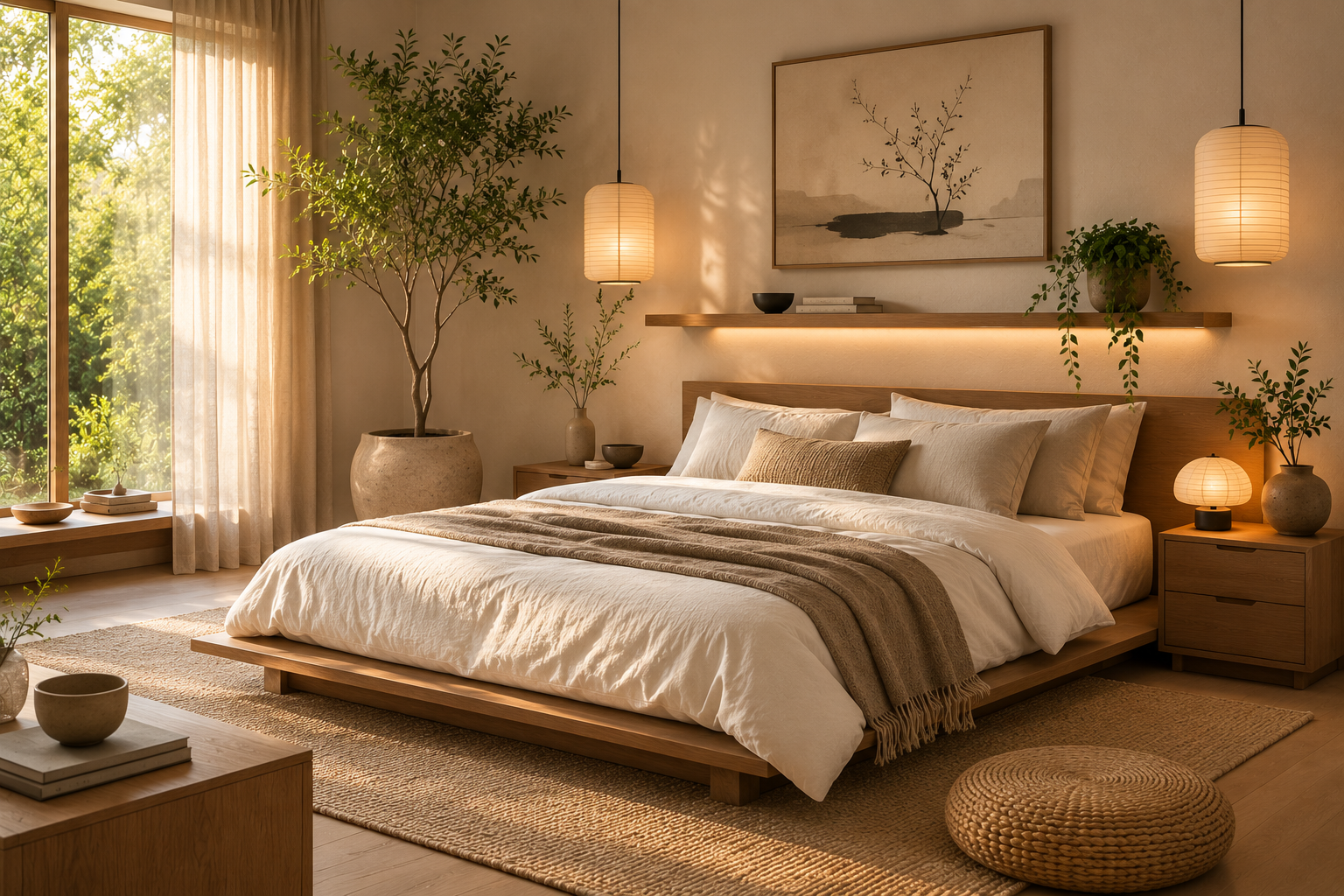
The bedroom is the most critical space for the Japandi transition. Many are moving away from bulky bed frames in favor of low-profile sleeping arrangements. A platform bed or a bed frame that sits 25 to 35 centimeters from the floor changes the entire proportion of the room.
White linen bedding, a simple wooden bedside table with nothing on it but a single lamp, and a woven rug beside the bed are the bedroom essentials. The bedroom is where Dark Japandi makes the most sense, a slightly moodier palette that encourages sleep rather than stimulation.
Avoid multiple decorative pillows, ornamental headboards, and elaborate bedding layers. The bed should look like a place of rest, not a display.
Kitchen
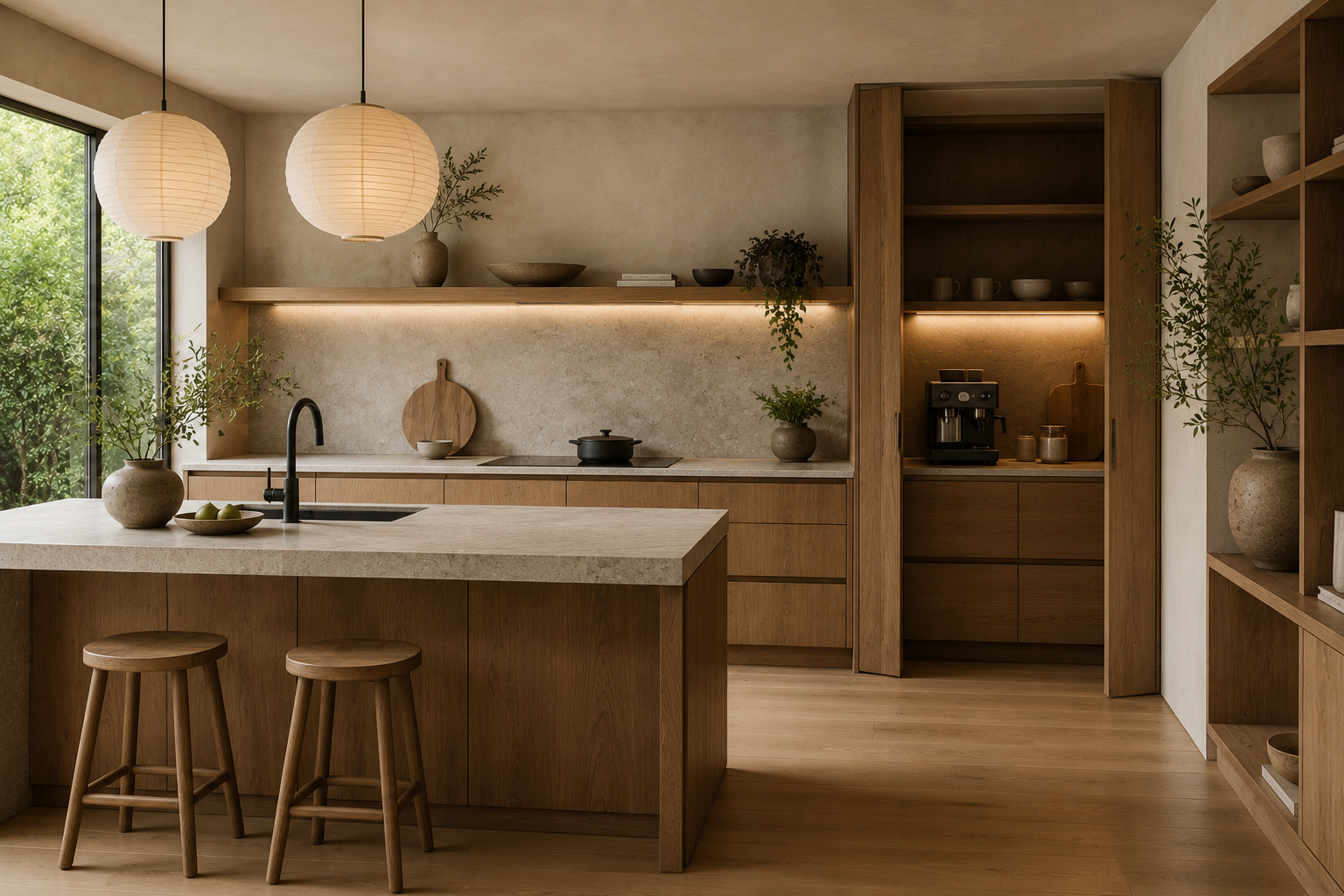
The 2026 Japandi kitchen features matte cabinetry in warm wood tones rather than high-gloss white, paired with honed granite or concrete-look quartz countertops. Hidden stations keep coffee bars and breakfast setups behind pocket doors so surfaces remain clear.
Handleless cabinet fronts in natural wood veneer, a farmhouse or undermount stone sink, open shelving for a small number of beautiful everyday objects, and pendant lights in rice paper or metal with a warm finish complete the picture.
The floor matters here, too. Natural wood or large-format stone tile in a honed finish keeps the material palette consistent. For homeowners considering distinctive flooring options that work in Japandi adjacent styles, this guide on checkerboard floor ideas covers the pattern and material combinations that work in organic and minimal interiors.
Bathroom
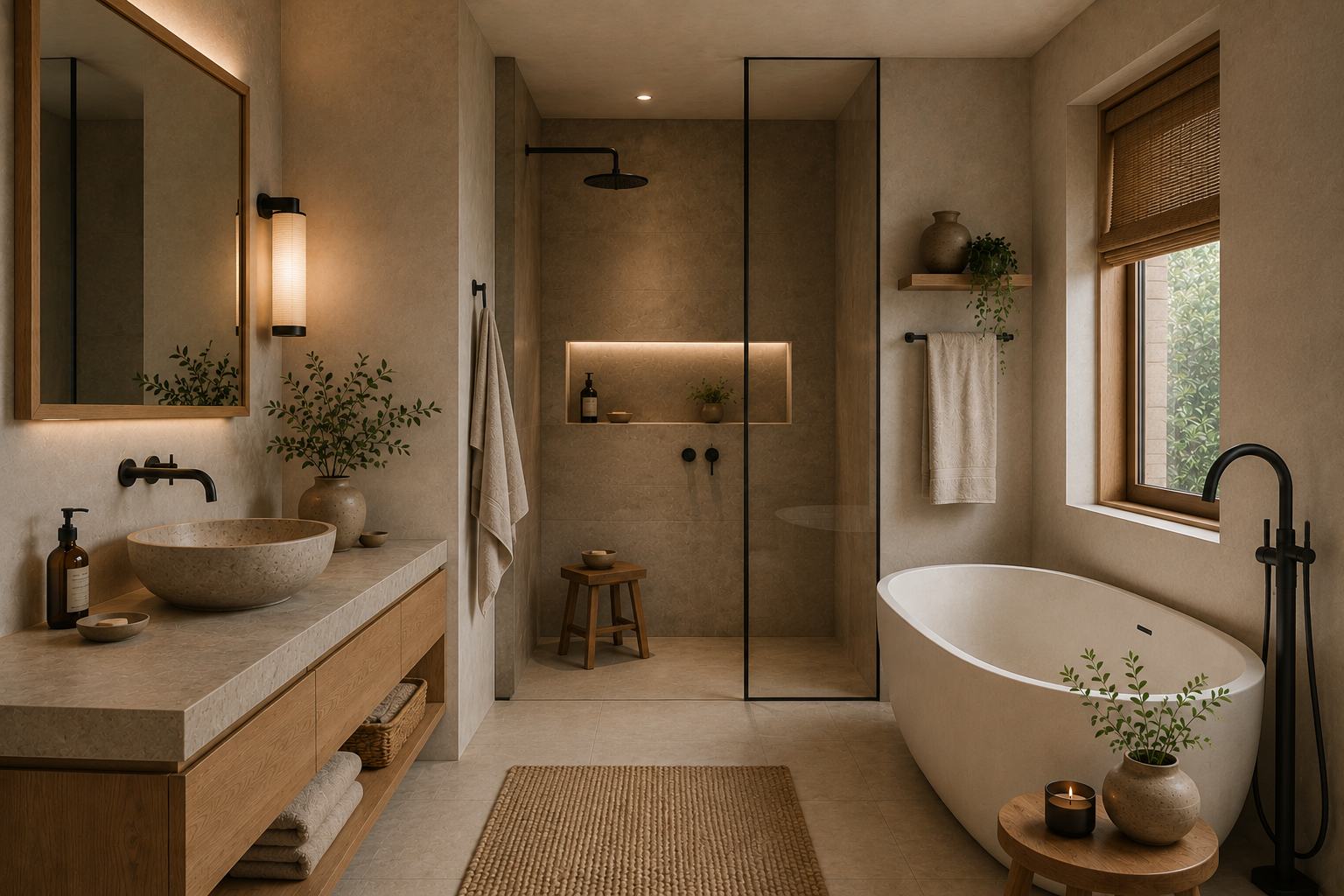
The goal is to transform the bathroom into a wet room if possible. Use large-format tiles that mimic stone to reduce grout lines. A floating vanity in dark wood with a stone vessel sink creates that luxury spa aesthetic.
Warm ambient lighting rather than harsh overhead strips, a wooden bath mat, undyed linen towels, and a single plant in an artisan pot complete the Japandi bathroom.
What Real Japandi Costs in 2026
Japandi sits in the mid-to-higher range, because the look depends on a few well-made, natural pieces rather than many cheap ones, and quality craftsmanship costs. A light refresh runs $400 to $1,000. A fuller living room makeover costs around $4,500 to $9,500 mid-range.
The spending is concentrated and intentional rather than spread across many objects. Here is where the money goes:
| Item | Budget Range | Mid-Range |
| Low sofa with natural frame | $800 to $1,200 | $1,500 to $3,000 |
| Coffee table (oak or stone) | $200 to $400 | $500 to $1,200 |
| Natural fiber rug | $150 to $400 | $500 to $1,500 |
| Linen curtains | $100 to $200 | $300 to $600 |
| Bedside tables (pair) | $150 to $300 | $400 to $800 |
| Handmade ceramics and objects | $100 to $300 | $300 to $600 |
| Paint (walls and trim) | $200 to $400 | $400 to $800 |
Where to save: textiles, ceramics, plants, and decluttering. Space costs nothing and does more than any object you could buy.
Where to spend: the sofa and one or two key wood pieces. These are the honest, well-made objects the whole calm room is built around. Compromising here is the most common reason a Japandi attempt looks like a budget imitation rather than the real thing.
For budget-conscious homeowners who want to maximize the impact of their Japandi refresh without overspending, the guide on home renovation tips and money-saving tricks covers how to sequence decorating decisions for maximum visual impact at a controlled cost.
For validated product picks and real-home case studies showing Japandi executed at different budget levels, Architectural Digest covers Japandi extensively with real home case studies, designer interviews, and product picks that show authentic Japandi at every budget level at architecturaldigest.com.
Japandi vs Minimalism vs Scandinavian: What Is the Difference
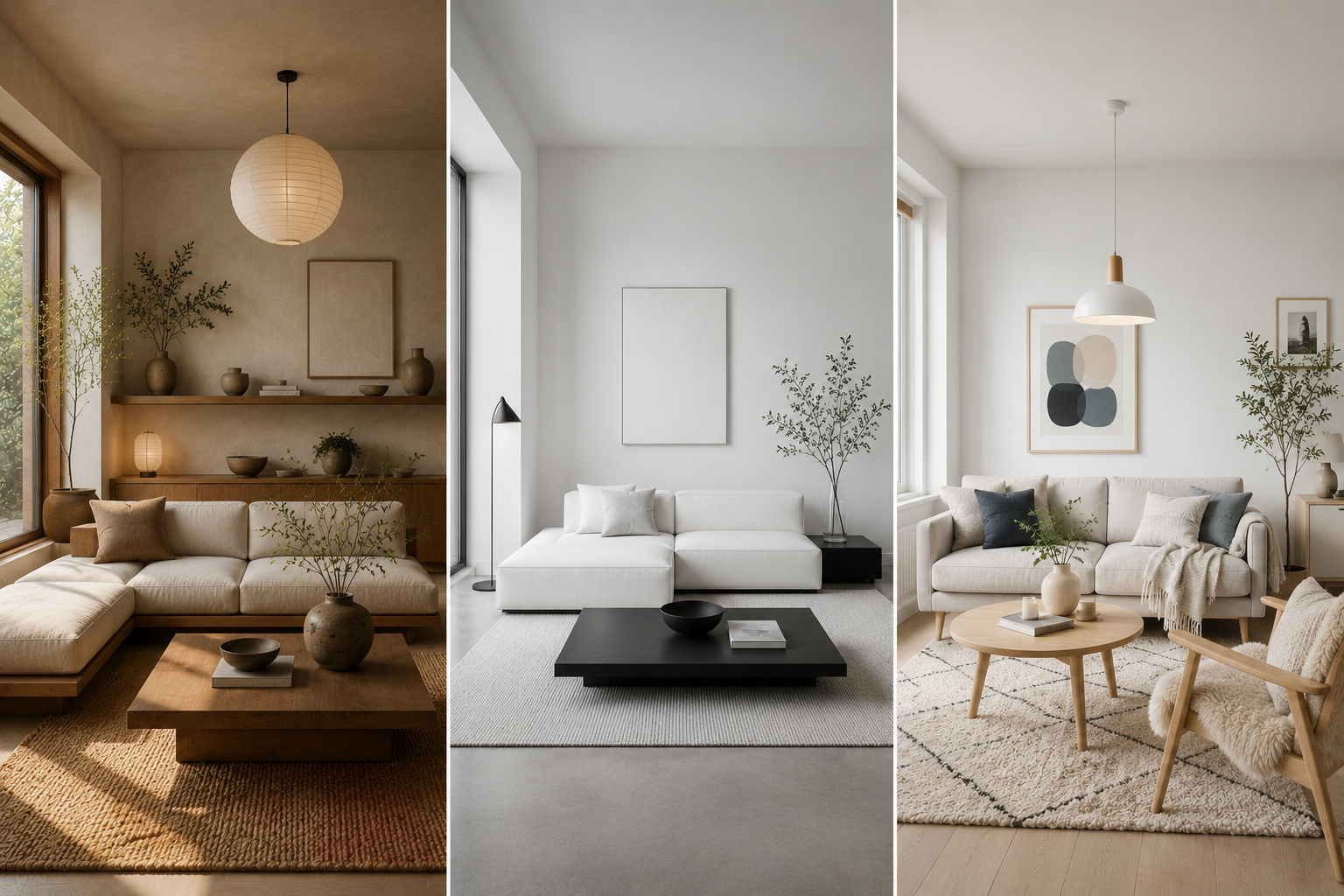
| Style | Palette | Warmth | Philosophy | Feel |
| Japandi | Warm neutrals, earthy anchors | High | Wabi-sabi plus hygge | Calm and livable |
| Minimalism | Cool, stark, often white | Low | Reduction as ideal | Clean but cold |
| Scandinavian | Soft pastels, cool whites | Medium | Hygge, functionality | Cozy but lighter |
| Japanese | Earth tones, dark accents | Medium | Wabi-sabi, ma (negative space) | Serene and contemplative |
Japandi is the warmest and most livable of the minimal-adjacent styles because it combines the warmth directive of Scandinavian design with the restraint discipline of Japanese design. It is harder to execute than maximalism precisely because every object carries more visual weight when there is less of everything.
Common Japandi Mistakes to Avoid
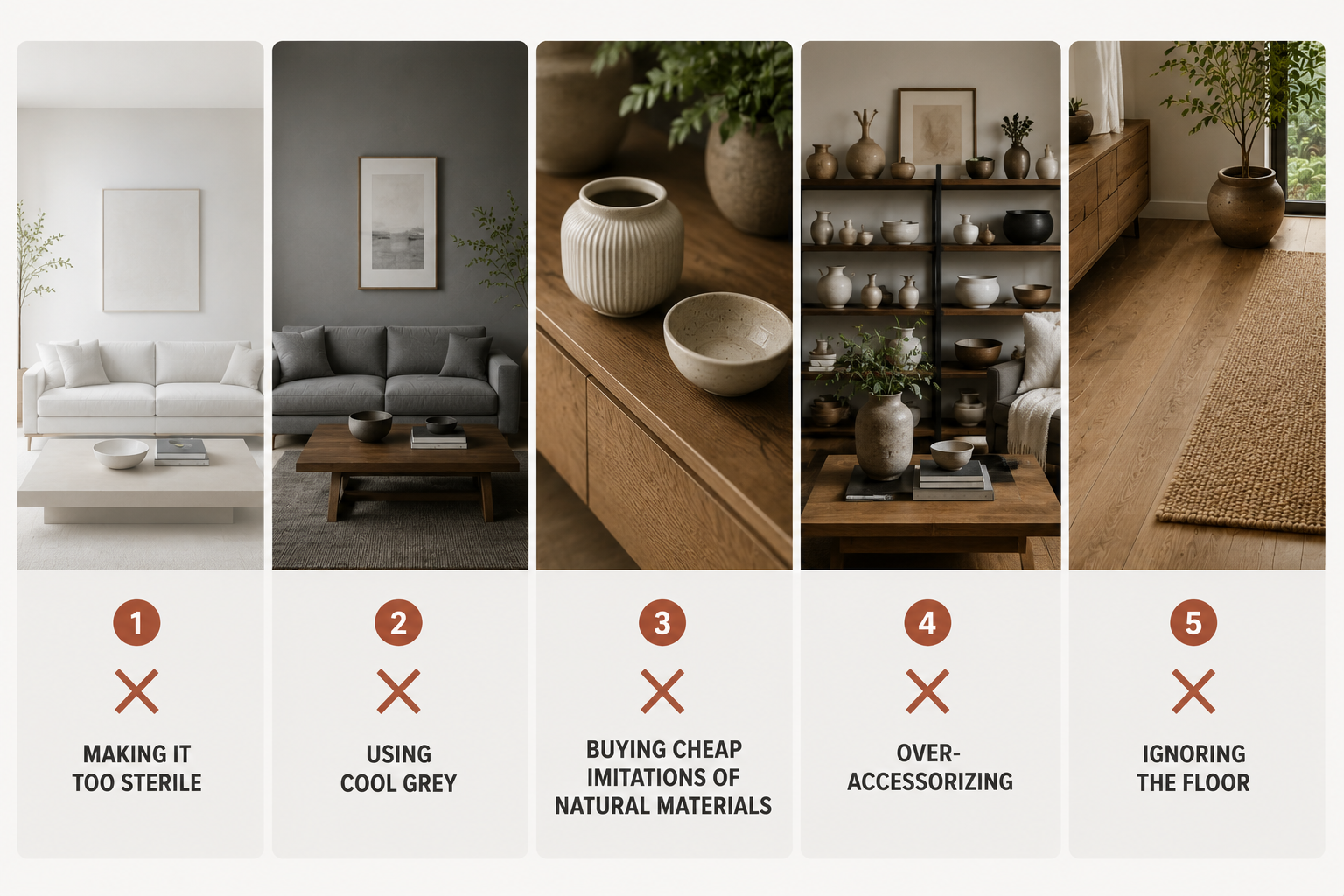
Making it too sterile. Minimalism does not mean emptiness. You must add warmth through texture, rugs, throws, and wood grain. A room with nothing in it is not Japandi. It is just empty.
Using cool grey. The Japandi palette is warm, not cool. Cool grey walls with natural wood furniture create a clash that reads as corporate rather than serene.
Buying cheap imitations of natural materials. Faux wood, synthetic linen, and machine-perfect ceramics all undermine the philosophy. The imperfection and texture of real materials are the point, not a secondary concern.
Over-accessorizing. More objects do not equal more Japandi. The discipline of choosing fewer, better things is what defines the style. If you are adding, you should also be subtracting.
Ignoring the floor. The floor is one of the largest surfaces in any room and is foundational to a Japandi space. Natural wood, stone, or concrete with a natural fiber rug sitting on it sets the material tone for everything above.
Frequently Asked Questions
Q: Is Japandi interior design still relevant in 2026?
A: More than ever. In 2026, Japandi has gone fully mainstream and is leaning warmer and more tactile: deeper earthy tones, more visible craftsmanship, soft curved forms, and a stronger wabi-sabi embrace of handmade imperfection. It has moved beyond trend into a genuine design philosophy that works across apartment sizes, ownership status, and budgets.
Q: What is the difference between Japandi and minimalism?
A: Minimalism pursues the absolute reduction of all elements and can feel cold and impersonal. Japandi is warmer, more human, and more livable than strict minimalism. It uses restraint in the number of objects but compensates with richness in texture, natural materials, and the deliberate warmth of wood, linen, and organic forms.
Q: How do I start a Japandi interior on a budget?
A: Start by subtracting. Declutter before you buy anything. The space you reveal may already be closer to Japandi than you realize. Then focus your spending on one quality textile like an undyed linen cushion cover or a natural fiber rug, one handmade ceramic object, and the right wall color. These three changes alone shift a room significantly toward the Japandi aesthetic without a major investment.
Q: What colors work best for Japandi walls?
A: Warm greige and off-white are the safest starting points. Benjamin Moore Pale Oak, Sherwin-Williams Accessible Beige, and Farrow and Ball Elephant’s Breath are consistently recommended for Japandi spaces. Avoid cool grey and stark white; both fight the natural material warmth that defines the style. One wall in a deeper earthy anchor tone, sage green, dusty charcoal, or raw umber, is the 2026 approach.
Q: Can Japandi work in a small apartment?
A: Japandi is arguably the most effective design style for small apartments because its two core spatial principles, low furniture and negative space, both make small rooms feel larger. The low furniture keeps walls visible, negative space prevents visual crowding, and the warm neutral palette prevents the room from feeling smaller. Japandi is genuinely better suited to small spaces than most other design styles.
Trying to apply Japandi principles to a specific room and not sure where to start? Drop your room dimensions, current furniture, and biggest challenge in the comments, and we will help you figure out the right approach.

Samreen Khadim Hussain is a home improvement writer and content creator at Domelite Home. She specializes in making home renovation, interior design, and bathroom safety accessible to everyday US homeowners, turning technical subjects into clear, actionable advice. Her work is rooted in research, real-world practicality, and a genuine belief that a better home is within everyone’s reach.
Hmm is anyone else encountering problems with the pictures on this
blog loading? I’m trying to figure out if its a problem on my end or if
it’s the blog. Any feed-back would be greatly appreciated.
Thank you for letting us know. We haven’t received any similar reports so far, but we’ll check the images on our side to make sure everything is working properly. If we find any issues, we’ll get them resolved. We appreciate your feedback!