
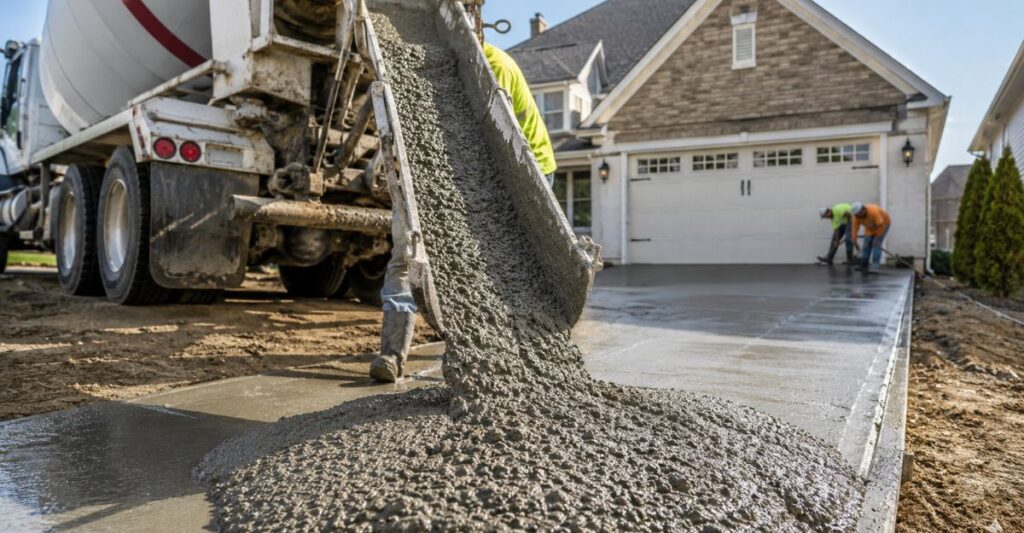
Quick answer: Ready-mix concrete typically costs $110 to $165 per cubic yard for material in 2026, with most residential homeowners paying around $125 to $150 per yard delivered for a standard 3,000 to 3,500 PSI mix. Industry-wide figures that include commercial and high-strength pours run higher, often quoted near $160 to $180 per yard, a distinction that explains most of the confusion you’ll run into while researching this.
If you’ve gotten a few quotes back and they don’t match what you read online, you’re not being overcharged and you’re not misreading anything. Concrete pricing is one of the more genuinely inconsistent numbers in home improvement, because “price per yard” gets reported differently depending on who’s measuring it and what they’re including.
This guide walks through what actually sets your price per yard, what full projects cost once labor and finishing are added, how bagged concrete compares, how pricing shifts by region and season, and how to read a quote so delivery fees and short-load surcharges don’t catch you off guard. It’s built for homeowners planning a driveway or patio, DIYers pricing a smaller pour, and contractors who want a quick reference to sanity-check supplier quotes.
Cost Summary Box
- National average material cost: $110 to $165 per cubic yard
- Typical residential range: $125 to $150 per yard
- Installed cost (material plus labor): $6 to $18 per square foot
- Standard truckload (10 yards): $1,100 to $1,650
- Short-load fee (under supplier minimum): $40 to $110
- Full cure time: 28 days (walkable in 24 to 48 hours)
How Concrete Is Actually Priced
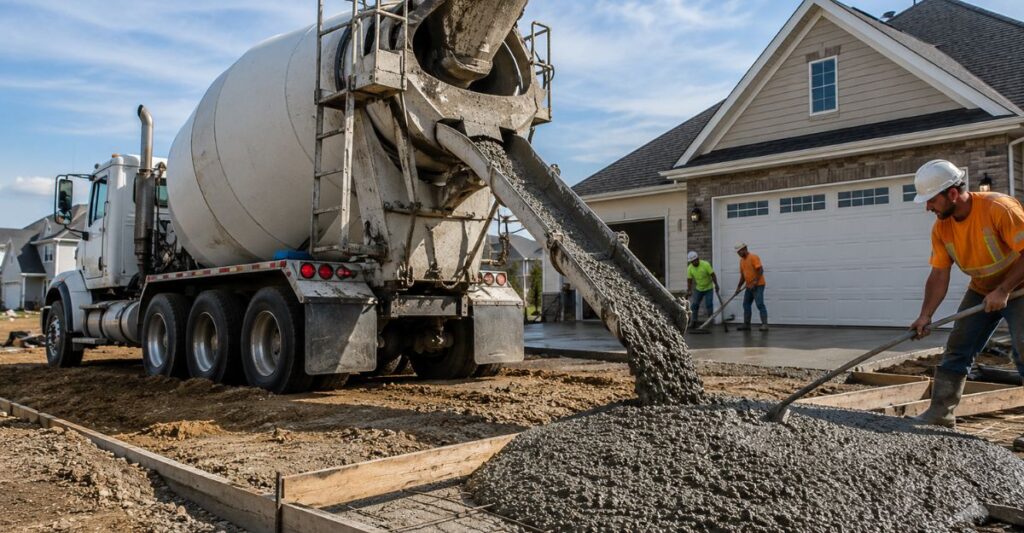
Before getting into numbers, it helps to understand what you’re paying for. Ready-mix concrete is a mixture of cement, water, sand, and coarse aggregate (gravel or crushed stone) batched at a plant and delivered by truck in a semi-liquid state, ready to pour. Production and quality standards for this process are governed by ASTM International’s ASTM C94 specification, which sets the technical baseline most U.S. batch plants follow for mixing, delivery time, and slump consistency.
You’re not buying a shelf product. You’re buying a custom mix, made to order, delivered on a schedule, with pricing built around volume, strength, and logistics. That’s the core reason concrete pricing looks so different from lumber or drywall. A 2×4 costs the same whether you buy one or fifty. A cubic yard of concrete can cost dramatically more or less per unit depending on how much you order, how far the truck has to drive, and what strength you specify.
Concrete Price Per Yard by PSI (Compressive Strength)
| Concrete Mix | Price Per Cubic Yard (Material Only) | Typical Use |
| 2,500 to 3,000 PSI | $110 to $135 | Walkways, light patios, shed pads |
| 3,000 to 3,500 PSI | $120 to $150 | Standard driveways, garage slabs |
| 3,500 to 4,000 PSI | $135 to $165 | Structural slabs, colder climates, freeze-thaw regions |
| 4,000+ PSI | $150 to $195+ | Foundations, footings, RV pads, commercial and industrial work |

PSI (pounds per square inch) measures how much compressive force the cured concrete can withstand. It’s the single biggest driver of your per-yard price, because higher-PSI mixes require more cement relative to aggregate, and cement is the most expensive ingredient in the mix by a wide margin. Structural design guidance for PSI selection generally follows standards published by the American Concrete Institute (ACI), particularly ACI 318, which engineers and contractors use to determine minimum strength requirements for footings, foundations, and slabs.
These prices reflect material delivered within a standard 20-mile radius of the batch plant. They do not include labor, forms, rebar or wire mesh reinforcement, subbase preparation, or finishing work, all of which are quoted separately and typically add $100 to $300 or more per yard once installed.
Direct answer: How much is concrete per yard? Expect $110 to $165 per cubic yard for standard residential mixes in 2026, with $125 to $150 being the most common range homeowners actually pay.
Why Published Averages Disagree by $50 or More
This is worth addressing directly, because it’s the single biggest source of confusion in concrete pricing content online.
The National Ready Mixed Concrete Association (NRMCA) tracks a national, volume-weighted average price that has landed in the $160 to $180 per cubic yard range in recent industry reporting. That number is accurate for what it measures, but it’s weighted heavily toward large commercial and infrastructure pours, which make up the bulk of the industry’s total shipped volume and typically use higher-strength, higher-cost mixes with specialized additives.
Contractor-facing cost guides, the kind homeowners actually search for, report a different, lower figure, usually $110 to $165 per yard, because they’re describing what residential customers pay for standard driveway and patio-grade mixes.
Direct answer: Why are concrete prices different across sources? Because they measure different things. NRMCA reports an industry-wide, volume-weighted average dominated by commercial work. Consumer cost guides report what homeowners pay for standard residential mixes. Neither is wrong, they’re answering different questions.
If a contractor quotes you close to $180 per yard for a standard patio, it’s worth asking directly what’s driving that. It may be a delivery distance charge, a small-load surcharge, or simply operating in a higher-cost regional market, rather than the base material price itself.
Regional Concrete Price Differences
Concrete is heavy, expensive to transport long distances, and produced at local batch plants rather than shipped nationally the way lumber or steel often is. That makes regional pricing swings real and worth planning for, not just a rounding error.
| Region or Market Type | Typical Price Range Per Yard | Why |
| Major Northeast metros (Boston, NYC) | $160 to $195+ | High labor costs, dense permitting, higher demand |
| West Coast metros (SF Bay Area, LA) | $150 to $190 | High labor and land costs, strict environmental compliance |
| Midwest (Ohio, Indiana, Illinois) | $115 to $150 | Lower labor costs, strong plant density |
| Southeast (Georgia, Florida, Carolinas) | $110 to $145 | Lower cost of living, competitive local supply |
| Mountain West and rural areas | $120 to $160 | Lower demand but higher delivery distances |
| Texas (major metros) | $115 to $150 | Large market with strong competition among suppliers |
Important caveat: these ranges are directional planning figures based on published 2026 industry and contractor-survey data, not live pricing. Concrete costs shift with local fuel prices, cement availability, and seasonal demand, so always confirm with at least two local suppliers before budgeting a project around these numbers.
Direct answer: Is concrete cheaper in some states than others? Yes. Southeastern and Midwest states generally see lower per-yard pricing than dense Northeast and West Coast metros, largely due to labor cost and permitting differences, not the concrete itself.
What Determines Your Price Per Yard
1. PSI and Mix Design
Match the PSI to the actual job. A backyard patio doesn’t need foundation-grade concrete, and specifying higher strength than the project requires is one of the most common ways homeowners overpay without realizing it.
2. Order Size and Short-Load Fees
A standard ready-mix truck carries roughly 10 cubic yards. Most suppliers set a minimum order, commonly 3 to 6 yards, and orders below that threshold trigger a short-load fee.
Quick Fact: Short-load fees typically run $40 to $110 flat, or roughly $50 per yard under the plant’s minimum order.
Example: A small 3-yard patio pour at a plant with a 6-yard minimum could add $150 or more in short-load fees alone, sometimes 20 to 30 percent on top of the material cost. If you have a second small concrete task on the property (a walkway, a fence post footing, a mailbox pad), combining orders into one delivery is one of the most reliable ways to avoid this fee entirely.
Direct answer: Can I save money by ordering more concrete at once? Yes. Combining smaller pours into a single order that meets or exceeds the plant’s minimum truckload avoids short-load fees and often lowers your effective price per yard.
3. Delivery Distance
Batch plants typically include a free delivery radius, often around 20 miles. Beyond that, expect a per-mile charge, commonly $2 to $10 per mile depending on the supplier and region. Rural properties farther from a plant should factor this into their budget before comparing quotes from different suppliers.
Direct answer: How does delivery affect concrete cost? Most plants include free delivery within about 20 miles. Beyond that radius, expect a per-mile surcharge, typically $2 to $10 per mile, added on top of material cost.
4. Regional Market Conditions
Covered in detail above. Local labor rates, plant density, and demand all shift the base price meaningfully.
5. Season and Scheduling
Spring and summer are peak pouring season across most of the country, meaning higher demand, tighter scheduling, and occasionally less room to negotiate. Cooler months can bring better availability and sometimes softer pricing, though cold-weather mixes with accelerants or heated curing blankets can offset part of that savings in climates where winter pours are even feasible.
Direct answer: When is concrete cheapest? Late fall and winter, where climate allows pouring, often bring lower demand and more scheduling flexibility. Spring and summer see the highest demand and least pricing flexibility.
6. Additives and Finish Type
Fiber reinforcement, air entrainment, coloring, and stamping all add cost on top of the base mix. Air entrainment, microscopic air bubbles mixed into the concrete, is not optional in most freeze-thaw climates. It’s what allows the slab to survive repeated freezing and thawing without cracking. Guidance on when air entrainment is required generally follows recommendations from the Portland Cement Association (PCA) and regional building codes. If a contractor is quoting an unusually low price on a driveway in a northern climate, confirm the mix includes air entrainment before assuming you found a bargain.
Contractor Warning: A quote that skips air entrainment in a freeze-thaw climate might look cheaper today, but the slab can start spalling and cracking within a few winters. This is one of the most common corners cut by lower-cost, less experienced crews.
Expert Tip: Ask for the Mix Design Sheet
Every batch plant can provide a mix design sheet showing the PSI, air content, slump (a measure of workability), and aggregate size for your specific order. Homeowners rarely ask for this, but it’s the single best way to confirm you’re actually getting what you’re paying for, and it gives you a document to reference if a slab underperforms later.
Concrete Yield and Coverage: How Much Do You Actually Need
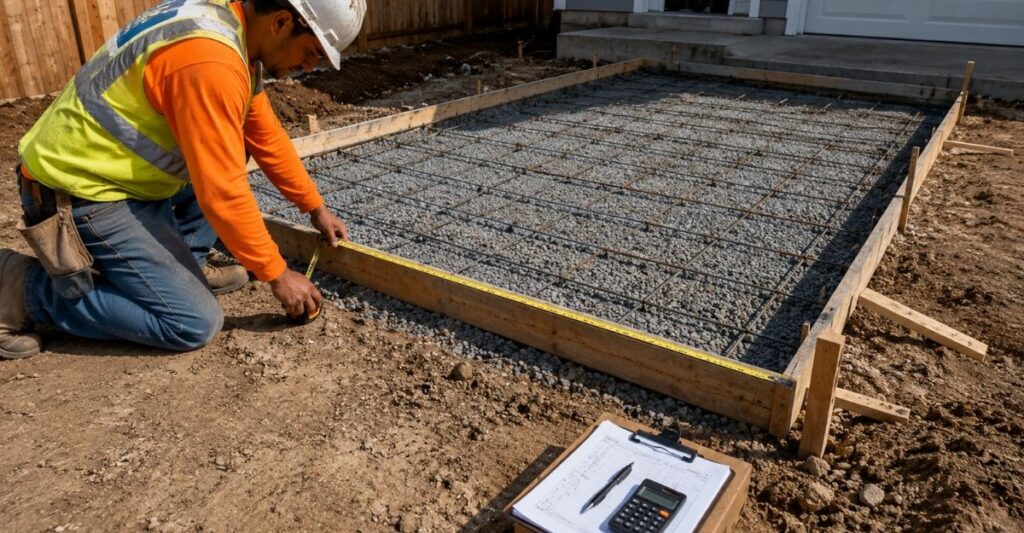
One of the most common and expensive mistakes homeowners make is misjudging yardage. Concrete yield depends on the thickness of the pour, not just the surface area.
| Slab Thickness | Coverage Per Cubic Yard |
| 4 inches | about 81 square feet |
| 5 inches | about 65 square feet |
| 6 inches | about 54 square feet |
| 8 inches | about 40 square feet |
Direct answer: How much concrete do I need? Multiply length in feet by width in feet by thickness in feet, then divide by 27, the number of cubic feet in a cubic yard. A standard 4-inch slab is 0.33 feet thick.
How to Calculate Concrete Yardage, Step by Step
- Measure the length and width of your project area in feet.
- Multiply length by width to get the square footage.
- Convert your planned thickness from inches to feet by dividing by 12.
- Multiply the square footage by the thickness in feet to get cubic feet.
- Divide the total cubic feet by 27 to get cubic yards.
- Add a 5 to 10 percent buffer for spillage and uneven subgrade before placing your order.
Real-world example: a 20 by 20 patio at 4 inches thick. 20 times 20 times 0.33, divided by 27, equals approximately 5.9 cubic yards. At $125 to $150 per yard, that’s roughly $740 to $885 in material alone, before labor, forms, and finishing.
Direct answer: How much does a 20×20 slab cost? Material alone typically runs $740 to $885 based on 2026 average pricing. Fully installed with labor and finishing, expect $2,400 to $7,200 depending on finish type and site conditions.
Always round up and add that 5 to 10 percent buffer for spillage, uneven subgrade, and minor measurement error. Running short mid-pour means either an expensive emergency short-load delivery or a cold joint where two pours meet, which weakens the slab structurally.
What a Full Concrete Project Actually Costs
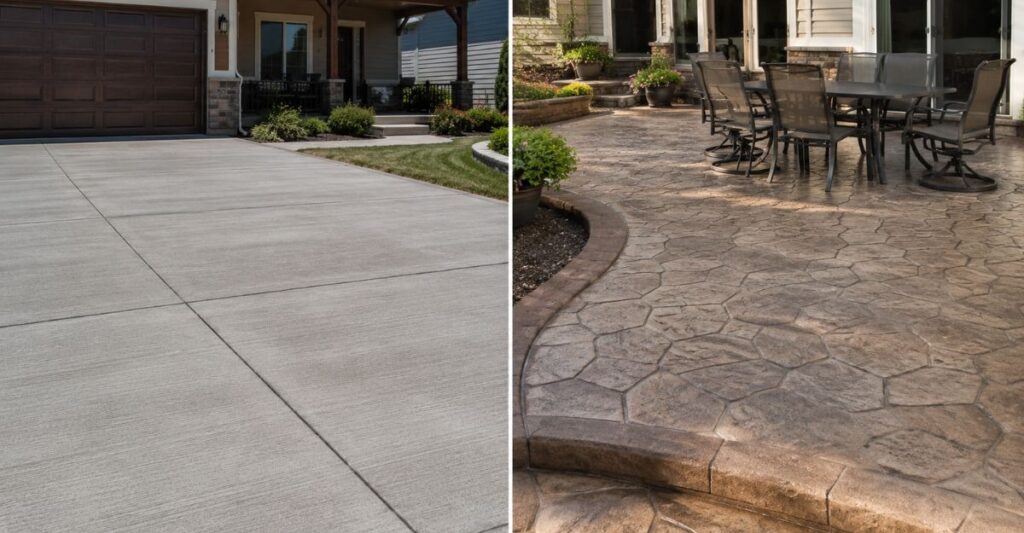
Price per yard is only half the picture. The number that actually matters for your budget is installed cost, meaning material plus labor, forms, subbase, and finishing.
| Project | Typical Installed Cost | Notes |
| Plain broom-finish slab | $6 to $10 per sq ft | Most common residential finish |
| Stamped or colored concrete | $8 to $18 per sq ft | Decorative finishes add significant labor cost |
| Standard sidewalk (20 ft) | $255 to $320 total | Small footprint, may trigger short-load minimums |
| 2-car driveway or garage slab | $1,060 to $1,270 total | Standard 3,000 to 3,500 PSI mix |
| 10×15 shed pad, 4 inch | $1,160 to $1,190 total | Roughly 2.2 cubic yards needed |
| 20×20 patio slab, 4 inch | $850 to $1,100 (material only) | Requires about 5.5 to 5.9 cubic yards |
| Full basement foundation | $4,500 to $17,000+ total | Varies enormously by size, depth, and soil conditions |
If a driveway or patio pour is part of a broader push to boost your home’s resale value, it’s worth weighing against lower-cost curb-appeal upgrades. We break down where concrete work ranks against cheaper options in our guide to cheap ways to increase home value.
Hidden Costs Buyers Often Forget
Beyond the price per yard, several add-on costs catch first-time buyers off guard:
- Subbase and gravel prep. A compacted gravel base is required under most slabs and is rarely included in a bare price-per-yard figure.
- Rebar or wire mesh reinforcement. Required for driveways and most structural slabs, priced separately from the concrete itself.
- Forms. The wooden or metal edging that shapes the pour, a labor and material cost most DIYers underestimate.
- Control joints. Cuts made in the slab to control where cracking occurs. Skipping these is a common amateur mistake.
- Sealing. Recommended within the first year and every 2 to 3 years after, typically $0.50 to $2 per square foot.
- Permit fees. Covered in more detail below, and easy to forget when budgeting only the concrete itself.
- Demolition and haul-away. If you’re replacing an old slab, removal and disposal can add $2 to $6 per square foot before the new pour even starts.
Ready-Mix vs. Bagged Concrete: Full Comparison
| Factor | Bagged Concrete | Ready-Mix (Delivered) |
| Best for | Under 1 cubic yard | 1+ cubic yards |
| Cost per yard equivalent | Often higher per yard at volume | $110 to $165 per yard |
| Labor | High, manual mixing | Low, pumped or chuted directly |
| Consistency | Variable batch to batch | Consistent, engineered mix |
| Delivery | Self-transport | Delivered to site |
| Best use cases | Post footings, small repairs | Driveways, patios, slabs, foundations |
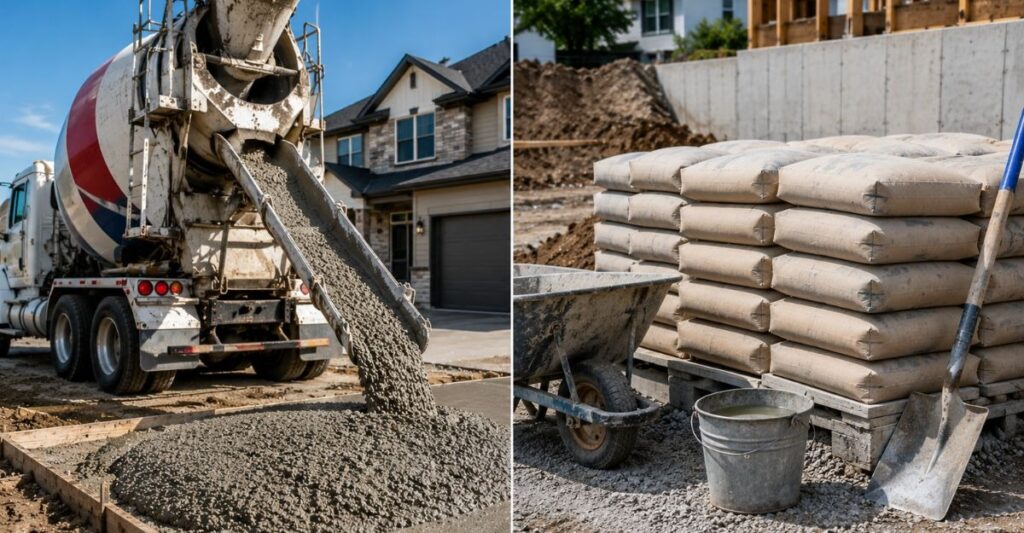
For small jobs, a mailbox post, a handful of stepping stones, a single fence post footing, bagged concrete from a hardware store is usually both cheaper and far more practical than ordering a ready-mix delivery. An 80 lb bag covers roughly 0.6 cubic feet and typically costs $6 to $7.
Direct answer: How many bags equal one cubic yard? It takes approximately 45 bags of 80 lb concrete mix to make one cubic yard.
Direct answer: Is ready-mix worth it? For any project over about 1 to 1.5 cubic yards, yes. Ready-mix almost always costs less per yard and requires far less physical labor than mixing dozens of bags by hand.
As a rule of thumb:
- Under 1 cubic yard: bagged concrete is almost always more practical.
- 1 to 2 cubic yards: it’s close, compare actual local bag prices against your nearest plant’s short-load fee.
- Over 2 cubic yards: ready-mix wins on cost and labor in nearly every case.
Concrete vs. Other Paving Materials
| Material | Installed Cost | Lifespan | Maintenance |
| Plain concrete | $6 to $10 per sq ft | 25 to 30+ years | Occasional sealing |
| Stamped or decorative concrete | $8 to $18 per sq ft | 25+ years | Periodic resealing |
| Asphalt | $4 to $8 per sq ft | 15 to 20 years | Resealing every 2 to 3 years |
| Pavers | $10 to $24 per sq ft | 25 to 50 years | Individual units replaceable |
| Gravel | $1 to $3 per sq ft | Ongoing, needs replenishing | Regular regrading |
Concrete sits in a middle ground. It’s more expensive upfront than asphalt or gravel, but has lower long-term maintenance than asphalt, and is generally cheaper than pavers while lacking their ability to be repaired one unit at a time. If a single paver cracks, you replace it. If a section of a concrete slab cracks, repair usually means patching or, in worse cases, replacing the whole section.
How to Read a Concrete Quote Without Getting Surprised
A trustworthy quote itemizes each of these separately rather than bundling everything into one number:
- Material cost per yard, based on PSI.
- Delivery fee, and whether your address falls inside or outside the free radius.
- Short-load fee, if your order is under the plant’s minimum.
- Fuel surcharge, increasingly standard, usually $10 to $30 per load, tied to diesel prices.
- Waiting time charges, most trucks allow about 45 minutes to unload before per-minute fees apply, often $3 to $5 per minute.
- Labor and finishing, quoted separately from material.
If a supplier or contractor gives you a single lump-sum number with no breakdown, ask for the itemized version before signing anything. It’s the fastest way to identify whether a quote is fair or whether undisclosed fees are being folded into the total.
Concrete work is often just one component of a larger DIY project. If you’re planning a backyard build involving a paver or concrete base, our DIY outdoor shower guide walks through a comparable real-world cost breakdown for a smaller pour, including drainage and permitting considerations that apply to concrete work too.
Contractor Pricing Tips
- Get at least three itemized quotes, not verbal estimates, before committing to a supplier or crew.
- Ask what PSI and mix design you’re actually paying for, not just a total dollar figure.
- Confirm whether subbase prep, forms, and reinforcement are included or billed separately. This is where quotes that look identical on the surface can differ by hundreds of dollars.
- Ask about the plant’s minimum order and short-load fee before finalizing your yardage.
- Request the mix design sheet for your order, especially on driveways and structural slabs.
- Confirm air entrainment is included if you’re in a freeze-thaw climate.
Money-Saving Strategies
- Right-size your PSI. Don’t pay for foundation-grade strength on a patio.
- Combine small pours into one delivery to clear the minimum order and avoid short-load fees.
- Time your project for the off-season where your climate allows it, when demand and sometimes pricing softens.
- Do your own subbase prep if you’re comfortable with the physical labor. This is one of the larger labor line items on a typical quote.
- Compare local suppliers directly rather than relying only on national average figures. Regional competition can meaningfully affect what you’re quoted.
- Ask about will-call or self-haul options for very small jobs where a full delivery isn’t cost-effective.
Concrete Ordering Checklist
Use this before calling a supplier:
- Measure the project area (length by width) precisely.
- Confirm your intended slab thickness (4 inches for patios and walkways, 6 inches for driveways is common).
- Calculate cubic yardage using the formula above, and add a 5 to 10 percent buffer.
- Decide on required PSI based on end use (patio, driveway, foundation).
- Confirm whether your climate requires air entrainment.
- Ask whether your order meets the plant’s minimum, or budget for a short-load fee.
- Confirm your property’s distance from the plant to anticipate delivery charges.
- Check whether a permit is required in your municipality.
- Request an itemized quote covering material, delivery, and any surcharges.
- Schedule around weather. Avoid pours immediately before heavy rain or hard freezes.
Buying Checklist: Questions to Ask Before You Order
- What PSI is included in this quote?
- Is air entrainment included, and is it required in my area?
- What is your delivery radius, and what’s the per-mile charge beyond it?
- What is your minimum order, and what’s the short-load fee if I’m under it?
- Are fuel surcharges included or added separately?
- How much unloading time is included before waiting fees apply?
- Can you provide a mix design sheet for this order?
- Is subbase prep, reinforcement, and finishing included, or billed separately?
Common Ordering Mistakes That Drive Up Costs
- Ordering the wrong PSI. Specifying foundation-grade concrete for a patio adds cost with no functional benefit.
- Underestimating yardage. Running short mid-pour risks a cold joint and an expensive emergency delivery.
- Skipping the mix design sheet. Without it, there’s no way to confirm you got what you paid for.
- Ignoring subbase prep. A poorly compacted base is the single most common cause of cracking, and redoing a cracked slab costs far more than proper prep would have.
- Not asking about air entrainment in cold climates. Skipping it to save a small amount per yard can shorten a driveway’s lifespan by years in freeze-thaw regions.
- Comparing quotes without confirming scope. A cheaper number sometimes means a lower PSI, no rebar, or excluded finishing. Always compare like-for-like.
- Forgetting permit requirements. Pouring without a required permit can create problems at resale or during a future home inspection.
Frequently Asked Questions About Concrete Price Per Yard
How much is a yard of concrete in 2026?
A cubic yard of ready-mix concrete typically costs $110 to $165 for material, with most homeowners paying around $125 to $150 per yard delivered for a standard 3,000 to 3,500 PSI mix. Industry-wide averages that include commercial and high-strength mixes run higher, often closer to $160 to $180 per yard.
How many square feet does a yard of concrete cover?
At a standard 4-inch thickness, one cubic yard covers about 81 square feet. At 6 inches thick, common for driveways expecting heavier vehicle loads, one yard covers roughly 54 square feet.
Is it cheaper to buy concrete in bags or by the yard?
For anything over roughly 1 to 1.5 cubic yards, ready-mix delivered by the yard is almost always cheaper than bagged concrete, both in material cost and labor. Bagged concrete only makes financial sense for small jobs like post footings, small repairs, or projects under a cubic yard.
Why do concrete price estimates vary so much between sources?
Different organizations measure different things. Contractor-facing cost guides report what residential customers actually pay for standard mixes, while industry bodies like the NRMCA report a volume-weighted national average that includes large commercial and infrastructure pours using higher-strength, higher-cost mixes.
What’s a short-load fee, and can I avoid it?
A short-load fee applies when your order falls below a supplier’s minimum truckload, typically 3 to 6 cubic yards. It’s usually $40 to $110 flat, or about $50 per yard under the minimum. The most reliable way to avoid it is ordering at or above the plant’s stated minimum, or combining a small pour with a larger one if you have more than one concrete task planned.
Does concrete cost more in winter?
It depends on your region. Areas that pour year-round sometimes see slightly lower demand and better scheduling in winter. In colder climates, cold-weather additives and heated curing measures can add cost even if base material pricing dips slightly during the off-season.
How long does poured concrete take to cure before it can be used?
Concrete typically reaches enough strength to walk on within 24 to 48 hours, but full cure, the point at which it reaches its rated PSI strength, takes about 28 days. Driveways generally shouldn’t handle vehicle weight until at least 7 days after the pour, and manufacturer or engineer guidance should always take priority over general rules of thumb.
Do I need a permit to pour a concrete driveway or patio?
In most U.S. municipalities, yes, particularly for driveways, since they typically involve grading, drainage considerations, and sometimes proximity to property lines or utility easements. Requirements vary significantly by city and county, so checking with your local building department before scheduling a pour is worth the extra step.
What’s the difference between concrete and cement?
Cement is one ingredient within concrete, essentially the binding powder that reacts with water to hold the mix together. Concrete is the finished material: cement, water, sand, and aggregate combined. People often use the two terms interchangeably, but a “price per yard” always refers to finished concrete, not raw cement.
Bottom Line on Concrete Price Per Yard
There isn’t a single honest answer to how much concrete costs per yard. It’s a range shaped by PSI, order size, delivery distance, region, and season. For most residential projects in 2026, plan on $125 to $150 per cubic yard for material, and always request an itemized quote so delivery, short-load, and fuel surcharges aren’t buried inside one number.
If you’re budgeting a driveway, patio, or slab as part of a larger renovation, it’s worth weighing concrete against your other home improvement priorities. It’s durable, low-maintenance, and holds up for decades, but it’s rarely the cheapest square-foot option on its own, so it earns its place best when longevity matters more than upfront cost.
For the official industry-wide production and pricing data referenced in this guide, see the National Ready Mixed Concrete Association.

I started Domelite Home because I got tired of home improvement advice that was either too vague or written by people who had never actually picked up a drill. I’m Naik Zali Shah I’ve spent years obsessing over renovation projects, smart home setups, and interior design, and I built this site to share what actually works. No fluff, no filler. Just honest advice for homeowners who want to get things right the first time.