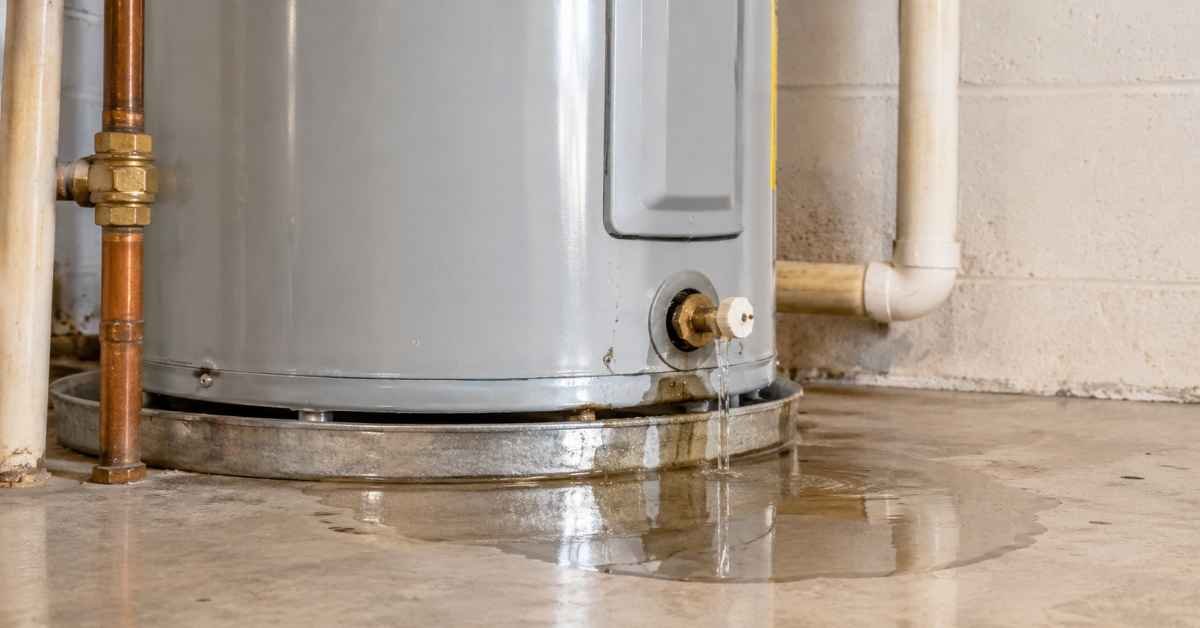
Quick Answer: A water heater leaking from bottom can be caused by a faulty drain valve, a corroded tank, a leaking temperature and pressure (T&P) relief valve, loose plumbing connections, condensation, a damaged heating element gasket, or a nearby pipe leak. Some problems can be repaired, but a tank that has corroded through usually needs replacement. Turn off the heater safely if water is leaking near electrical or gas components, and identify the source before attempting repairs.
What to Do First When Your Water Heater Leaking From Bottom
Water around the base of a water heater should never be ignored. Even a small leak can damage nearby flooring, walls, and stored belongings if it continues.
Before trying to identify the cause, take these precautions:
- Keep away from standing water near electrical components. If water is reaching the electrical connections or controls, do not touch the heater. Switch off its circuit breaker only if you can safely reach a dry electrical panel.
- Shut off the water supply. If the leak is active, close the cold-water supply valve leading to the heater, provided it is safely accessible.
- Turn off the heat source safely. For an electric heater, use the appropriate breaker. For a gas model, follow the manufacturer’s shutdown instructions if the controls are safely accessible. If you smell gas, leave the area and contact your gas utility or emergency service.
- Keep children and pets away. Water escaping from a heater can be hot enough to cause burns.
- Avoid opening the heater. Do not remove access panels, insulation, or covers to look for a leak unless you are qualified to service the equipment.
If water is spraying, flooding the area, or coming from a pressure-relief discharge pipe, contact a qualified plumber promptly.
7 Common Causes of a Water Heater Leaking From Bottom
Finding water underneath a water heater does not automatically mean the storage tank has failed. Water can travel down the outside of the unit from a connection or valve located higher up.
According to A. O. Smith’s water heater troubleshooting guide, water pooling around a heater can result from condensation, a leaking drain valve, a faulty T&P relief valve, plumbing connections, damaged heating element gaskets, or a leaking tank.
Here are seven possible causes and what homeowners should know about each one.
1. A Leaking or Loose Drain Valve
The drain valve is usually located near the bottom of a tank-style water heater. It allows homeowners or plumbing professionals to empty the tank during maintenance.
Over time, the valve can become loose, worn, or unable to close completely. A damaged washer or internal valve component can also allow water to escape.
Common signs:
- Water appears near the small outlet at the bottom of the heater.
- You notice occasional dripping from the drain valve.
- The leak becomes noticeable after flushing or draining the tank.
How to fix it:
If the valve is only slightly loose, check the manufacturer’s instructions before attempting any adjustment. Avoid forcing or overtightening it, particularly if it has a plastic body.
A worn or damaged drain valve may need replacement. This usually requires shutting off the water supply, cooling and draining the tank, and installing a suitable replacement.
Because the tank contains hot water and remains connected to the plumbing system, have a plumber handle the repair if you are unfamiliar with the procedure.
2. A Corroded or Damaged Water Heater Tank

A leaking storage tank is one of the most serious possible causes.
Traditional tank water heaters contain a steel storage vessel with a protective interior lining. Over time, corrosion can weaken the tank. Once the metal develops a hole or crack, water can escape through the tank body or bottom seam.
Common signs:
- Water appears to come directly through the tank’s outer casing.
- Rust-colored water or corrosion is visible around the lower section.
- The leak continues even after checking accessible valves and connections.
- Water collects underneath the unit without an obvious external fitting leak.
How to fix it:
Unfortunately, a tank that has corroded through generally cannot be repaired safely.
Sealants, epoxy, waterproof tape, and similar products are not reliable solutions for a leaking pressurized water heater tank.
In this situation, replacing the entire water heater is usually necessary.
A plumber can confirm whether the tank itself has failed or whether water is coming from a replaceable component.
3. A Leaking Temperature and Pressure Relief (T&P) Valve
The temperature and pressure relief valve is an important safety component. It releases water when the temperature or pressure inside the tank becomes too high.
Although this valve is normally installed near the top or side of a water heater, its discharge pipe often extends downward toward the floor.
As a result, water released from the valve can collect near the bottom of the heater and look like a tank leak.
Common signs:
- Water appears near the end of the discharge pipe.
- You notice intermittent dripping or continuous water flow.
- The leak becomes noticeable while the heater is heating water.
- Water appears to come from a pipe rather than directly through the tank.
How to fix it:
A leaking T&P valve should not automatically be replaced without checking why it is releasing water.
Possible causes include excessive water pressure, thermal expansion, overheating, or a defective valve.
A qualified plumber can test the system, identify the cause, and replace the valve if necessary.
Important: Never cap, plug, or block the T&P valve or its discharge pipe. Doing so can prevent the heater from releasing dangerous pressure.
4. Loose or Leaking Water Supply Connections
Water heaters have cold-water inlet and hot-water outlet connections that allow water to enter and leave the tank.
These connections can loosen, deteriorate, or develop leaks over time.
Even when the leak starts near the top of the heater, water can travel down the outer surface and collect underneath.
Common signs:
- Moisture appears around the upper pipe connections.
- Water runs down the side of the heater.
- Corrosion or mineral deposits appear around fittings.
- The floor becomes wet even though the drain valve looks dry.
How to fix it:
First, identify whether water is coming from a pipe connection, fitting, or nearby plumbing component.
A plumber may need to tighten or replace the affected fitting, connector, or section of pipe.
Avoid tightening corroded or damaged connections yourself. Excessive force can make the leak worse or damage the fitting.
5. Condensation Around the Water Heater

Not every water heater is actually leaking.
Condensation can form when cold incoming water meets warmer, humid air around the tank or its pipes.
This is particularly noticeable when the heater has recently been filled, during periods of high humidity, or after a large amount of hot water has been used.
On some gas models, water vapor from combustion can also condense on cooler surfaces during startup.
Common signs:
- Small water droplets appear on the tank or nearby pipes.
- Moisture develops after the heater has been running or refilled.
- The tank and connections do not show an obvious leak.
- The moisture decreases once the heater reaches its normal operating temperature.
How to fix it:
Allow the heater to operate normally if there is no sign of an actual leak or other unsafe condition.
Dry the surrounding area and monitor it for new moisture.
If water continues collecting, condensation should not be assumed to be the cause. Have a plumber inspect the unit and its connections.
6. A Damaged Heating Element Gasket (Electric Water Heaters)
Electric tank water heaters contain heating elements that warm the stored water.
These elements fit into openings in the tank and use gaskets to prevent water from escaping.
Over time, a gasket can deteriorate, become loose, or fail. Water may then leak around the heating element and run down the outside of the heater.
Common signs:
- Moisture appears near an element access panel.
- Water runs down the side of an electric water heater.
- The leak seems to originate around the heating element fitting.
- The problem may become more noticeable during operation.
How to fix it:
A damaged heating element gasket may need replacement. In some cases, the heating element itself may also be defective.
This repair involves disconnecting electrical power, draining the tank to the appropriate level, removing the element, and installing a suitable replacement gasket.
Because water and electricity create a serious safety risk, this work should be performed by a qualified technician unless you have the necessary experience.
Never remove an access panel or touch electrical components while the heater is energized.
7. A Leak From Nearby Pipes or Appliances
Sometimes the water heater is not the source of the problem at all.
A nearby washing machine, plumbing pipe, water filter, or other appliance may leak. Water can travel across the floor and collect around the base of the heater.
This can make an unrelated plumbing problem look like a leaking water heater.
Common signs:
- The heater’s visible connections appear dry.
- Water is present farther away from the unit.
- The moisture increases when another appliance operates.
- Nearby pipes, hoses, or appliances show signs of dripping.
How to fix it:
Check the surrounding area for visible water sources without touching electrical equipment or disturbing plumbing connections.
If you find moisture around another appliance or pipe, arrange the appropriate repair.
A plumber can help determine whether the water is coming from the heater or another part of the plumbing system.
How to Find the Source of a Water Heater Leaking From Bottom

Before paying for a repair or replacing the heater, try to establish where the water is coming from.
A simple visual inspection can help narrow down the possibilities.
Follow these steps:
Step 1: Dry the surrounding floor.
If it is safe to do so, remove standing water from the area. This makes it easier to identify whether fresh water appears and where it collects.
Step 2: Look at the bottom drain valve.
Check for visible moisture around the drain valve and its connection to the tank. Do not turn the valve or attempt to remove it.
Step 3: Inspect the visible pipe connections.
Look at the cold-water inlet, hot-water outlet, and accessible plumbing connections. Check for droplets, corrosion, or water running down the tank.
Step 4: Check the T&P discharge pipe.
Observe whether water is coming from the discharge pipe’s outlet. Do not block the pipe or operate the relief valve yourself.
Step 5: Look for water on the tank body.
Moisture on the outside may be coming from a higher connection. However, water emerging directly through the tank body or bottom seam can indicate internal tank failure.
A. O. Smith’s water heater troubleshooting FAQs also explain that water collecting around a heater can come from several different sources, including condensation, valves, pipe connections, and the tank itself.
Step 6: Check nearby appliances and pipes.
Look for other possible water sources in the surrounding area.
If you cannot identify the source, arrange a professional inspection rather than guessing.
Can You Repair a Leaking Water Heater or Should You Replace It?
The right decision depends on which component is leaking.
Some water heater problems involve replaceable parts, while others indicate that the storage tank itself has failed.
| Leak source | Typical solution |
| Loose or faulty drain valve | Repair or replace the valve |
| Leaking pipe connection | Repair or replace the fitting |
| Faulty T&P relief valve | Inspect the cause and replace if necessary |
| Condensation | Identify and address the moisture source |
| Heating element gasket | Replace the gasket or defective element |
| Nearby plumbing leak | Repair the affected pipe or appliance |
| Corroded storage tank | Replace the water heater |
A leaking tank generally cannot be restored with a simple repair.
If the leak comes directly through the tank body, replacement is usually the appropriate solution.
When comparing replacement estimates, ask whether the quote includes the new unit, installation labor, required plumbing changes, disposal of the old heater, and any applicable permits.
For broader renovation budgeting advice, see our home renovation tips and money-saving tricks.
When Should You Call a Plumber?
Some water heater leaks require professional attention rather than a DIY repair.
Contact a qualified plumber if:
- Water is coming through the tank body or bottom seam.
- The T&P relief valve is releasing water continuously.
- You cannot identify where the leak starts.
- Water is reaching electrical components.
- The drain valve or heating element needs replacement.
- The leak continues after an apparent repair.
- The heater shows significant corrosion or other visible damage.
If you smell gas, leave the area and contact your gas utility or emergency service. Do not operate electrical switches or attempt to inspect the heater.
Prompt professional attention can help prevent water damage and identify potentially dangerous equipment problems.
How to Prevent Water Heater Leaks
Regular inspection can help homeowners notice developing problems before they cause significant damage.
Use these practical maintenance habits:
- Inspect visible connections: Look for moisture, rust, and mineral deposits around accessible pipes and fittings.
- Check the drain valve: Watch for dripping around the valve, especially after maintenance.
- Monitor the discharge pipe: Pay attention to unexpected or repeated water discharge from the T&P relief system.
- Follow manufacturer maintenance instructions: Draining, flushing, and other maintenance requirements vary by heater model and local water conditions.
- Watch for corrosion: Check accessible areas for rust, deterioration, and signs of persistent moisture.
- Know where the water shutoff is: Learn how to shut off the heater’s cold-water supply in an emergency.
- Arrange professional inspections: Have a qualified technician investigate unusual noises, recurring leaks, or other changes in performance.
You can also use our home maintenance checklist to organize regular plumbing and appliance inspections.
If freezing weather is common in your area, our winter preparedness checklist offers additional advice on preparing household systems for colder conditions.
Frequently Asked Questions
1. Why is my water heater leaking from bottom but the top is dry?
A leaking drain valve, damaged tank, or condensation may cause water to collect underneath a water heater even when the upper connections appear dry. Check the visible lower fittings and surrounding area. If water seems to emerge through the tank itself, arrange a professional inspection.
2. Is a water heater leaking from bottom dangerous?
It can be. A small leak from a drain valve may be repairable, but a failed tank or water near electrical components can create serious risks. A leaking T&P discharge pipe may also indicate a pressure or temperature problem. Do not ignore the leak or continue using a heater that may be unsafe.
3. Can a leaking water heater be repaired?
Yes, depending on the source. A faulty drain valve, leaking connection, T&P valve, or heating element gasket may be repairable. However, a storage tank that has corroded through generally needs complete replacement.
4. Should I turn off my water heater if it is leaking?
If the heater is actively leaking, take appropriate shutdown precautions. For an electric heater, switch off its circuit breaker if you can safely access a dry electrical panel. For a gas heater, follow the manufacturer’s shutdown instructions if safe. If there is a gas smell, leave the area and contact the gas utility. Have a professional assess the problem before restarting the unit.
5. How do I know if my water heater tank is leaking or just the drain valve?
A drain valve leak usually produces moisture around the small valve near the bottom of the tank. A tank leak may appear through the tank body or bottom seam. Water can also travel down from higher connections, so the location of the puddle alone is not enough to confirm the source.
6. Should I replace a water heater that is leaking from bottom?
Not necessarily. A leaking drain valve or plumbing connection may only require a repair. However, if the storage tank itself has corroded or developed a hole, replacement is generally necessary. Have the source confirmed before purchasing a new unit.
Final Thoughts
A water heater leaking from bottom can indicate anything from a minor valve problem to a failed storage tank. The important thing is to identify where the water is actually coming from before deciding what to do.
Check the visible drain valve, plumbing connections, discharge pipe, and surrounding area. Take appropriate safety precautions, and contact a qualified plumber if the source is unclear or the leak involves electrical, gas, or pressure-related components.
A timely inspection can help prevent unnecessary replacement costs, limit water damage, and keep your home’s hot water system operating safely.

I’m Samreen Khadim Hussain, a home improvement writer specializing in practical, research-driven content for U.S. homeowners. At Domelite Home, I cover home renovation, interior design, home maintenance, and residential safety, translating technical information and industry research into clear, actionable guidance. My approach combines search intent research, reliable sources, and reader-focused writing to help homeowners understand their options, make informed decisions, and create safer, more functional living spaces.