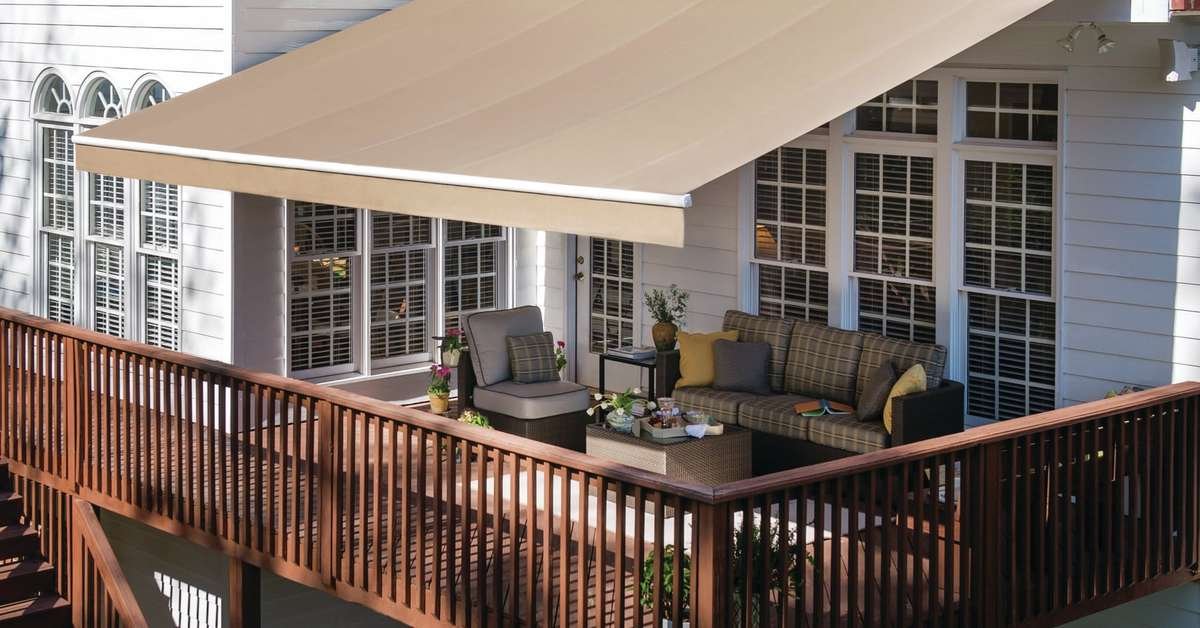
Quick Answer: Retractable awnings are adjustable shade systems mounted to a wall, roof, or standalone frame that extend and retract to control sunlight and weather exposure. Choose a lateral arm model for a patio, a drop arm model for a window, and a full cassette if you want the fabric protected when closed. Measure width and projection first, retract at 20 to 25 mph wind, and budget $200 to $3,000 installed for manual and $1,000 to $6,000 for motorized, as estimates.
Retractable awnings give you shade when you want it and full sun when you do not. This guide shows you how to pick the right type, size, fabric, and motor, what it costs, how long it lasts, and how to keep it working.
What Is a Retractable Awning
A retractable awning is an adjustable shade system mounted to a wall, roof, or standalone frame that extends and retracts to control sunlight and weather exposure. Folding arms push the fabric out over a patio, deck, balcony, or window, then pull it back into a compact roll.
Many owners value retractable models because closing them extends fabric life and protects them in harsh weather. Others view fixed awnings as more durable because they have no moving arms or motor to fail.
The University of Arkansas Extension cooling guide says awnings can reduce cooling energy use by 26 percent in hot climates and 33 percent in temperate climates. The Missoula Climate guide says awnings can reduce solar heat gain by up to 65 percent on windows with southern exposures and 77 percent on those with western exposures.
Types of Retractable Awnings
Lateral Arm
A lateral arm awning is the standard patio and deck model. Two or more articulating arms extend horizontally from the wall and support the fabric canopy. Widths run 8 to 20 feet, and projections are 5 to 12 feet.
Drop Arm / Window
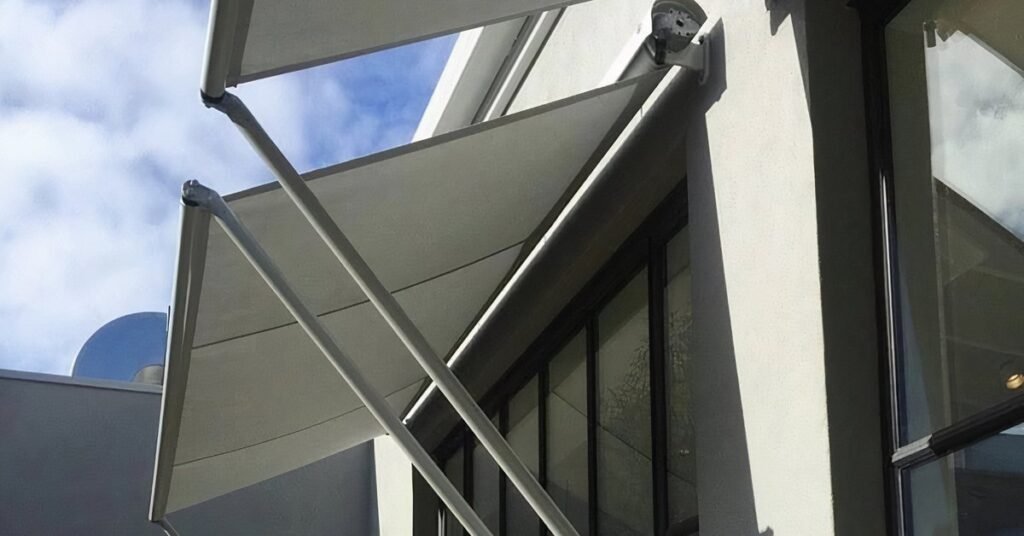
A drop arm awning extends downward at an angle rather than outward, so it shades a window or door without covering a whole patio.
Cassette vs Open
The housing, also called the cassette, protects the fabric and arms when closed. A full cassette encloses the rolled fabric and arms inside a protective housing. A semi-cassette covers the top only. An open model leaves fabric and arms exposed.
| Housing | Protection when closed | Cost |
| Full cassette | Fabric and arms fully enclosed | Highest |
| Semi-cassette | Top covered, sides open | Mid range |
| Open | No cover, fabric exposed | Lowest |
Manual vs Motorized
A manual awning uses a hand crank, costs less upfront, and needs no power. A motorized awning uses a remote, wall switch, or app, extends in under 60 seconds, and can add wind and sun sensors that retract it automatically. Choose manual for a small awning and a tight budget, motorized for a wide awning or daily use.
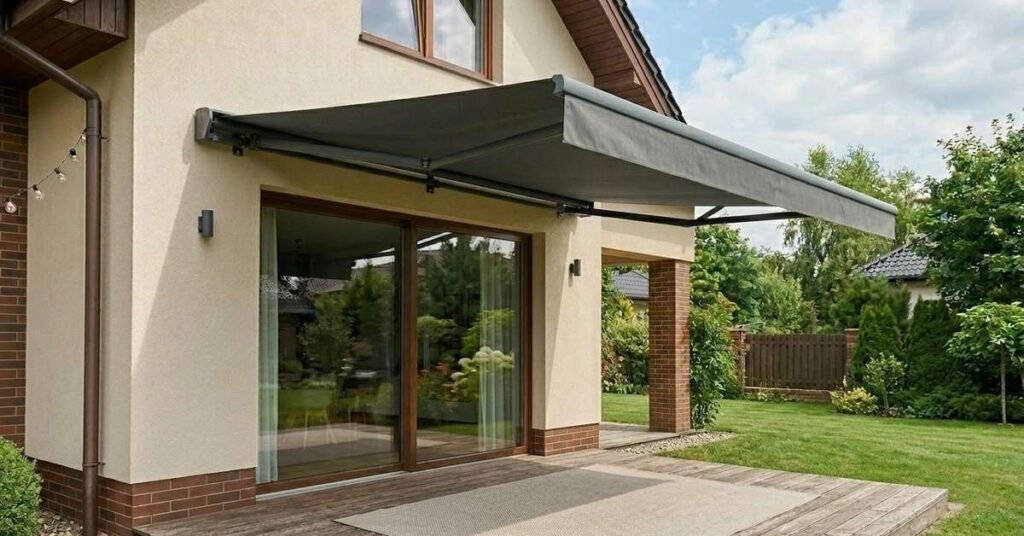
Retractable awnings with a dark gray motorized awning extended over a patio by sliding glass doors
Solution-dyed acrylic resists fading longer than standard polyester, because the color is built into the fiber. Most fabrics are water-resistant rather than fully waterproof unless treated and pitched for drainage.
Best Retractable Awning by Use
Ask three questions first: how you plan to use it, patio, terrace, balcony, or storefront; your size and wall, width, projection, wall type, and sun direction; and your preferences, manual or motorized, budget, and weather needs.
Best for a small patio: a manual lateral arm awning, 8 to 10 feet wide, with 7 to 8 feet of projection. Best budget manual: a manual open model in solution-dyed acrylic, 10 to 12 feet wide. Best motorized: a motorized full cassette awning with a wind sensor and a manual crank backup. Best for rain: a steep pitch, at least 14 degrees, and a water-resistant treated fabric. Best for a balcony: a small drop arm or lateral arm model, 5 to 8 feet wide, or a no-drill canopy.
How to Measure and What Size Retractable Awning Do You Need
Measure the Shade You Need, Not Just the Awning Width
Measure the wall width, projection, and clearance height before you buy. Add 1 to 2 feet of width on each side of the seating area, so sun does not slip past the edge. As a worked example, not a rule: a 12 foot wide seating area needs a 14 foot wide awning with 10 feet of projection, covering 140 square feet.
Keep the front edge at least 7 feet above the patio floor. A west facing patio needs a wider awning than a north facing patio. Plan the seating first with these backyard makeover ideas and then size the awning to the seating zone.
How Much Do Retractable Awnings Cost
All costs are estimates.
| Type | Installed estimate |
| Manual, 10 to 13 ft | $800 to $1,500 |
| Motorized, 10 to 13 ft | $1,200 to $2,500 |
Manual materials for 10 to 13 feet run $400 to $900, motorized materials run $700 to $1,500. A motor adds $300 to $1,000, plus $150 to $500 in labor for electrical work. Installing it yourself saves $300 to $800. As one listed starting price from the AI Overview, not independently verified, PERGOLUX lists motorized aluminum cassette awnings starting around $1,799.
Wind, Rain and Snow Limits
Retractable awnings are sun shades first, not storm covers. Most handle 15 to 20 mph wind when extended. Retract at 20 to 25 mph, and retract in a storm, heavy rain, or snow.
| Condition | Limit | What to do |
| Moderate wind, Beaufort 4 | 13 to 18 mph | Use with care |
| Strong wind, Beaufort 5 | 19 to 24 mph | Retract |
| Storm wind, Beaufort 6 plus | 25 mph and above | Retract at once |
| Heavy rain | More than light rain | Retract, or keep a steep pitch |
| Snow | Any snow load | Retract, brush snow off |
Understanding Wind and Weather Resistance
Beaufort is a wind scale from 0 to 12, where Beaufort 4 moves small branches and Beaufort 5 moves small trees. A flat awning holds water in the middle, and the arms can bend. Let the fabric dry before you retract it.
Retractable Awning Fabric: Waterproof vs Water-Resistant
Water-resistant fabric sheds light rain, but water will soak through in heavy or prolonged rain. Waterproof fabric has a coating that blocks water, but it still needs pitch for drainage, and the seams can leak. Ask for the fabric type and coating in writing.
Solution-dyed acrylic is the best choice for most homes. It resists fading and mildew and lasts 8 to 12 years as an estimate. Standard polyester is cheaper, but it fades faster and often lasts 5 to 7 years. PVC handles rain well, but it can crack in cold weather. Look for a UPF rating: UPF 50 blocks about 98 percent of UV.
How Long Do Retractable Awnings Last
A well-made awning lasts 10 to 15 years, with the fabric needing replacement first. Basic models last 5 to 7 years, mid range models last 8 to 12 years, and high-end models last 12 to 15 years or more. By part, fabric lasts 8 to 12 years, a powder-coated aluminum frame lasts 15 to 20 years, and a motor lasts 5 to 10 years.
How to Install a Retractable Awning
Check the Mounting Surface Before Picking a Model
A retractable awning pulls hard on its wall mounts, especially in wind, so the wall must take the load. Brick and concrete are strongest: use sleeve or wedge anchors, and drill into brick or block, not mortar alone. Wood framing is strong if you bolt into studs or a header, never into siding alone. Stucco needs solid backing. Vinyl siding cannot take the load alone, so use a mounting plate that reaches the studs.
Hire a pro if the awning is wider than 14 feet, motorized with hard wiring, or mounted on a weak wall. Pro labor costs $150 to $500 as an estimate, and $300 to $500 for a motorized model with electrical work. Check permits and HOA rules before you order.
How to Maintain a Retractable Awning
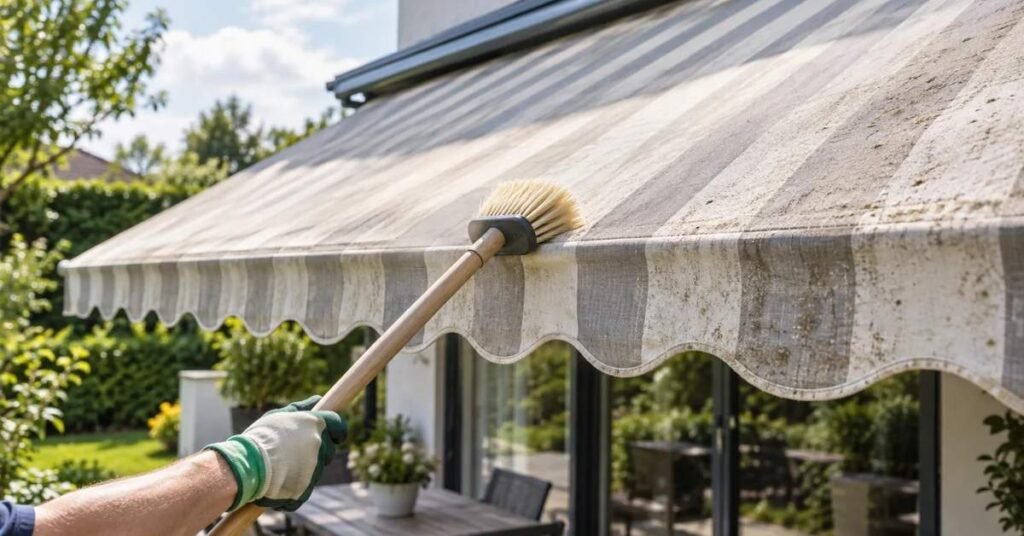
Brush off leaves and dust every month in summer. Clean the fabric once or twice a year with mild soap and water, rinse with a garden hose on low, and let it air dry fully before you retract it. Never retract a wet awning, because trapped moisture grows mold and mildew. Always retract in a storm. Rinse mud off the patio with a DIY outdoor shower after a storm.
Common Mistakes With Retractable Awnings
Do not buy before you measure: a 10 foot awning over a 14 foot seating area leaves the ends in full sun. Do not leave it out in wind over 20 mph: wind is the number one cause of awning damage, and a $200 wind sensor can save hundreds in repairs. Do not retract it wet: mold starts in a closed, damp roll within days. Do not mount it on a weak wall: vinyl siding, thin stucco, and rotted wood will pull out under load. Use the 50 percent rule: if a repair such as torn fabric, a broken arm, or a failed motor costs more than 50 percent of a replacement, replace the awning instead.
Frequently Asked Questions
How much does a retractable awning cost?
A manual retractable awning costs $200 to $3,000 installed, and a motorized awning costs $1,000 to $6,000 installed, as estimates. A 10 to 13 foot manual model costs $800 to $1,500 installed, and a motorized model costs $1,200 to $2,500.
What size retractable awning do I need?
Measure the seating area, add 1 to 2 feet on each side for width, and choose 8 to 10 feet of projection. A 12 foot seating area needs a 14 foot wide awning with 10 feet of projection for example.
Can retractable awnings withstand wind?
Most retractable awnings handle 15 to 20 mph wind when extended. Retract the awning at 20 to 25 mph, and always retract it in a storm. A wind sensor helps, but it is not flawless.
Are retractable awnings waterproof?
Most retractable awnings are water-resistant, not fully waterproof. They shed light rain, but heavy rain can soak through unless the fabric is treated and pitched for drainage. Keep a pitch of at least 14 degrees so rain runs off.
How long do retractable awnings last?
A well-made retractable awning lasts 10 to 15 years as an estimate. Basic models last 5 to 7 years, mid range models last 8 to 12 years, and high-end models last 12 to 15 years or more. Fabric wears out first, in 8 to 12 years.
Can I install a retractable awning myself?
Yes, you can install a manual awning yourself if the wall is solid brick, concrete, or wood studs. Hire a pro for awnings wider than 14 feet, motorized models with hard wiring, or weak walls. DIY saves $300 to $800.
Is a motorized retractable awning worth it?
A motorized awning is worth it if you use the patio daily, the awning is wide, or the crank is hard to reach. It extends in under 60 seconds, and wind sensors can retract it in gusts. It costs $300 to $1,000 extra.
Shade When You Want It, Sun When You Don’t
Pick the right type for your spot, measure the width and projection, and buy fabric that lasts. A manual lateral arm awning suits a small patio, and a motorized full cassette suits daily use. Retract it in winds of 20 to 25 mph, and it should shade your patio for 10 to 15 years. For the rest of your home, follow this home maintenance checklist.

I’m Samreen Khadim Hussain, a home improvement writer specializing in practical, research-driven content for U.S. homeowners. At Domelite Home, I cover home renovation, interior design, home maintenance, and residential safety, translating technical information and industry research into clear, actionable guidance. My approach combines search intent research, reliable sources, and reader-focused writing to help homeowners understand their options, make informed decisions, and create safer, more functional living spaces.