
Quick Answer: Which Way Should a Ceiling Fan Spin in Winter?
The correct ceiling fan direction for winter is clockwise at a low speed when viewed from directly below the fan. This setting helps circulate warm air that collects near the ceiling back into the living space without creating an uncomfortable breeze. To change the direction, turn off the fan, wait until the blades stop completely, and use the reverse switch on the motor housing or the appropriate remote control setting. In summer, most reversible ceiling fans should spin counterclockwise to create a cooling breeze. Reversing your fan in winter may improve comfort and help you use your heating system more efficiently, but actual energy savings depend on your home, climate, and heating habits.
Cold weather often sends homeowners searching for ways to keep their homes comfortable without turning up the thermostat. You might already have a ceiling fan in your bedroom, living room, or dining area, but did you know that changing its direction can make a difference during winter?
Many people associate ceiling fans with summer cooling. However, a reversible ceiling fan can also help redistribute warm air during the colder months. The trick is knowing which direction to use, how fast the blades should spin, and when running the fan makes sense.
In this guide, you’ll learn how to set your ceiling fan for winter, how to check its direction, how to reverse the blades safely, and what this simple adjustment can realistically do for your heating bills.
Ceiling Fan Direction for Winter: Clockwise or Counterclockwise?
For most reversible ceiling fans, clockwise rotation at a low speed is the recommended winter setting. The U.S. Department of Energy explains that reversing a ceiling fan to rotate clockwise at low speed creates an updraft that helps redistribute warm air near the ceiling into the occupied space.
Why does this matter? Warm air naturally rises, so the air near your ceiling can be warmer than the air around your sofa, bed, or dining table. This difference can be more noticeable in rooms with high ceilings or during the heating season.
When the fan rotates clockwise at a low speed, it gently circulates the air rather than pushing a strong stream directly onto people below. This helps move warmer air around the room while limiting the chilly draft that a typical summer setting can create.
For the official recommendation, see the U.S. Department of Energy’s winter energy-saving tips.
For more guidance on fan direction and proper use, read ENERGY STAR’s ceiling fan installation and usage tips.
How to Tell if Your Ceiling Fan Is Spinning Clockwise
The easiest way to check your fan’s direction is to stand safely beneath it and look straight up at the blades. Imagine the hands of a clock: clockwise rotation follows the same direction as a clock’s hands.
If the blades move clockwise, your fan is generally set for winter operation. If they move counterclockwise, it is usually in summer mode.
Do not rely on the direction of the wall switch, pull chain, or remote button alone. Controls vary between manufacturers, and some remotes display a reverse symbol rather than spelling out the direction. Always observe the blades after changing the setting.
Why Should You Reverse Your Ceiling Fan in Winter?
The main reason to reverse your ceiling fan is to improve the distribution of heat throughout the room. Your heating system warms the air, but that heat does not always remain evenly distributed, particularly in rooms with tall ceilings.
Warm Air Collects Near the Ceiling
When a furnace, heat pump, or another heating system warms a room, the warmer air tends to rise while cooler air remains lower down. This process can leave the upper part of a room warmer than the area where you actually sit or sleep.
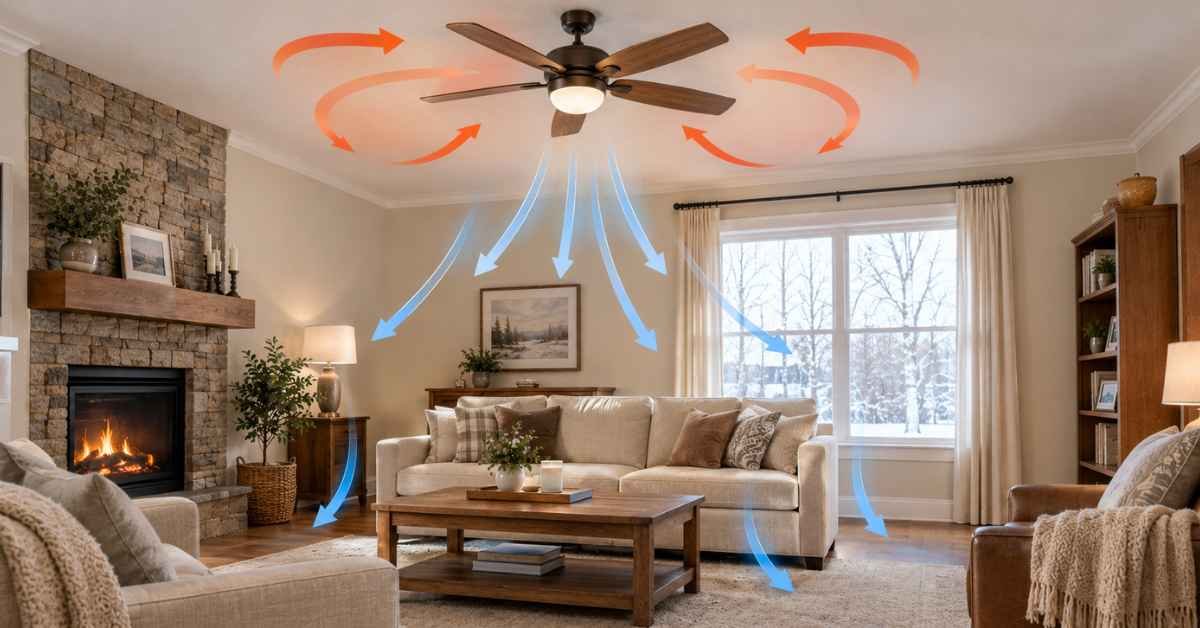
A ceiling fan helps mix the air instead of allowing temperature differences to persist. In winter mode, the gentle airflow encourages circulation without creating the strong downward breeze many people dislike in cold weather.
A Ceiling Fan Can Improve Comfort Without Heating the Room
A ceiling fan does not generate heat like a furnace or electric heater. Instead, it helps redistribute the heat your existing system has already produced.
This distinction matters because running a fan doesn’t automatically warm a room. It changes how air moves around the room, which can help reduce uncomfortable temperature differences between the ceiling and the occupied area.
If you have a room with a high ceiling, a winter fan setting may be particularly useful because more warm air can accumulate above the living space. In a room with a low ceiling and little temperature variation, the difference may be less noticeable.
How to Change Ceiling Fan Direction for Winter

Changing the direction of your fan usually takes only a few minutes. The exact process depends on whether your model has a manual reverse switch, a remote control, a wall control, or a smart-home connection.
Step 1: Turn Off the Fan
Switch off the fan using the wall control, remote, or pull chain. Wait until the blades stop moving completely before touching the motor housing or climbing a ladder.
Never try to change a manual direction switch while the blades are spinning. Moving blades can cause injury, and working around a running fan makes it harder to handle the controls safely.
Step 2: Locate the Reverse Switch
Many traditional ceiling fans have a small direction switch on the motor housing, often beneath the blades. Depending on the model, the switch may be on the side or top of the housing.
If you cannot find it, check the manufacturer’s manual. Some modern fans use a remote control or wall controller, so there may be no visible manual switch.
Step 3: Change the Setting
If your fan has a manual switch, move it to the opposite position. Do not assume that moving the switch up or down always selects winter mode, because the arrangement varies by model.
For a remote-controlled fan, look for a reverse button or a setting identified in the instructions. Smart fans may offer the same function through an app or compatible control system.
For more ways to use connected technology around your home, explore Domelite Home’s guide to AI smart home devices in 2026.
Step 4: Restart the Fan at Low Speed
Move away from the blades before turning the fan back on. Select the lowest speed for gentle air circulation, then look up to confirm the blades are rotating clockwise.
Stand beneath the fan briefly. You should not feel a strong, direct breeze. If the airflow feels chilly, check the direction and reduce the speed if necessary.
What Is the Best Ceiling Fan Speed for Winter?
Low speed is generally the best starting point for winter operation. The goal is to circulate warm air gently, not create a noticeable wind chill.
At high speed, a fan can move air strongly enough to make people feel colder, even when the room’s actual temperature has not changed. This defeats the purpose of using the fan for winter comfort.
Start with the lowest setting and increase it slightly only if the room needs more circulation and the airflow remains comfortable. Every fan behaves differently, so your best setting may depend on the blade design, room size, ceiling height, and furniture arrangement.
If you still feel a draft while sitting directly underneath the fan, try a lower speed or turn it off when the room is comfortable. You do not need to run the fan continuously to benefit from improved air circulation.
Ceiling Fan Direction in Summer vs. Winter

The difference between summer and winter fan settings comes down to how the blades move air and how that airflow affects your comfort.
| Feature | Winter setting | Summer setting |
| Typical blade direction | Clockwise | Counterclockwise |
| Recommended speed | Low | Medium to high, as needed |
| Main purpose | Redistribute warm air | Create a cooling breeze |
| Airflow effect | Gentle circulation with minimal direct draft | Downward airflow across occupants |
| Best use | During the heating season | During warm weather |
| Potential benefit | Improved comfort and possible heating savings | Improved comfort and possible cooling savings |
In summer, the counterclockwise setting typically pushes air downward, creating a breeze that helps sweat evaporate from your skin. This makes you feel cooler without actually lowering the room’s air temperature.
In winter, clockwise rotation at low speed encourages gentle circulation instead. The aim is to reduce the temperature difference between the ceiling and the occupied area without blowing cold-feeling air directly onto you.
Can Changing Ceiling Fan Direction Lower Heating Bills?
Changing your ceiling fan direction may help reduce heating costs, but it is not a guaranteed source of savings. The result depends on factors such as your home’s insulation, ceiling height, heating system, climate, and thermostat settings.
If your fan helps distribute warm air more evenly, you may feel comfortable at a slightly lower thermostat setting. That could reduce heating demand, especially if your home has a high ceiling and significant temperature differences between the upper and lower parts of the room.
However, simply reversing the fan does not automatically reduce energy use. If you run it in an empty room or turn up the heating at the same time, you may not save anything.
The U.S. Department of Energy recommends turning ceiling fans off when a room is unoccupied. Fans are generally used to improve comfort for people in the room, rather than to change the temperature of a space.
For practical ways to improve household efficiency, explore Domelite Home’s guide to home renovation tips and money-saving tricks.
How to Use a Ceiling Fan With Your Heating System
Begin by setting the fan to clockwise rotation at low speed. Allow the room to circulate air for a while, then assess whether the occupied area feels more comfortable.
If the room feels more evenly heated, you can experiment with a small thermostat adjustment while maintaining a comfortable temperature. Avoid lowering the thermostat so much that the room becomes uncomfortable or unsafe for household members.
Keep in mind that a ceiling fan cannot fix poor insulation, significant air leaks, or an undersized heating system. If a room remains cold despite reasonable heating settings, inspect windows, doors, attic insulation, and other possible sources of heat loss.
Does Every Ceiling Fan Have a Winter Direction?

No. Most modern reversible ceiling fans allow you to change blade direction, but some models are designed to operate in only one direction.
If your fan does not have a reverse switch, check the owner’s manual or the manufacturer’s website before assuming that it can be reversed. Some smart models provide direction control electronically, while others may not support it at all.
Do not attempt to rewire a fan or modify its motor to change the direction. Incorrect electrical work can damage the equipment or create a safety hazard. If the fan’s controls are unclear or the unit is malfunctioning, contact the manufacturer or a qualified electrician.
Common Ceiling Fan Mistakes to Avoid in Winter
Even a reversible fan may not improve comfort if you use the wrong settings or overlook basic maintenance.
Running the fan too fast: High speed can create a draft that makes the room feel colder. Start at the lowest setting and adjust only when necessary.
Assuming clockwise always means winter mode without checking: Most reversible fans follow this convention, but the important thing is to confirm the actual direction of rotation. Look at the blades from directly below rather than relying only on the switch position.
Leaving the fan on in an empty room: A ceiling fan generally does not need to run when nobody is there to benefit from the airflow. Turn it off when leaving the room.
Expecting the fan to replace a heating system: A ceiling fan redistributes existing heat but does not produce it. Continue using an appropriate heating system to maintain a safe, comfortable indoor temperature.
Ignoring fan maintenance: Dust buildup can affect cleanliness and may contribute to poor performance. Turn the fan off before cleaning the blades, and check that visible fasteners remain secure according to the manufacturer’s instructions.
Changing the switch while the blades are moving: Always turn the fan off and wait for the blades to stop before operating a manual reverse switch.
When Should You Change Your Ceiling Fan Direction?
Change your fan to its winter setting when you begin using your heating system regularly and notice that warm air collects near the ceiling. In many parts of the United States, this means making the change during fall or at the start of the heating season.
There is no single calendar date that works for every home. A household in a colder northern state may need the winter setting earlier than someone living in a mild southern climate.
Switch back to summer mode when you want a noticeable cooling breeze during warmer weather. If your climate changes frequently, let comfort guide your decision rather than following a rigid seasonal schedule.
You can also use your fan differently depending on the room. A high-ceiling living room may benefit from winter circulation, while a room that already feels evenly heated may not need the fan running at all.
Conclusion
The correct ceiling fan direction for winter is generally clockwise at a low speed. This setting helps redistribute warm air that collects near the ceiling, potentially improving comfort without creating the strong breeze associated with summer operation.
To change the direction safely, turn off the fan, wait until the blades stop completely, and use the reverse switch or the appropriate remote control setting. Confirm the rotation from below and begin with the lowest speed.
Remember that a ceiling fan does not create heat or guarantee lower energy bills. Its main purpose in winter is to improve air circulation. When combined with sensible thermostat settings, good insulation, and regular home maintenance, this simple adjustment can help make your living space more comfortable throughout the heating season.
Frequently Asked Questions
1. Should a ceiling fan spin clockwise or counterclockwise in winter?
Most reversible ceiling fans should spin clockwise in winter when viewed from directly below. Use a low speed to help circulate warm air without creating an uncomfortable draft.
2. Should I run my ceiling fan all night in winter?
You can run a ceiling fan at low speed overnight if it improves comfort and the manufacturer permits continuous operation. However, it is not necessary if the room already feels comfortable. Turn it off if it creates a draft or disturbs your sleep.
3. Which way should a ceiling fan turn in winter with high ceilings?
Clockwise rotation at low speed is the usual recommendation for rooms with high ceilings. These rooms can allow more warm air to collect overhead, so gentle circulation may help distribute heat more evenly through the occupied space.
4. Does a ceiling fan make a room warmer in winter?
A ceiling fan does not generate heat or directly raise the room’s temperature. It redistributes warm air, which can make the occupied area feel more comfortable when heat collects near the ceiling.
5. How do I change ceiling fan direction without a switch?
Check the owner’s manual to see whether your fan supports direction changes through a remote control, wall controller, or smart-home app. If the fan is not reversible, do not attempt to modify its wiring or motor. Contact the manufacturer or a qualified electrician if you need help identifying the available controls.

I’m Samreen Khadim Hussain, a home improvement writer specializing in practical, research-driven content for U.S. homeowners. At Domelite Home, I cover home renovation, interior design, home maintenance, and residential safety, translating technical information and industry research into clear, actionable guidance. My approach combines search intent research, reliable sources, and reader-focused writing to help homeowners understand their options, make informed decisions, and create safer, more functional living spaces.