Quick Answer
Set your thermostat to 68°F in winter and 78°F in summer while you are home and awake. Move it 7 to 10 degrees toward the outdoor temperature when you sleep or leave for the day. Setting 72°F in winter is not unsafe, but it costs more, and most homes feel comfortable at 68°F to 70°F once drafts are sealed. These are the recommended thermostat settings for summer and winter that we use as the starting point in the rest of this guide.
Heating and cooling take up about half of the energy most US homes use, yet most people set the dial once and never touch it again. A few degrees in either direction can change your bill more than any gadget you buy. This guide covers the recommended thermostat settings for summer and winter, answers the 72-degree question, and shows how to adjust for sleep, work hours, travel, and heat pumps.
Is 72 Too High for a Thermostat in Winter?
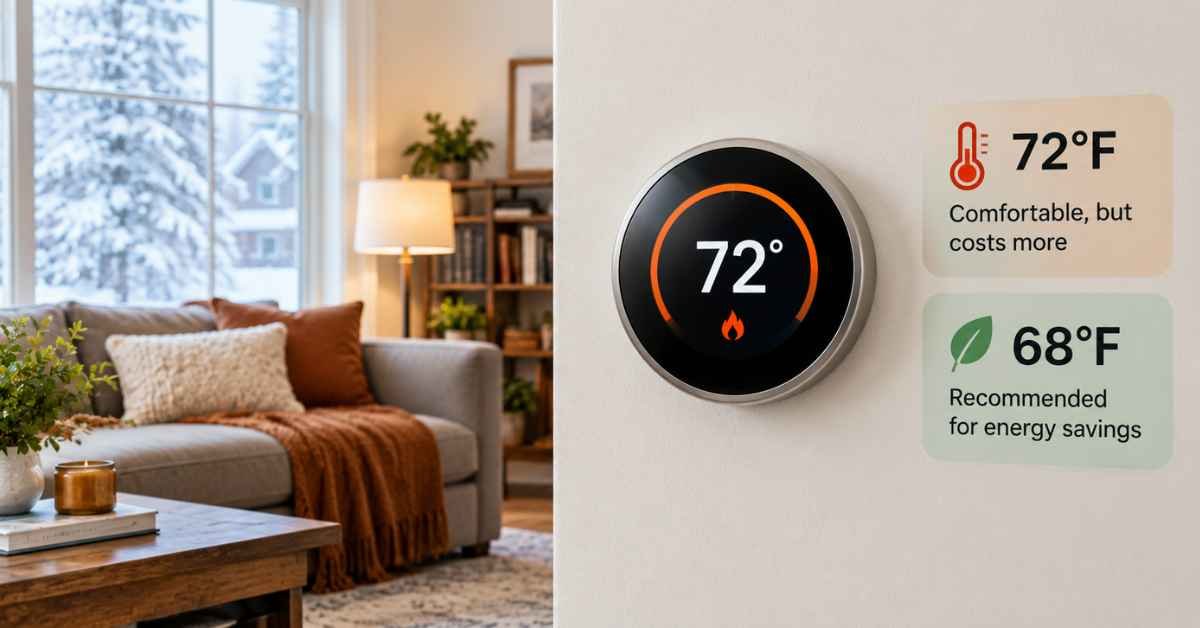
No. Seventy-two degrees is a normal, safe indoor temperature, and many households run at it all season. It is simply higher than the 68°F the U.S. Department of Energy recommends for saving energy, as this thermostat setback guide from This Old House explains.
The cost comes from the gap between indoor and outdoor air. The bigger that gap, the faster heat leaks out through walls, windows, and doors, and the longer your furnace runs. The Department of Energy says turning your thermostat back 7 to 10 degrees for 8 hours a day can cut yearly heating and cooling costs by up to 10%. That works out to roughly 1% per degree over those 8 hours. So a home held at 72°F all day pays for about four extra degrees compared with 68°F.
If you want to move toward the recommended thermostat settings for summer and winter without feeling it, drop the setting by one degree every few days. Stop when you feel slightly cool, then go back up one degree. That is your personal sweet spot.
Recommended Thermostat Settings for Summer and Winter at a Glance
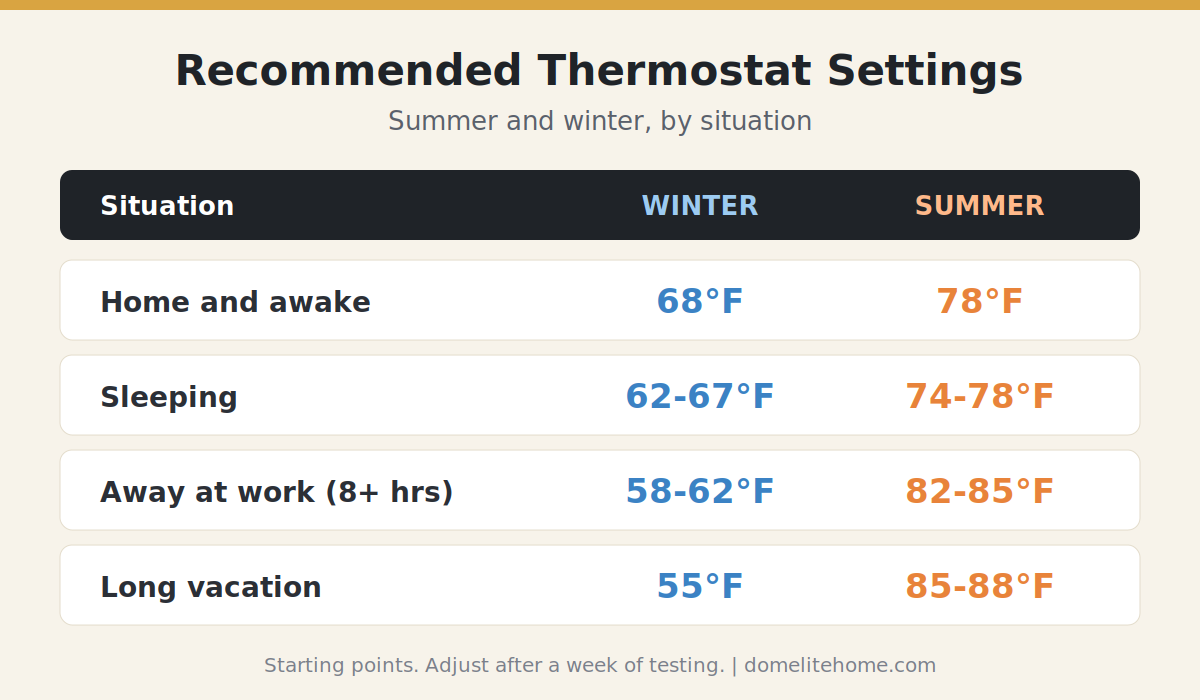
Treat these recommended thermostat settings for summer and winter as starting points. A drafty older house and a tight new build feel very different at the same number, so adjust after a week of testing.
Best Winter Thermostat Setting for Each Situation
Home and Awake
Start at 68°F. If it feels cold, add a sweater and warm socks before you touch the dial. Comfort depends on more than air temperature. Cold windows, bare floors, and drafts make a room feel colder than the thermostat reads.
Sleeping
Most people sleep better in a cool room. Aim for 62°F to 67°F and use a heavier blanket. You are not using the warmth while you sleep, so overnight setbacks are the easiest savings you will find.
Away From Home
For a workday, set the thermostat 7 to 10 degrees below your normal setting, usually 58°F to 62°F. For a trip of several days, 55°F is a safe floor for most homes.
The Lowest Safe Setting
Never let the house drop below 55°F. Pipes in exterior walls, crawl spaces, and garages can freeze, and a burst pipe costs far more than any heating savings. During a hard freeze, open the cabinet doors under sinks so warm air can reach the pipes.
Best Summer Thermostat Setting for Each Situation
For the summer half of the recommended thermostat settings for summer and winter, the Department of Energy recommends 78°F when you are home. Higher settings cost less because the gap between outdoor and indoor air shrinks, so your air conditioner runs less.
- Home and awake: 78°F. A ceiling fan makes the room feel about 4 degrees cooler, so you can hold 78°F and still feel comfortable.
- Sleeping: 74°F to 78°F, depending on humidity and personal comfort.
- Away for the day: 82°F to 85°F. In humid climates, do not go much higher, because indoor moisture can encourage mold.
- Coming home to a hot house: Resist the urge to set 65°F. The system cools at the same speed either way, so a lower number only makes it run longer.
Does Turning the Heat Down Really Save Money?
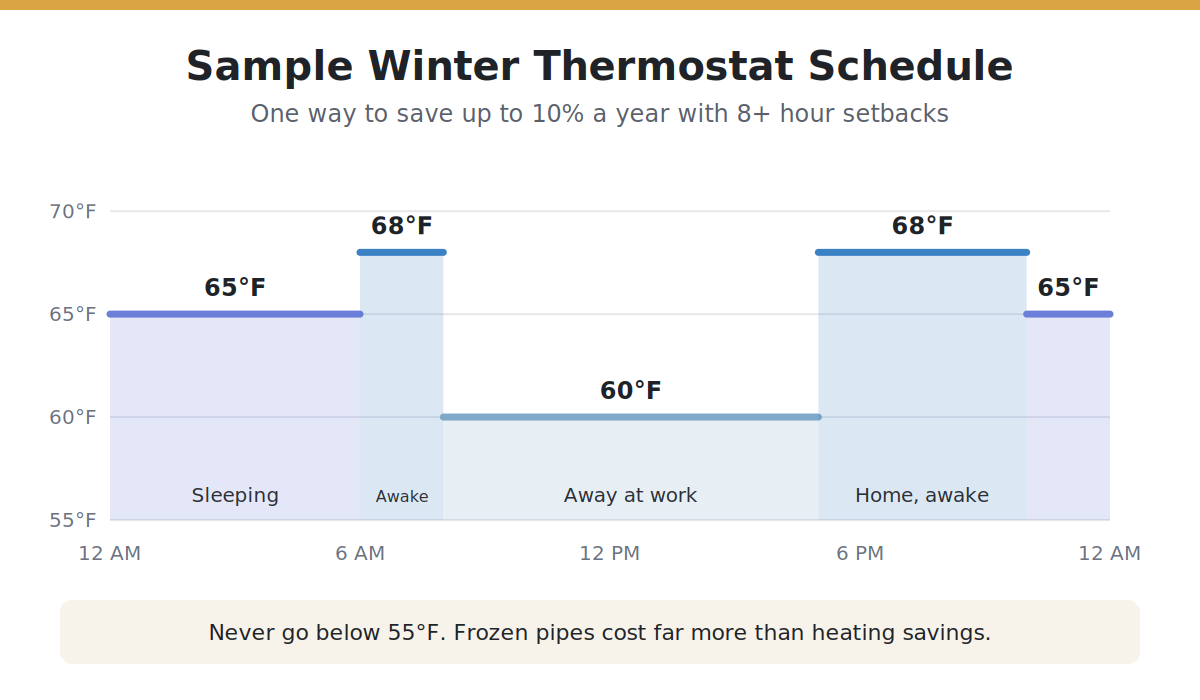
Yes. A common myth says your furnace works so hard to reheat the house that you save nothing. The Department of Energy says otherwise. The energy used to bring the house back up is less than the energy saved while it was cooler, and the savings grow the longer the setback lasts. That is why 8 hours is the benchmark.
Skip one habit: cranking the dial to 80°F to heat the house faster. Most furnaces heat at one speed, so a higher setting only makes the system run longer and overshoot your target.
How to Stay Comfortable at a Lower Setting
Following the recommended thermostat settings for summer and winter is easy on paper. These fixes make them livable:
- Seal drafts. Gaps around doors let warm air out all winter. Our guide to sliding glass door weather stripping shows how to fix one of the leakiest spots in a house.
- Use your ceiling fans. Running a fan clockwise on low pushes warm air down from the ceiling. Here is how to set your ceiling fan direction for winter.
- Open curtains on sunny days and close them at night to trap heat.
- Add humidity if the air is dry. Air at 30% to 50% humidity feels warmer than dry air at the same temperature.
- Put rugs on hard floors. Cold floors make the whole room feel colder.
- Change your air filter every 1 to 3 months so your system moves air properly.
Programmable and Smart Thermostats
A programmable thermostat applies the recommended thermostat settings for summer and winter on a schedule, so you do not need to remember them. A smart thermostat goes further by learning your schedule, adjusting by location, and showing your usage. ENERGY STAR certified smart thermostats are tested to save energy, and many people save more simply because they stop forgetting to turn the heat down.
If you are building a connected home step by step, our smart home automation guide explains where a thermostat fits. Check compatibility with your furnace, heat pump, or baseboard system before buying. Some systems need a C-wire, and line-voltage baseboard heaters need a special thermostat.
Heat Pumps Need Smaller Setbacks
With a heat pump, the recommended thermostat settings for summer and winter still apply, but deep setbacks can backfire. When the house is far colder than the setting, the system may turn on backup electric heat to catch up, and that costs much more to run. Keep the setback to 2 or 3 degrees, or use a thermostat designed for heat pumps that manages recovery on its own. Follow the guidance for your specific model.
Common Thermostat Mistakes

- Changing the setting all the time. Constant manual changes cancel out savings. Set a schedule and leave it.
- Placing the thermostat near a heat source. A sunny wall, a lamp, or a kitchen doorway gives false readings.
- Ignoring humidity. Dry winter air and sticky summer air both change how a temperature feels.
- Skipping maintenance. A dirty filter or an overdue furnace tune-up raises your bill at any setting.
- Setting one number for everyone. Babies, older adults, and people with medical conditions may need warmer rooms.
FAQs About Thermostat Temperatures
Is 72 degrees too hot for a house in winter?
No. It is comfortable and safe, just less efficient than 68°F. Expect a higher heating bill.
Is 68 degrees too cold for a house?
For most healthy adults, 68°F feels fine with normal clothing. If it feels cold, check for drafts first. Infants, older adults, and people with medical conditions may need 68°F to 70°F or warmer. Ask your doctor if you are unsure.
What is the best thermostat temperature at night in winter?
Between 62°F and 67°F for most people, with a warm blanket.
What temperature should I set when I am away in winter?
For a day, 58°F to 62°F. For a longer trip, 55°F. Never go lower, because of the risk of frozen pipes.
What temperature should a baby’s room be?
Many pediatric sources suggest 68°F to 72°F, with the baby in light layers and no heavy blankets. Confirm with your pediatrician.
Is 65 degrees too cold for a house?
It works for sleeping or a short absence but feels cool during the day.
Is 70 degrees a good winter setting?
Yes. It is a common compromise. It costs a little more than 68°F, but many people find it comfortable without extra layers.
At what temperature do pipes freeze?
Water in pipes can freeze when the surrounding space drops to about 32°F, and pipes in exterior walls get there faster. Keep the house at 55°F or above.
Is 78 degrees too hot for summer?
It is part of the recommended thermostat settings for summer and winter when you are home. Use fans to make it feel cooler. If it is too warm, try 76°F and adjust.
Is 75 too hot for a thermostat in summer?
No. It is comfortable, but it costs more to maintain than 78°F because the air conditioner runs longer.
How hot can I let my house get when I am away in summer?
Around 82°F to 85°F on a normal day. In humid areas, do not go much higher.
What is 68°F in Celsius?
68°F is 20°C. Also, 72°F is about 22°C, 78°F is about 26°C, and 55°F is about 13°C.
Should I leave my thermostat at one temperature all day?
It is simple, but it wastes energy when nobody is home or you are asleep. A schedule built on the recommended thermostat settings for summer and winter saves more.
What is the best thermostat setting for a heat pump in winter?
Around 68°F to 70°F, with very small setbacks. Large overnight drops can trigger expensive backup heat.
Does a smart thermostat save money?
It can. ENERGY STAR certified models are tested to cut heating and cooling use, mostly by automating setbacks people forget. Results depend on your home and habits.
What are the recommended thermostat settings for summer and winter?
Set 68°F in winter and 78°F in summer while you are home and awake. Lower the winter setting 7 to 10 degrees when you sleep or leave, and raise the summer setting to 82°F to 85°F when you are away.
The Bottom Line
The recommended thermostat settings for summer and winter are 68°F in winter and 78°F in summer while you are home, with a 7 to 10 degree setback for sleep and away time. If you prefer 72°F, you can keep it. Just know it costs more. Start at 68°F, seal the leaks that make rooms feel cold, and adjust one degree at a time until it feels right.

I’m Samreen Khadim Hussain, a home improvement writer specializing in practical, research-driven content for U.S. homeowners. At Domelite Home, I cover home renovation, interior design, home maintenance, and residential safety, translating technical information and industry research into clear, actionable guidance. My approach combines search intent research, reliable sources, and reader-focused writing to help homeowners understand their options, make informed decisions, and create safer, more functional living spaces.