
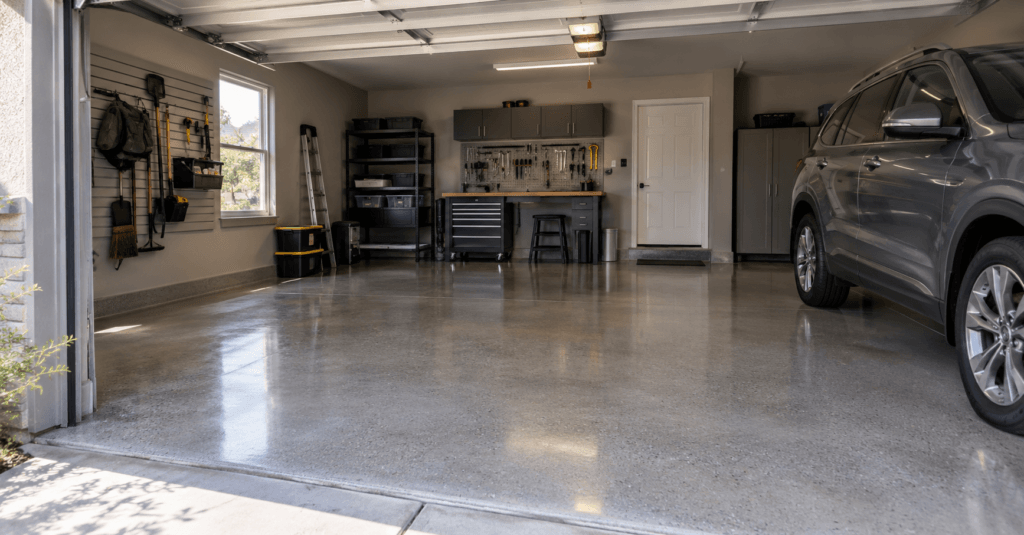
Quick Answer: The best garage flooring options for US homes in 2026 are polyaspartic coatings for permanent professional finishes ($5 to $15 per sq ft installed), interlocking tiles for renter-friendly DIY installs ($2 to $5 per sq ft), epoxy for budget homeowners willing to do proper prep ($1 to $4 per sq ft DIY), polished concrete for industrial-modern looks, rubber flooring for workshop and gym garages, and SPC vinyl tiles for multifunctional lifestyle garages. The single biggest mistake is treating garage flooring the same as indoor flooring and choosing a product not built for vehicle weight, chemical exposure, and temperature swings.
Most garage floors in US homes are an afterthought. The cabinets get planned. The lighting gets upgraded. The organization system gets a budget. And the bare gray concrete slab that takes the hardest daily abuse in the entire property gets a $35 paint roller kit from a big-box store that peels within eighteen months.
That failure is not the homeowner’s fault. It results from not knowing that the garage floor is genuinely one of the most demanding surfaces in any home, and that the right material for it isn’t interior flooring applied to a garage context. It is purpose-built for the specific combination of vehicle weight, oil and chemical spills, temperature extremes, road salt, and freeze-thaw cycling that no other room in the house experiences.
This guide covers every major garage flooring option with honest performance data, real 2026 US cost ranges, and the specific use case each one fits. No brand promotions. No vague ranges. Just what actually works and why.
Why Garage Flooring Fails Within 2 Years
Before choosing garage flooring, understand the conditions it needs to survive. Most buying guides skip this context entirely.
Vehicle weight and hot tire pickup. A standard car exerts 2,000 to 4,000 pounds of load on the floor. Modern high-performance tires, particularly on electric vehicles with high torque, heat up significantly during driving. When a hot tire sits on an improperly cured or low-grade coating, it picks up the coating as it cools, leaving bare concrete patches. This is called hot tire pickup, and it eliminates box-store epoxy kits within months.
Chemical exposure. Motor oil, gasoline, brake fluid, transmission fluid, and road salt are all present in an active garage environment. These chemicals penetrate unsealed concrete and attack low-grade coatings. A coating with poor chemical resistance looks fine on day one and begins staining, bubbling, or delaminating within a year of regular use.
Temperature extremes and freeze-thaw cycling. In most US climate zones, garage floors experience temperature swings from below freezing in winter to above 100°F in summer. Concrete expands and contracts with these swings. Any coating that cannot flex with the concrete cracks and delaminates at the stress points.
Moisture vapor transmission. Concrete is not waterproof. Moisture vapor rises through the slab from the ground below. If a coating is applied over concrete with high moisture vapor emission, the vapor pressure builds under the coating and causes bubbling, blistering, and delamination that no amount of prep on the surface itself can prevent.
For US homeowners, the best garage flooring depends heavily on climate. Northern states need strong freeze-thaw performance, while hot southern and southwestern regions need flooring that tolerates high surface temperatures and UV exposure.
Option 1: Polyaspartic Coating: The 2026 Professional Standard
Polyaspartic coating is the most significant development in garage flooring in the past decade and the professional standard in 2026 for good reason. It outperforms traditional epoxy on every performance metric that matters in a garage environment.
Polyaspartic cures in four to six hours compared to epoxy’s 24 to 72-hour cure time. This means a professional polyaspartic installation is complete in a single day and the garage is usable the same evening. Epoxy installations require the garage to be out of service for at least three days.
Polyaspartic is UV-stable, meaning it does not yellow in sunlight the way epoxy does. In a garage with windows, doors, or skylights, this difference is visible within the first year on an epoxy floor. Polyaspartic maintains its color and sheen for the life of the coating.
Polyaspartic coatings generally tolerate a wider temperature range than standard epoxy, making them a strong choice for garages exposed to significant seasonal temperature changes. Standard epoxy has a narrower application and performance temperature range, which creates problems in both northern winters and southwestern summers.
The hot tire pickup resistance of polyaspartic is significantly better than epoxy at comparable price points. Professional-grade polyaspartic coatings pass hot tire testing that most epoxy products fail.
The honest limitation: polyaspartic requires professional installation. The chemistry requires precise mixing ratios and rapid application before the product begins to gel. DIY application of professional-grade polyaspartic is not realistic for most homeowners.
Cost: $5 to $15 per square foot installed. A two-car garage of 400 square feet costs $2,000 to $6,000 installed. Lifespan: 15 to 20 years with minimal maintenance. Best for: Permanent installs, daily-driver garages, homeowners who want the longest-lasting result.
Option 2: Epoxy Coating: The Most Misunderstood Option
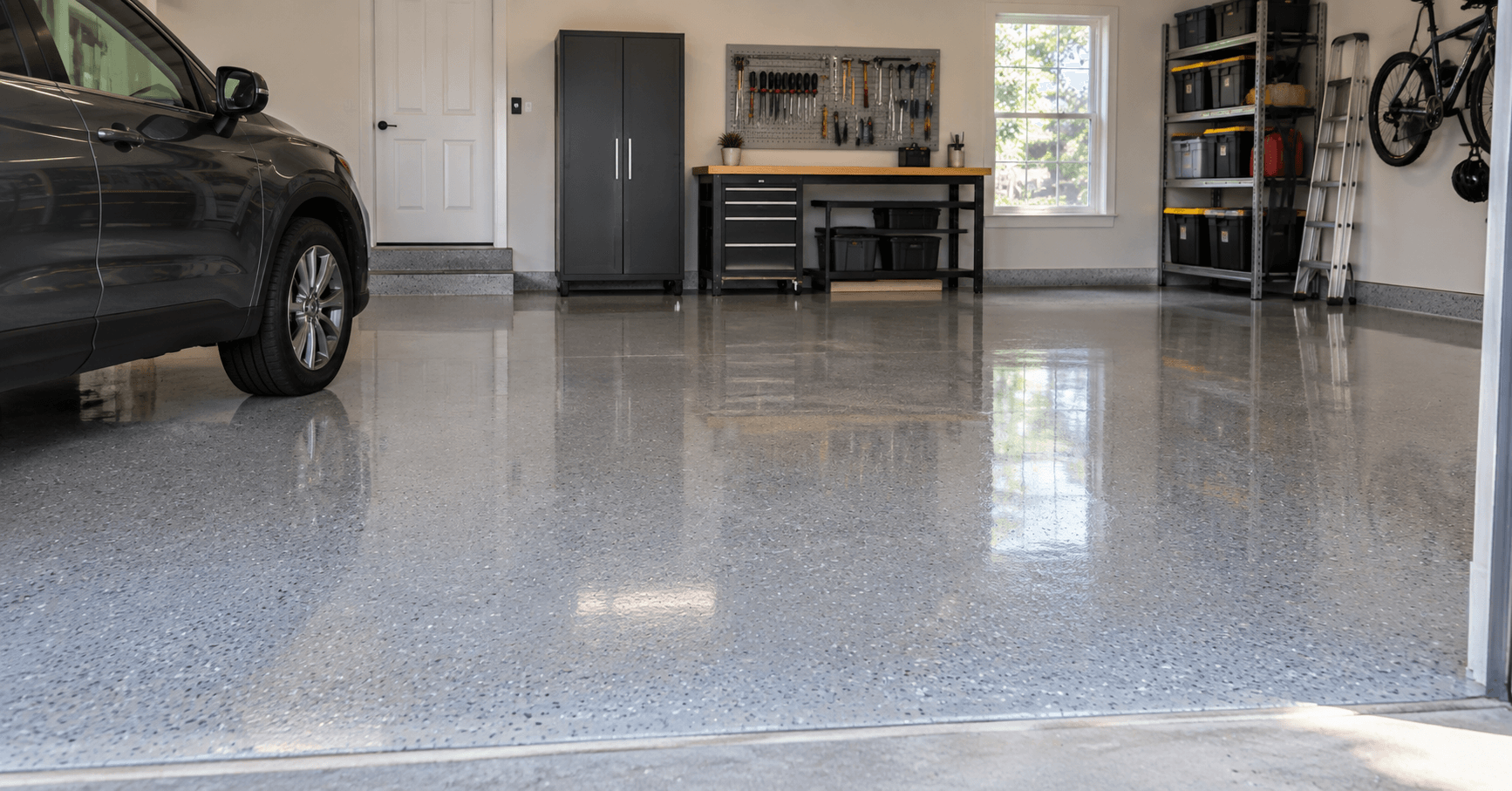
Epoxy has a complicated reputation in garage flooring, and most of it comes from the same mistake: using box-store epoxy kits on floors that were not properly prepared.
Box-store kits from brands like Rust-Oleum EpoxyShield use water-based formulations with low solids content. These products apply easily but create a thin coating that does not withstand hot tire pickup, heavy vehicle use, or chemical exposure. They peel within one to two years under normal garage use. This is not a failure of epoxy technology. It is the wrong product for the application.
Professional two-part solvent-based or 100-percent solids epoxy is a fundamentally different product. It requires proper surface preparation, including acid etching or diamond grinding, moisture testing of the concrete, and careful mixing ratios. Done correctly, professional epoxy creates a coating that handles vehicle weight, chemical exposure, and moderate temperature swings for eight to twelve years.
The critical prep step that determines everything: moisture vapor emission rate testing. If the concrete slab emits more than three pounds of moisture per 1,000 square feet per 24 hours, standard epoxy cannot be applied without a moisture-blocking primer. Skipping this test is the most expensive mistake in garage floor coating because the coating fails from below regardless of how well it was applied on top.
Cost: $1 to $4 per square foot DIY with proper materials, $3 to $7 per square foot professionally installed. Lifespan: 8 to 12 years professionally installed with proper prep. 1 to 3 years with box-store kits. Best for: Budget-conscious homeowners willing to do thorough preparation and professional installation.
Option 3: Interlocking Tiles: The Renter-Friendly Instant Install
Interlocking garage tiles are the only garage flooring option that requires no adhesive, no concrete prep, no curing time, and no professional installation. They snap together over bare concrete and can be removed and reinstalled in a different garage when you move.
This is not a compromise product for people who cannot afford real garage flooring. Modern interlocking tiles in polypropylene and PVC handle vehicle weight, chemical spills, and temperature extremes effectively. They are the correct choice for renters, homeowners who move frequently, and anyone who wants to convert a garage to a gym, workshop, or living space without a permanent installation.
The design options have expanded significantly in 2026. Solid color tiles in dozens of colors, two-color checkerboard patterns, wood-look vinyl tiles, and perforated designs that allow air circulation under vehicles are all available. The checkerboard pattern using two contrasting colors is one of the most popular looks in garage floor design and translates directly from interior design into the garage context.
For homeowners interested in checkerboard patterns and how they work across different materials and spaces, the guide on stunning checkerboard floor ideas covers the full range of checkerboard applications, including the specific tile sizes and color combinations that work best at different scales.
Cost: $2 to $5 per square foot for materials. Installation labor is zero for most DIYers. Lifespan: 10 to 20 years depending on tile quality and vehicle traffic. Best for: Renters, frequent movers, gym and workshop garages, anyone who wants a removable install.
Option 4: Polished Concrete, The Industrial-Modern Look
Polished concrete does not add a coating to the concrete surface. It treats the existing concrete slab itself through a progressive grinding and polishing process that densifies the surface and creates a high-sheen finish directly in the concrete.
The result is a floor that looks genuinely different from any coated surface. The aggregate within the concrete becomes visible through the polished surface, creating variation and depth that coating systems cannot replicate. In garages used as showrooms, high-end workshops, or converted living spaces, polished concrete creates the most sophisticated and permanent aesthetic available.
The practical advantages: no coating that can peel, chip, or delaminate because the surface is the concrete itself. No hot tire pickup because there is no coating to pick up. Polished concrete with a densifier and sealer is highly resistant to oil and chemical penetration.
The honest limitations: polished concrete requires significant equipment and expertise. The progressive grinding process uses diamond-segment grinding pads in multiple grit levels, which is specialized work. The finished surface is also harder underfoot than coated or tiled surfaces, which matters in garages used for exercise or long work sessions.
Cost: $3 to $8 per square foot professionally installed. Lifespan: Essentially permanent with periodic resealing. Best for: Showroom garages, converted living spaces, industrial-modern aesthetic.
Option 5: Rubber Flooring: The Workshop and Gym Solution
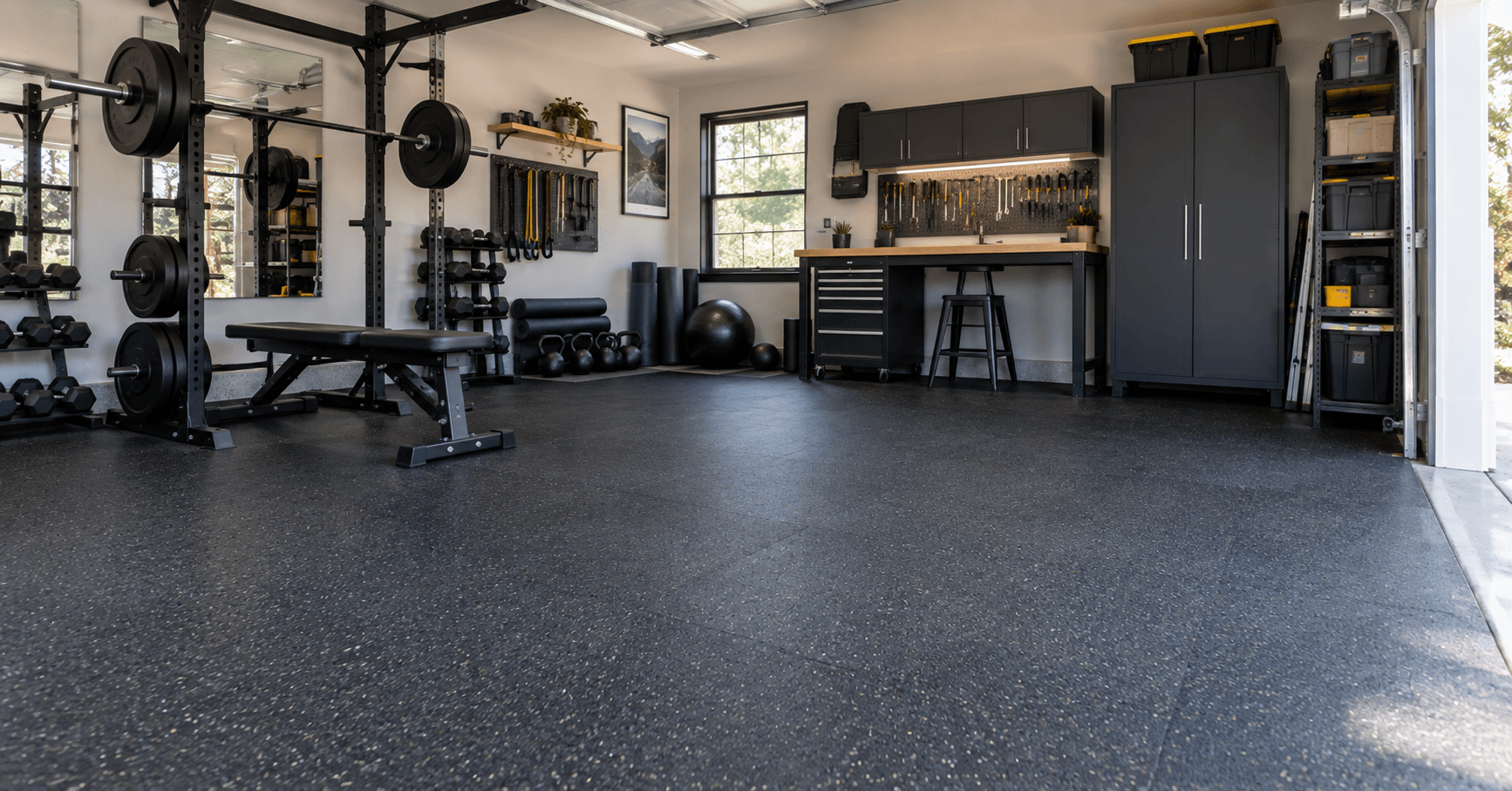
Rubber garage flooring is the correct choice when the garage is primarily used as a gym, workshop, or hobby space rather than vehicle parking. It provides cushioning that no coating or tile system matches, protects dropped tools and equipment from bouncing and damaging themselves and the floor, reduces fatigue during long standing work sessions, and provides slip resistance in wet conditions.
Rubber tiles and rolls come in thicknesses from three-eighths inch to three-quarters inch. Thicker rubber provides more cushioning and better noise dampening, which matters in workshops where equipment vibration transfers to the floor. For gym use, a minimum half-inch thickness is recommended for joint protection during floor exercises and lifting.
The limitation for vehicle garages: rubber is not rated for full vehicle weight on a sustained basis and does not resist oil and chemical spills as effectively as coating systems. For a garage that splits use between vehicles and a gym or workshop, a hybrid approach works well: rubber flooring in the dedicated gym or work zone and a coated or tiled surface in the vehicle area.
Cost: $1 to $4 per square foot for materials. Lifespan: 10 to 20 years depending on use intensity. Best for: Gym garages, workshops, hobby spaces, sound-dampening applications.
Option 6: SPC Vinyl Tile: The Multifunctional Lifestyle Garage
Stone Plastic Composite vinyl tile is the fastest-growing garage flooring category in 2026. The growth reflects the broader trend toward garages as multifunctional lifestyle spaces rather than purely automotive storage.
SPC vinyl uses a stone-based composite core that provides rigidity and dimensional stability superior to standard vinyl. The 20-mil or thicker wear layer handles moderate vehicle weight and resists the scuffs and gouges that lighter vinyl products cannot withstand in a garage environment. The waterproof core handles the moisture exposure that concrete slabs generate from below.
The defining advantage of SPC in a lifestyle garage context is aesthetics. Wood-look, stone-look, and abstract designs that are genuinely indistinguishable from interior flooring at normal viewing distances allow a converted garage to look like an extension of the home rather than a modified storage space. For garages being converted to home offices, playrooms, or additional living space, SPC closes the visual gap between the garage and the adjacent interior completely.
The limitation: SPC is not rated for heavy vehicle use. A garage that sees regular full vehicle parking needs a coating or tile system, not vinyl. SPC is correct for garages that are primarily used as living space with only occasional light vehicle access.
Cost: $2 to $6 per square foot installed. Lifespan: 15 to 25 years in appropriate use conditions. Best for: Converted garage living spaces, lifestyle garages, home offices, playrooms.
The Concrete Prep Truth Nobody Tells You
Every garage flooring system fails at the same point: the concrete surface it is applied to or installed over.
Concrete that has active cracks, spalling, oil contamination, or high moisture vapor emission cannot support any coating system reliably, regardless of the quality of the coating itself. The preparation step is not optional, and it is not a minor add-on to the project. It is the foundation that determines whether the investment holds for fifteen years or fails in eighteen months.
Before any coated flooring installation, the concrete should be tested for moisture vapor emission rate, cleaned of any oil contamination with a degreaser, repaired for any cracks or spalling, and profiled to create adhesion texture through acid etching or diamond grinding. Diamond grinding is the professional standard and produces more consistent adhesion than acid etching.
Interlocking tiles and rubber flooring are more forgiving of imperfect concrete because they are not bonded to the surface. But even these systems perform better over flat, clean concrete than over a rough or uneven slab.
The 2026 Garage as a Living Space
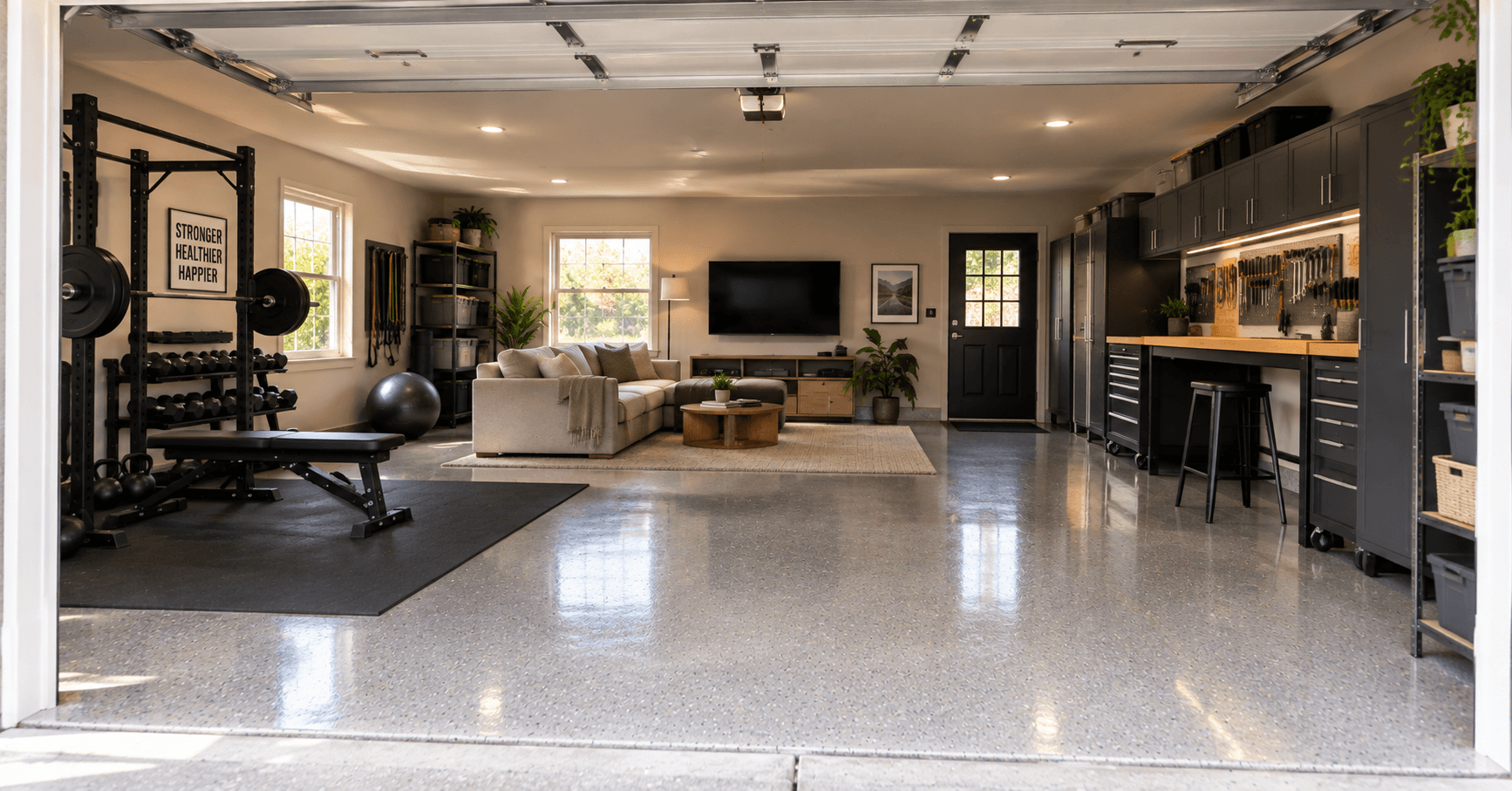
The garage is no longer just a parking structure in US home design. The garage is no longer just a parking structure in US home design. More homeowners are using garages as home gyms, workshops, hobby rooms, and multifunctional living spaces.
This shift changes the flooring decision fundamentally. A garage that also functions as a home gym needs rubber flooring in the exercise zone. A garage converted to a home office needs SPC vinyl that matches the interior aesthetic. A workshop needs a coating that resists chemical spills and supports prolonged standing.
For homeowners designing the functional layout of a converted garage space, including storage, seating, and work areas, the guide on DIY mudroom bench with storage covers the built-in storage and seating construction that complements a well-designed garage floor.
For broader renovation budget planning that covers garage flooring alongside other high-ROI home improvements, the guide on home renovation tips and money-saving tricks covers how to sequence projects for maximum value and minimum wasted spend.
Real 2026 Cost Comparison
| Option | DIY Cost Per Sq Ft | Installed Cost Per Sq Ft | Lifespan |
| Box-store epoxy kit | $0.50 to $1 | Not recommended | 1 to 3 years |
| Professional epoxy | $1.50 to $3 (materials) | $3 to $7 | 8 to 12 years |
| Polyaspartic coating | Professional only | $5 to $15 | 15 to 20 years |
| Interlocking tiles | $2 to $5 | $2 to $5 | 10 to 20 years |
| Polished concrete | Professional only | $3 to $8 | Permanent |
| Rubber flooring | $1 to $4 | $1 to $4 | 10 to 20 years |
| SPC vinyl tile | $2 to $4 | $2 to $6 | 15 to 25 years |
For a two-car garage of 400 square feet, budget $800 to $2,000 for quality interlocking tiles or rubber flooring, $1,200 to $2,800 for professional epoxy, and $2,000 to $6,000 for polyaspartic.
For detailed product testing and recommendations from the most trusted US home improvement authorities, This Old House maintains a comprehensive garage floor coating guide at thisoldhouse.com, and Bob Vila covers the full range of coating options with installer guidance at bobvila.com.
Frequently Asked Questions
Q: What is the best garage flooring for a two-car garage in 2026?
A: Polyaspartic coating is the best permanent option for a two-car garage that sees daily vehicle use. It handles hot tire pickup, chemical exposure, and temperature extremes better than epoxy at a comparable installed price. Interlocking polypropylene tiles are the best choice for homeowners who want a DIY install, a removable system, or a renter-friendly option with a lower upfront cost.
Q: Can you put flooring over a cracked garage floor?
A: Yes, with preparation. Fill and repair cracks before applying any coating system, or the cracks will telegraph through the coating and cause delamination at stress points. Interlocking tiles and rubber flooring are more forgiving of minor cracks because they are not bonded to the surface, but significant cracks should be repaired before any flooring installation for a stable, level result.
Q: How long does garage floor epoxy last?
A: Professional two-part epoxy with proper surface preparation lasts eight to twelve years under normal garage conditions. Box-store water-based epoxy kits last one to three years under the same conditions. The difference is not brand quality but chemistry: water-based kits have too little solid content to build a durable film, while professional 100-percent-solids epoxy creates a genuinely thick, bonded coating.
Q: What garage flooring works best in cold climates?
A: Polyaspartic coating performs in temperatures from negative 30°F to over 140°F, making it the most climate-tolerant coating option. Interlocking tiles made from polypropylene also handle extreme cold without cracking. Standard epoxy has a narrower temperature performance range and can become brittle in sustained extreme cold. In northern US states, polyaspartic or interlocking tiles are the most reliable choices.
Q: Is it worth spending more on professional garage flooring?
A: For a garage you plan to own for five or more years, yes. The cost difference between a box-store kit and a professional polyaspartic coating is roughly $2,000 to $4,000 on a two-car garage. The professional coating lasts fifteen to twenty years versus one to three for the kit. Over a ten-year period, the professional coating costs less per year and eliminates the labor and disruption of recoating every two years.
Q: What is the best garage flooring for heavy vehicles?
A: Polyaspartic coating or high-quality interlocking polypropylene tiles are strong choices for garages with regular vehicle use. Polyaspartic provides a permanent bonded surface, while interlocking tiles offer a removable DIY option.
Not sure which garage flooring option fits your specific situation, vehicle use, climate, budget, or renter status? Drop your details in the comments, and we will help you identify the right choice for your garage.

Samreen Khadim Hussain is a home improvement writer and content creator at Domelite Home. She specializes in making home renovation, interior design, and bathroom safety accessible to everyday US homeowners, turning technical subjects into clear, actionable advice. Her work is rooted in research, real-world practicality, and a genuine belief that a better home is within everyone’s reach.